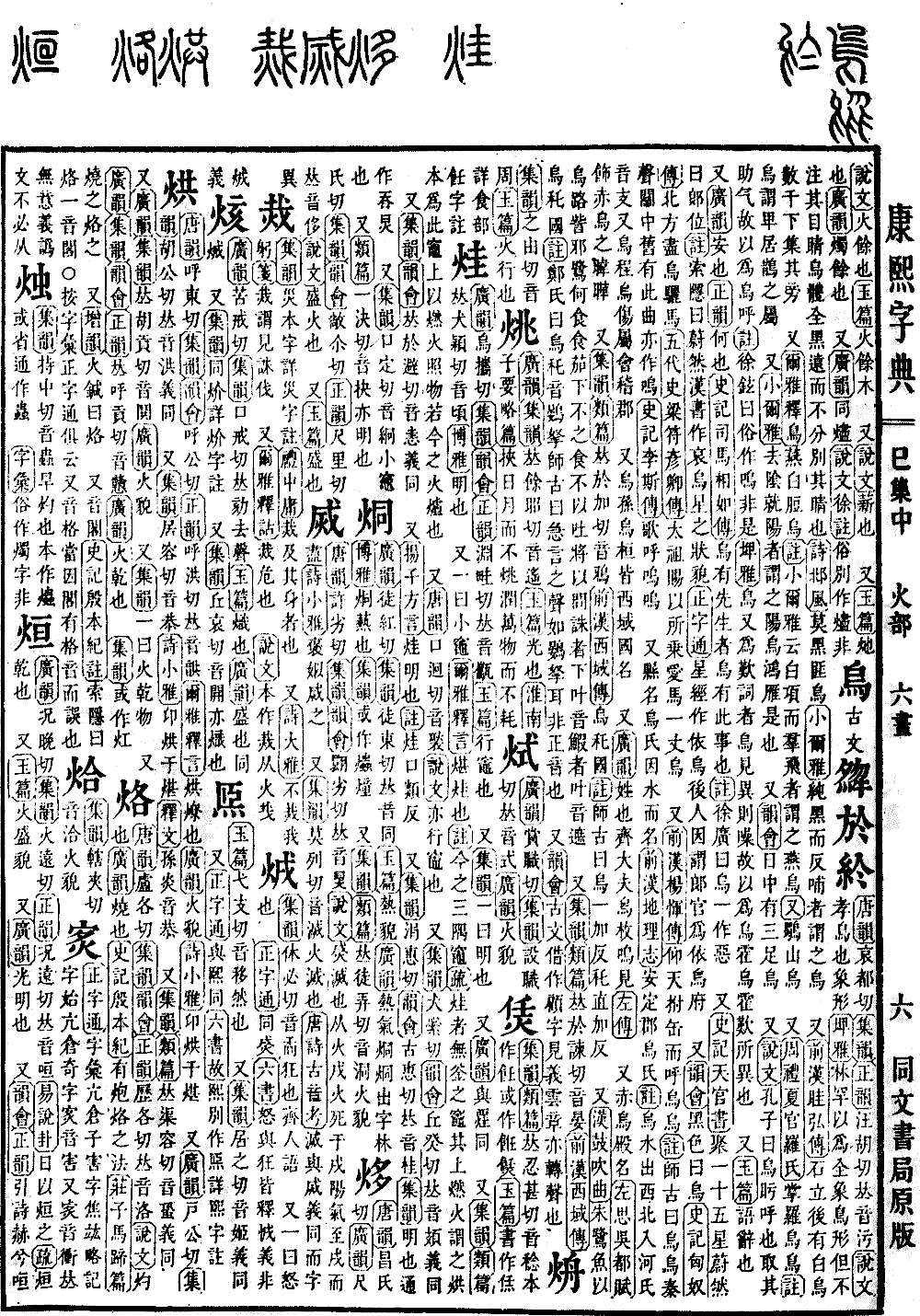
Si Collection, Middle Volume
Radical: Fire (huǒ)
Kangxi Strokes: 10
Page 670, Entry 01
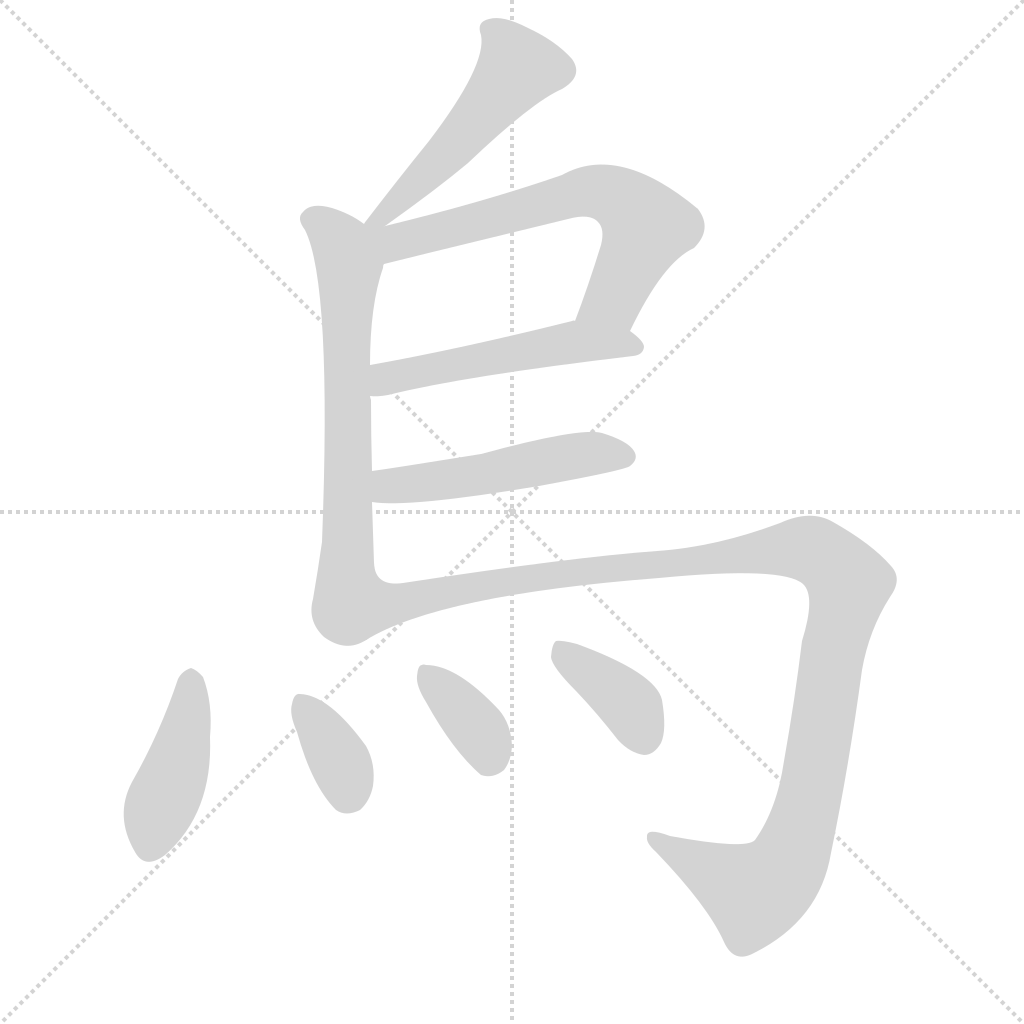
Ancient form of the character at (yú).
Pronounced wu.
Explaining Graphs and Analyzing Characters (Shuowen Jiezi): It is a filial bird. It is a pictograph.
Piya: Lin Han considered the form to be a complete bird shape, except that the pupil of the eye is not marked. The body of the bird is entirely black, so from a distance, the pupil cannot be distinguished.
Book of Odes (Shijing), Odes of Bei (Beifeng): There is nothing black that is not a crow.
Xiao Erya: Those that are pure black and feed their parents in return are called crows.
Also, History of the Former Han (Qian Hanshu), Biography of Sui Hong: Stones stood upright, and later thousands of white crows descended and gathered beside them.
Also, Erya: A swallow-necked crow. Commentary: Xiao Erya says that those with white necks that fly in flocks are called swallow-crows.
Also, the mountain crow.
Also, Rites of Zhou (Zhouli), Summer Official: The official in charge of catching crow-birds. Commentary: The term crow refers to magpies and their kind.
Also, Xiao Erya: Those that leave the shade for the sun are called sun-crows; the wild goose is one such bird.
Also, Rhyme Collection (Yunhui): There is a three-legged crow in the sun.
Also, Explaining Graphs and Analyzing Characters (Shuowen Jiezi): Confucius said, "The character for crow (wu) acts as an exclamation (hu); it is used to assist the breath, hence it is used as an exclamation (wu hu)." Commentary: Xu Xuan said, "The popular version written as wu is incorrect."
Piya: The character for crow is also used as an exclamation; when a crow sees something strange, it caws, hence it is used for expressing wonder.
Also, Jade Chapters (Yupian): A sentence-final particle.
Also, Extensive Rhymes (Guangyun): Peaceful.
Correct Rhymes (Zhengyun): How.
Records of the Grand Historian (Shiji), Biography of Sima Xiangru: Master Wu-you (Non-existence); that is to say, there is no such matter. Commentary: Xu Guang says that for this character, some write the character for evil (e).
Also, Records of the Grand Historian (Shiji), Treatise on the Celestial Offices: Fifteen stars gathered together in a dense cluster is called the Lang-wei (Courtier position). Commentary: The Suoyin commentary says that for the term dense cluster, the History of the Han (Hanshu) uses the characters for ai-wu, describing the appearance of the stars.
Correct Character Penetration (Zhengzitong): The Classic of Stars (Xingjing) writes it as yi-wu, and later generations consequently called the officials of the court the Yi-wu Bureau.
Also, Rhyme Collection (Yunhui): Black is called wu.
Records of the Grand Historian (Shiji), Account of the Xiongnu: The northern regions are full of black-maned horses.
History of the Five Dynasties, Biography of Liang Fu Yanqing: Emperor Taizu bestowed upon him his favorite horse, the Yizhang-wu.
Also, History of the Former Han (Qian Hanshu), Biography of Yang Yun: Looking up to the sky and tapping on a pottery jar, he cried out "wu wu." Commentary: Shigu says that "wu wu" is the sound of Qin music. There is such a melody in the Guanzhong region, also written with the character for crying (wu).
Records of the Grand Historian (Shiji), Biography of Li Si: Singing and calling out "wu wu."
Also, a county name. Wushi County, named after a river.
History of the Former Han (Qian Hanshu), Geographical Records: Anding Commandery, Wushi County. Commentary: The Wu River emerges in the northwest and flows into the Yellow River. The character shi is pronounced zhi.
Also, Wucheng, Wushang, belonging to Kuaiji Commandery.
Also, Wusun and Wuhuan are both names of kingdoms in the Western Regions.
Also, Extensive Rhymes (Guangyun): A surname. A Qi official named Wu Meiming, seen in the Zuo Tradition (Zuo Zhuan).
Also, Red Crow (chiwu), the name of a palace hall. Zuo Si, Rhapsody on the Capital of Wu (Wu Du Fu): Adorning the Red Crow palace with its radiant brilliance.
Also, Rhyme Collection (Yunhui), Categorized Compendium (Leipian): Pronounced ya.
History of the Former Han (Qian Hanshu), Record of the Western Regions: Wucha Kingdom. Commentary: Shigu says that for this, the character wu is pronounced with the sound of the character jia. The character cha is pronounced with the sound of the character zhi.
Also, Han Dynasty Drum and Flute Songs: The red ibis and the fish, with the wu-lu-zi-ye; why does the ibis eat, it eats beneath the lotus. If it does not eat it, it does not vomit it, but will use it to question the punished. The character xia rhymes with the sound, and the character zhe rhymes with the sound.
Also, Rhyme Collection (Yunhui), Categorized Compendium (Leipian): Pronounced yan.
History of the Former Han (Qian Hanshu), Record of the Western Regions: Wucha Kingdom. Commentary: Mr. Zheng says that Wucha is pronounced like an-na. Shigu says this is the sound of rapid speech, like saying an-na, but it is not the standard pronunciation.
Also, Rhyme Collection (Yunhui): In ancient texts, it is borrowed as the character for care (gu). Seen in the Yiyizhang chapter. It is also a variation of sound.