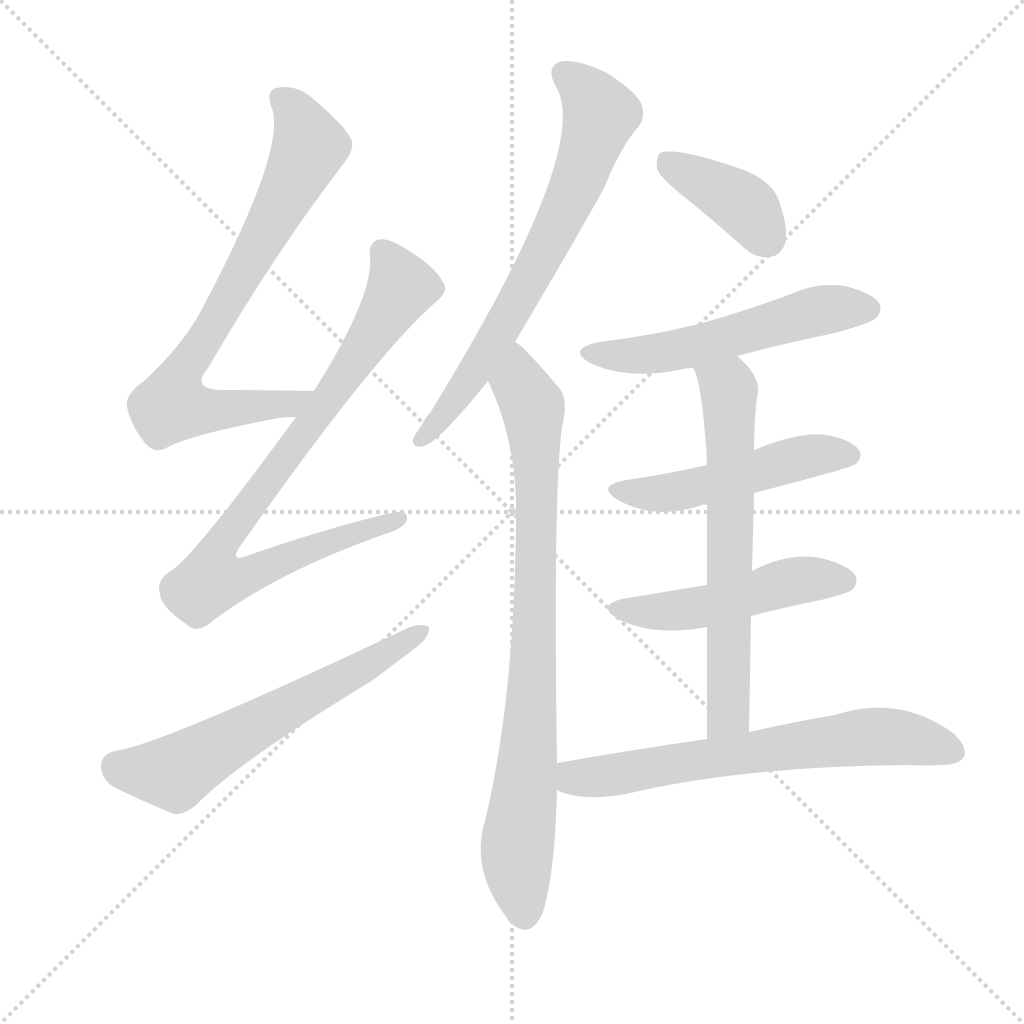
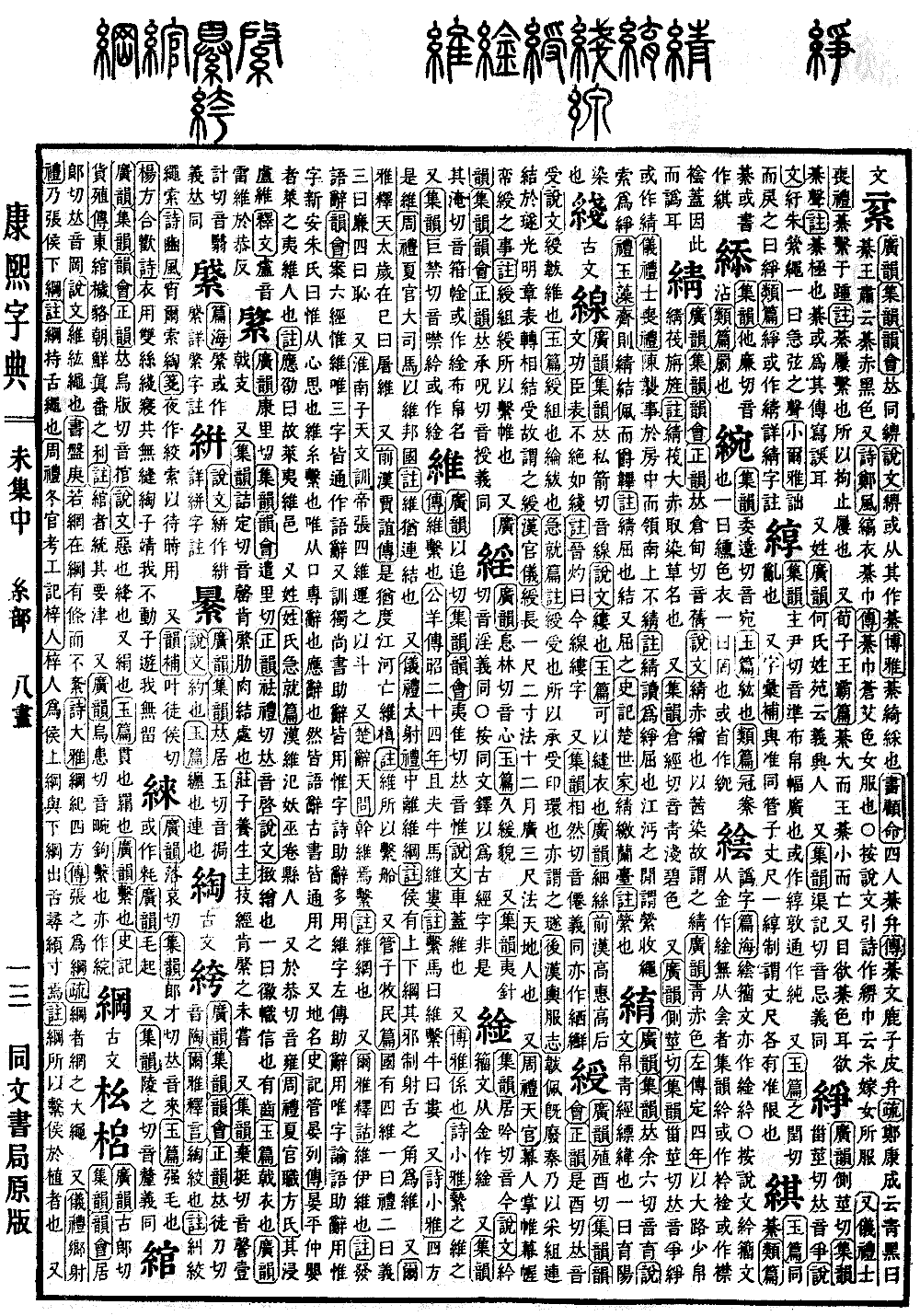
Wei Collection, Middle Volume. Radical: Thread (mì). Kangxi stroke count: 14. Page 927, Entry 02.
Pronounced wei (rising tone). According to the Explaining Graphs and Analyzing Characters (Shuowen Jiezi), it refers to the tie ropes of a carriage canopy.
Also, according to the Broad Categorized Dictionary (Boya), it means to tie or bind. In the Book of Odes (Shijing), it is said: "Bind them and tie them." The Commentary explains: "Wei means to bind." In the Gongyang Commentary on the Spring and Autumn Annals (Gongyang Zhuan), it is said: "Furthermore, for cattle and horses, use wei and lou." The Annotation explains: "To tie a horse is called wei; to tie a cow is called lou."
Also, in the Book of Odes (Shijing), it is said: "The four quarters are bound." In the Rites of Zhou (Zhouli), it is said: "Used to connect the states of the kingdom." The Annotation explains: "Wei is like a connection."
Also, in the Book of Etiquette and Ceremonial (Yili), it is said: "In the middle, separate the net-ropes." The Annotation explains: "The target has upper and lower ropes; the diagonal ropes that control the corners of the target center are called wei."
Also, in the Erh Ya (Erya), it is said: "When the Grand Year (taisui) is in the position of Si, it is called Tuwei."
Also, in the Former Han (Qianhan), Biography of Jia Yi, it is said: "This is like crossing a river without wei and oars." The Annotation explains: "Wei are the ropes used to moor a boat."
Also, in the Guanzi, Chapter on Herding the People, it is said: "The state has four principles (wei): first is propriety, second is righteousness, third is integrity, and fourth is a sense of shame."
Also, in the Huainanzi, Treatise on Astronomy, it is said: "The Heavenly Emperor spreads out the four pillars (wei) and rotates them with the Dipper."
Also, in the Songs of Chu (Chuci), it is said: "To what are the main pillars tied?" The Annotation explains: "Wei means the main net-ropes."
Also, in the Erh Ya (Erya), Interpretation of Words, it is said: "Yi, wei, and hou are all sentence-initial particles." The Annotation explains: "These are initial particles." The Dictionary of Pronunciation (Yunhui) notes: In the Six Classics, the three characters pronounced wei are all used interchangeably as sentence particles or to mean 'only.' The Book of Documents (Shangshu) uses the character (wei - with heart radical) for particles; the Book of Odes (Shijing) mostly uses the character (wei - with thread radical); the Zuo Commentary (Zuo Zhuan) uses the character (wei - with mouth radical); the Analects (Lunyu) uses the character (wei - with heart radical). Master Zhu of Xin'an says: The one with the heart radical implies thought; the one with the thread radical implies binding; the one with the mouth radical is a specific or responsive particle. However, they are all particles, and in ancient texts, they are used interchangeably.
Also, a place name. In the Records of the Grand Historian (Shiji), Biography of Guan and Yan, it is said: "Yan Pingzhong Ying was a man of Yiwei in the state of Lai." The Annotation by Ying Shao says: "It was the ancient Yiwei settlement of the Lai people."
Also, a surname. In the Compendium of Surnames (Xingshi Jijiu Pian), it is recorded: "During the Han dynasty, there was a man named Wei Si, an exorcist from Juan County."
Also, pronounced yong (level tone). In the Rites of Zhou (Zhouli), it is said: "Its flooded marshes are Luwei." The Commentary on Pronunciations (Shiwen) notes: Lu is pronounced lei; wei is pronounced yong.
Textual Verification: In the Songs of Chu (Chuci), "To what are the main pillars tied?" The Annotation says "Wei is a net." It is hereby corrected according to the original text to read "Wei is a main rope." In the Erh Ya (Erya), "Wei means Yiwei." It is hereby corrected according to the original text to read "Wei means Yi, wei, and hou."