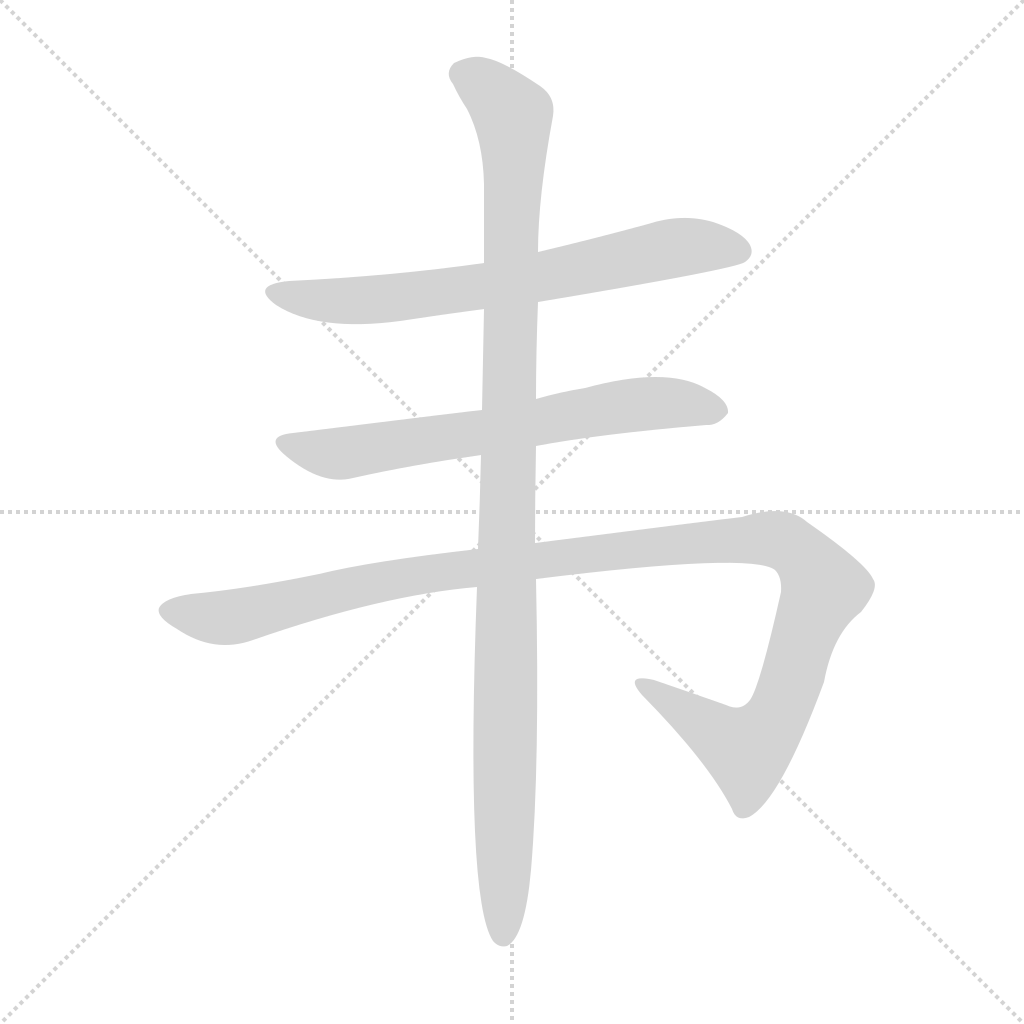
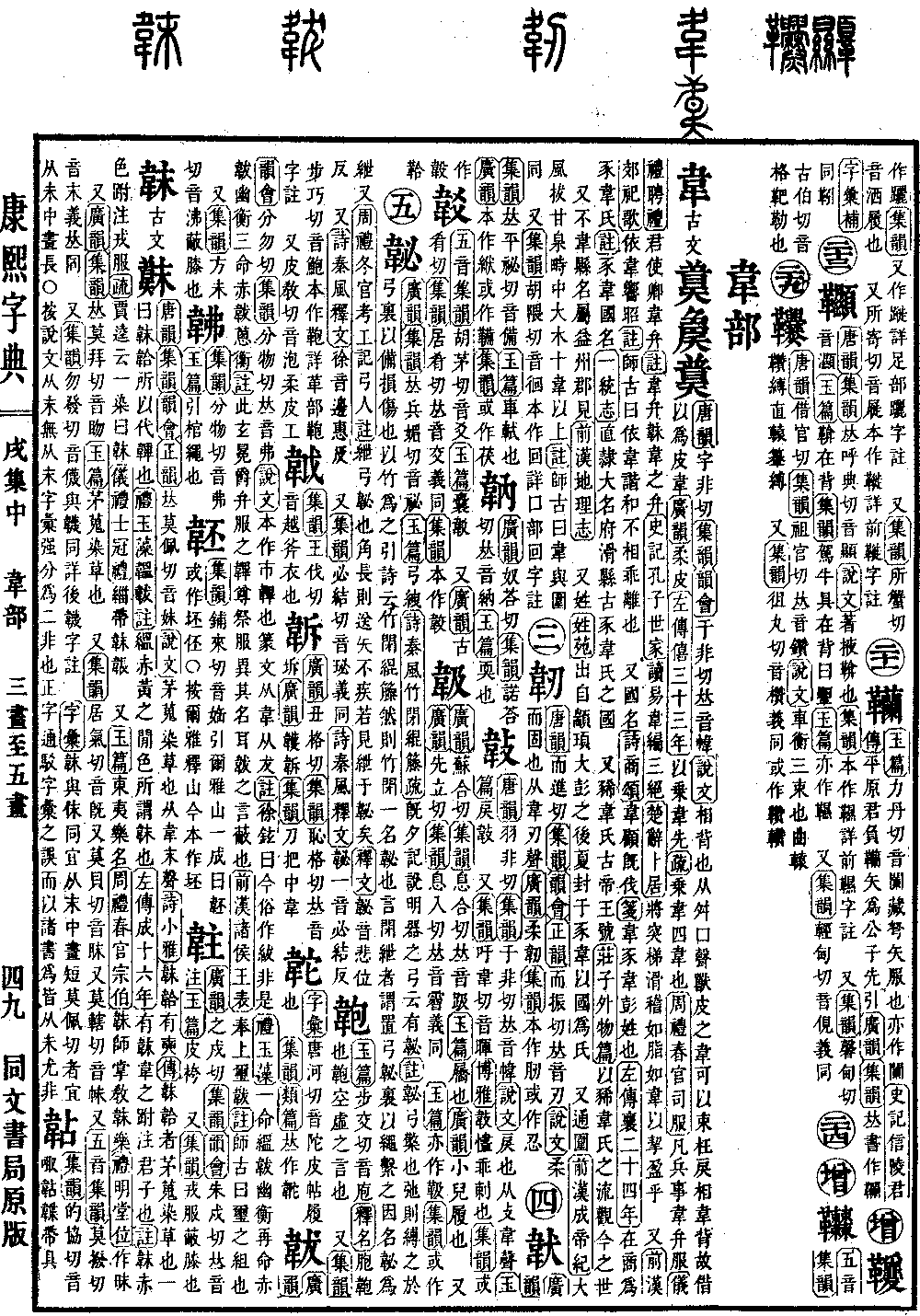
Xu Collection, Middle Volume
Radical: Leather (wéi)
Kangxi stroke count: 9
Page 1393, Entry 06
Ancient script. Pronounced wei (level tone).
Explained in the Explaining Graphs and Analyzing Characters (Shuowen Jiezi) as meaning to turn away from one another. Formed by the radical for opposing (chuǎn) and the phonetic component for mouth (kǒu). Leather of an animal, which can be used to bind things that are bent or contrary, hence borrowed to represent tanned leather.
Broad Rhymes (Guangyun): Soft, tanned leather.
Zuo Tradition (Zuo Zhuan), 33rd year of Duke Xi: Used four pieces of tanned ox hide to send as an advance gift.
Sub-commentary (Shu): Chengwei refers to four pieces of tanned ox hide.
Rites of Zhou (Zhou Li), Office of Spring, Ministry of Ceremonies: For all military campaigns, wear the leather ceremonial cap (wéi biàn).
Ceremonial Rites (Yili), Visiting Rites: The ruler dispatches a high official wearing the leather ceremonial cap.
Annotation (Zhu): The leather ceremonial cap is made from tanned leather dyed reddish-yellow.
Records of the Grand Historian (Shiji), Hereditary House of Confucius: While studying the Book of Changes (Yijing), the leather cords binding the bamboo strips broke multiple times.
Songs of Chu (Chu Ci), Divination (Buju): Are you going to be slippery and conformist, soft like grease or tanned leather, to cater to the people of this world?
Also: Records of the Former Han (Qianhan), Hymns for the Suburban Sacrifices: Harmonious and coordinated, the sounds are clear and bright.
Annotation (Zhu): Shigu said: Yiwei refers to harmony, not being in opposition.
Also: A state name.
Book of Odes (Shijing), Eulogies of Shang (Shangsong): The state of Wei and the state of Gu have already been punished.
Annotation (Jian): Wei is the state of Shiwei, of the Peng surname.
Zuo Tradition (Zuo Zhuan), 24th year of Duke Xiang: In the Shang dynasty, it was the Shiwei clan.
Annotation (Zhu): Shiwei is a state name.
Comprehensive Geography of the Empire (Yitongzhi): Located in Hua County, Daming Prefecture, Zhili; this was the state of the ancient Shiwei clan.
Also: The Xiwei clan, a title of an ancient emperor.
Zhuangzi, External Things: Looking at the present age from the perspective of the Xiwei clan.
Also: Buwei, a county name belonging to Yizhou Commandery, see Records of the Former Han (Qianhan), Treatise on Geography.
Also: A surname.
Garden of Surnames (Xingyuan): Descended from the progeny of Zhuanxu and Dapeng; enfeoffed in Shiwei during the Xia dynasty, taking the state name as their surname.
Also: Interchangeable with the character for surround (wéi).
Records of the Former Han (Qianhan), Annals of Emperor Cheng: A great wind uprooted large trees of ten spans or more in circumference within the Ganquan altar.
Annotation (Zhu): Shigu said: This character is the same as the character for surround (wéi).
Also: Collected Rhymes (Jiyun), pronounced huai (level tone). Originally written as return (huí). See the entry for the character return (huí) under the enclosure radical.