Chen Collection, Lower Volume
Radical: Lack (qiàn)
Kangxi Strokes: 12
Page 568, Entry 01
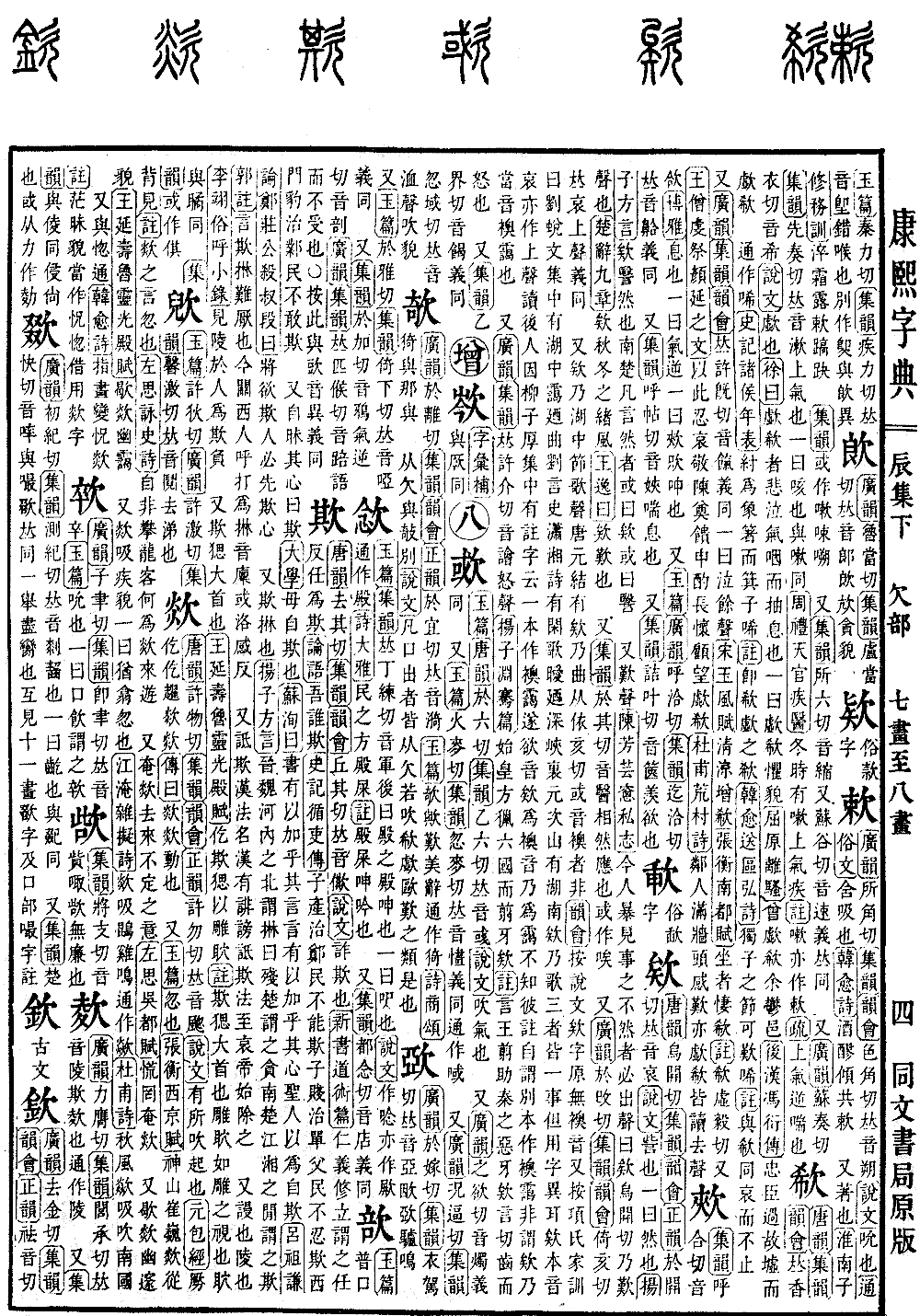
Ancient classical literature records: Guangyun (Guangyun) pronounces it qin (falling tone). Jiyun (Jiyun), Yunhui (Yunhui), and Zhengyun (Zhengyun) pronounce it qin, with a sound similar to qin. Shuowen Jiezi (Shuowen Jiezi) defines it as the appearance of opening the mouth and exhaling. Another interpretation is the meaning of respect. The Book of Documents (Shujing) contains the phrase, "Respectful, wise, accomplished, and thoughtful, being serene and stable." The Ta Jia (Ta Jia) also states, "Be respectful in your behavior." Zhengzitong (Zhengzitong) mentions that nowadays imperial commands are called imperial decree, and envoys sent by the emperor are called imperial mandate, commonly known as imperial envoy; all these take the meaning of respect. Also, the term qin qin expresses the meaning of longing and waiting. The Book of Odes (Shijing) contains, "With anxious heart I long and hope." The Mao Commentary (Mao Zhuan) explains: When longing and waiting, one's heart is filled with incessant sorrow. Also used to describe the rhythmic sound of bells. The Book of Odes (Shijing) contains, "The ringing bells are rhythmic." Also used as a posthumous title. The Jizhong Zhoushu (Jizhong Zhoushu) records: A demeanor that is majestic and complete is called qin. Also the name of a prefecture, and the name of a river. Yunhui (Yunhui) records: During the Liang dynasty it was An Prefecture, changed to Qin Prefecture during the Sui dynasty, named after the Qin River. The Guangyu Ji (Guangyu Ji) records: It belongs to Lian Prefecture of Guangdong. Within the prefecture are the Qin River and the Longmen River. Also the name of a mountain. The Classic of Mountains and Seas (Shanhaijing) records: Qin Mountain produces much gold and jade and has no stone; the Shi River originates here. There is also a place called Qinkou. The Book of Han (Hanshu) records: Qinkou Mountain in Wu'an County, Wei Commandery, is the source of the Baiqu River. There is also a bird called qin qinyuan, all recorded in the Classic of Mountains and Seas (Shanhaijing). Also a surname. The Heshi Xingyuan (Heshi Xingyuan) records: They are people of the Wu region. In the Song dynasty, there was Qin Dezai, who called himself the Old Man of Shouyan. Also pronounced in the falling tone. It means to press. Li Yi, Suhu Xiaolu (Suhu Xiaolu) records: To press is called qin. Qin is pronounced in the falling tone. Wang Ju, Shejing (Shejing) records: Slightly bend the body and press, fixing one's gaze on the target. It also records: When drawing a bow and shooting, one must press the bow handle with the body turned outward, aiming clearly at the target. Also, Jiyun (Jiyun) pronounces it yin, with a sound similar to yin. It is the same as the character for chanting. It means to moan. The Classic of Mountains and Seas (Shanhaijing) records: Gang Mountain has many spirits, and the sound they emit is like qin. Guo Pu Commentary (Guo Pu Zhu) explains: Qin is also a phonetic loan character for yin. Note: The Book of Han, Treatise on Geography (Hanshu Dilizhi) records: Inner respect is called gong, and outer respect is called qin. Also, Zheng Kangcheng says: To be respectful in dealing with matters and frugal in expenditure is called qin. Qin originally referred to both inner and outer aspects and cannot refer exclusively to outer aspects. Even being respectful in matters and frugal in expenditure does not fully cover the meaning of qin, so it is not included in the formal explanation but is recorded here in the appendix.