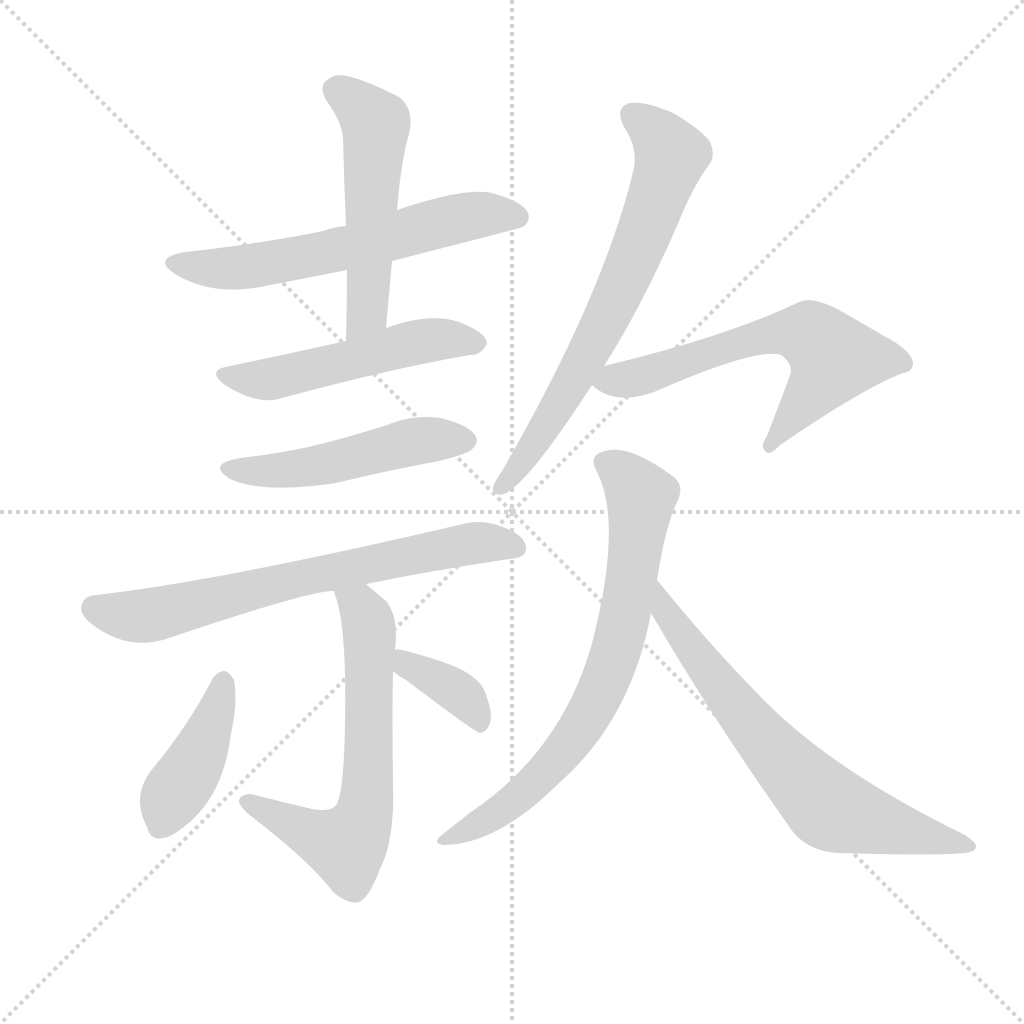
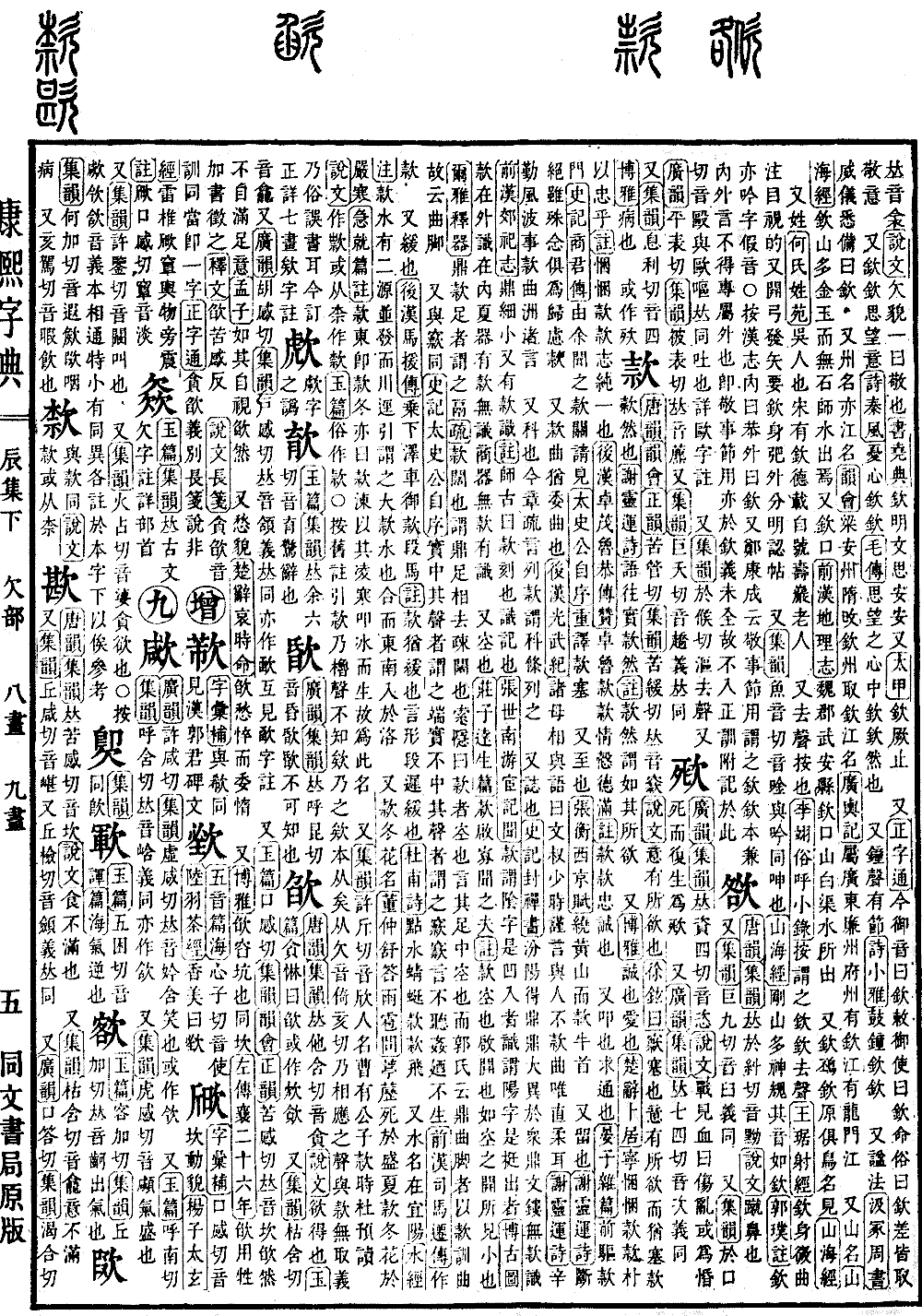
Chen Collection, Lower Volume
Radical: Lack (qiàn)
Kangxi Strokes: 12
Page 569, Entry 03
Pronounced kuan (rising tone). According to the Classic of Rhymes (Tangyun), the Rhyme Assembly (Yunhui), and the Correct Rhymes (Zhengyun), the pronunciation is kuan. According to the Collected Rhymes (Jiyun), the pronunciation is kuan, with a sound like kuan (hollow).
According to the Explaining Graphs and Analyzing Characters (Shuowen), it means to have a desire. Xu Xuan stated: It means to block. To have a desire but remain blocked is expressed as kuan-kuan. In a poem by Xie Lingyun, it says, "The words sent forth are truly kuan-ran." The commentary explains: Kuan-ran means as one desires.
Also, according to the Broad Records (Boya), it means sincerity and love. In the Songs of Chu (Chuci), under the chapter Seeking Divination, it says, "Is it better to be pure and sincere, simple and loyal?" The commentary explains: To be pure and sincere means one's will is unified. In the Eulogy of the Biographies of Zhuo Mao and Lu Gong in the History of the Later Han (Hou Hanshu), it says, "Zhuo and Lu were sincere, their feelings were honest and their virtues abundant." The commentary explains: Sincere means loyal and honest.
Also means to knock or to seek passage. In the Miscellaneous Chapters of the Master Yan (Yanzi), it says, "The vanguard knocked at the gate." In the Biography of Shang Yang in the Records of the Grand Historian (Shiji), it says, "You Yu heard this and knocked at the pass to request an audience." In the Preface of the Grand Historian, it says, "Interpreting through many stages and knocking at the border fortresses."
Also means to arrive. In the Western Capital Rhapsody by Zhang Heng, it says, "Circling Huangshan and arriving at the Niu River."
Also means to remain. In a poem by Xie Lingyun, it says, "Though the paths are cut off, the thoughts remain, both sharing the desire to return."
Also kuan-qu, meaning circuitous or complex. In the Chronicle of Emperor Guangwu in the History of the Later Han, it says, "The various aunts spoke together, saying: Wen Shu was cautious in speech when young, and was not circuitous with others, only direct and gentle." In a poem by Xie Lingyun, it says, "Hardships of wind and waves, circuitous words by the island."
Also means categories. Today, in official documents, listing kuan refers to listing items by category.
Also means to record. In the Treatise on the Feng and Shan Sacrifices in the Records of the Grand Historian, it says, "In Fenyang, a tripod was obtained; the tripod was very different from common tripods, and the decorations and inscriptions had no maker's mark." In the Treatise on Suburban Sacrifices in the History of the Former Han (Qian Hanshu), it says, "The tripod was small and had a maker's mark." The commentary by Yan Shigu says: Kuan means to carve; shi means to record. Zhang Shinan in the Records of Official Travels says: Kuan refers to yin characters, which are incised; shi refers to yang characters, which are raised. The Illustrations of Antiquities (Bogu Tu) states: Kuan is on the outside, shi is on the inside. Xia dynasty artifacts have kuan but no shi; Shang dynasty artifacts have no kuan but have shi.
Also means hollow. In the Mastering Life chapter of the Zhuangzi, it says, "The hollow and ignorant man." The commentary says: Kuan means empty; qi means to open. Like an opening in something empty, what is seen is small. In the Erh Ya, Explaining Implements, it says, "A tripod with hollow feet is called a ge." The commentary says: Kuan means wide. It refers to the tripod feet being set far apart. The Suoyin commentary says: Kuan means empty, saying the feet are hollow inside. However, Guo Pu stated the tripod has curved feet, interpreting kuan as curved, hence saying curved feet.
Also the same as the character for hollow. In the Preface of the Grand Historian, it says, "That which strikes the center of the sound is called duan; that which does not strike the center of the sound is called kuan; if kuan words are not listened to, then treachery will not arise." In the Biography of Sima Qian in the History of the Former Han, it is written as kuan.
Also means slow. In the Biography of Ma Yuan in the History of the Later Han, it says, "Riding in a low-axle carriage, driving a slow, steady horse." The commentary says: Kuan means slow, indicating the movement is sluggish. In a poem by Du Fu, it says, "The dragonfly touching the water flies slowly."
Also the name of a river. Located in Yiyang. The Commentary on the Classic of Waterways (Shuijing Zhu) says: The Kuan River has two sources, which flow and converge into a stream, known as the Great Kuan River, which joins and flows southeast into the Luo River.
Also kuan-dong, the name of a flower. Dong Zhongshu in his Answers to Questions on Rain and Hail says, "The shepherd's purse dies in the height of summer, the kuan-dong blooms in the harsh winter." The commentary to the Essential Learning (Jijiu Pian) says: Kuan-dong is the same as kuan-dong, also called kuan-dong; because it blooms by knocking against the frozen ice in the cold, it is named this way.
Also pronounced xin (first tone) according to the Collected Rhymes (Jiyun). Used in names. There was a son of the ruler of Cao named Kuan Shi. Du Yu used this reading. In the Explaining Graphs and Analyzing Characters, it is written as a compound character. Or written as a variant with the nai radical. The Jade Compendium (Yupian) lists a vulgar form. Note: The old commentary cites kuan as the sound of oars, but the character for the sound of oars, ai, originally follows the sound component yi and the lack radical, pronounced yi (rising tone) and hai (falling tone), which is a sound of response and has no relationship to kuan; it is a vulgar miswriting. This is now corrected. See the note for the character ai under the seven-stroke section. The original character was written based on a component.