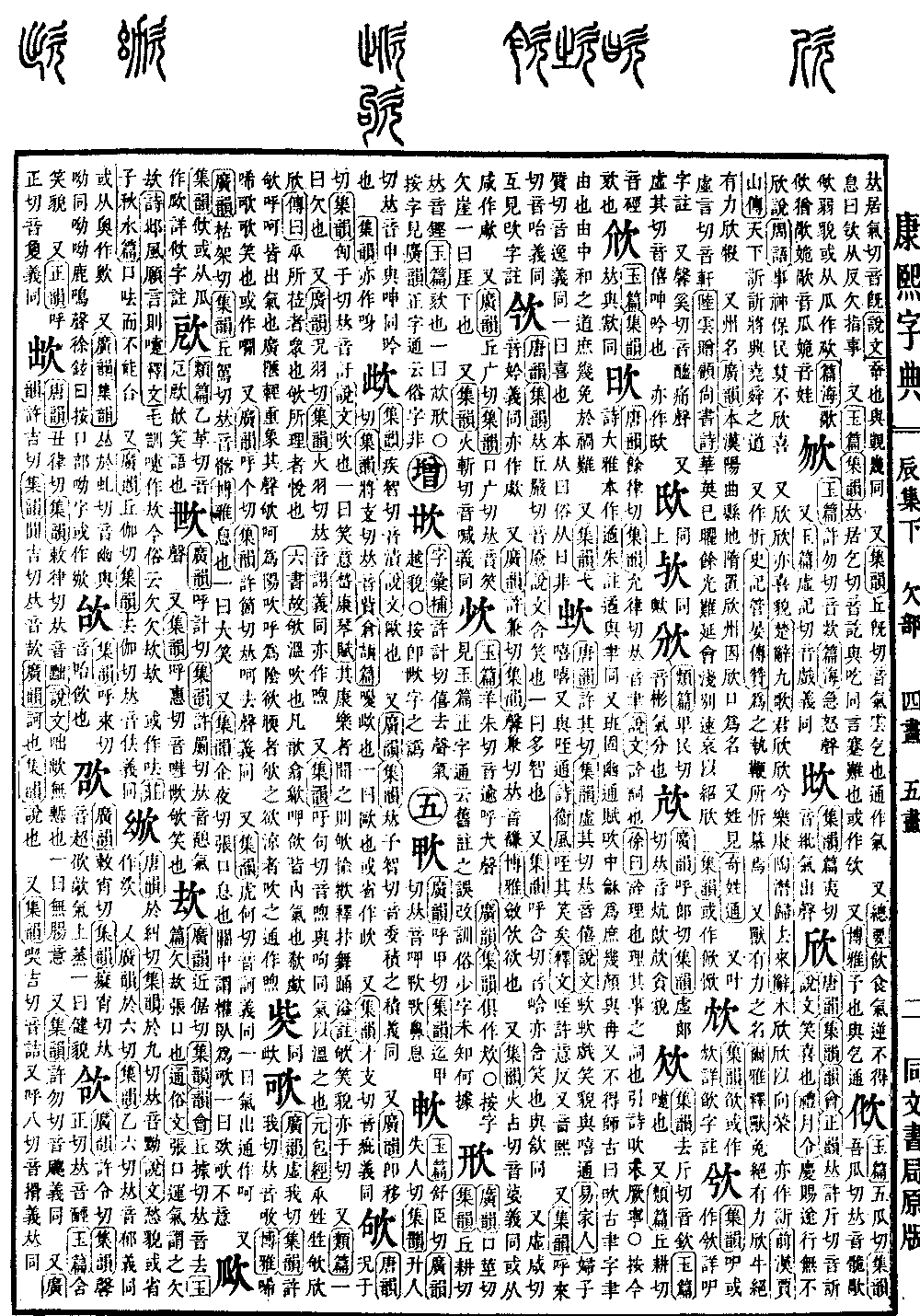
Chen Collection, Lower Volume
Radical: Lack (qiàn)
Page 566, Entry 04
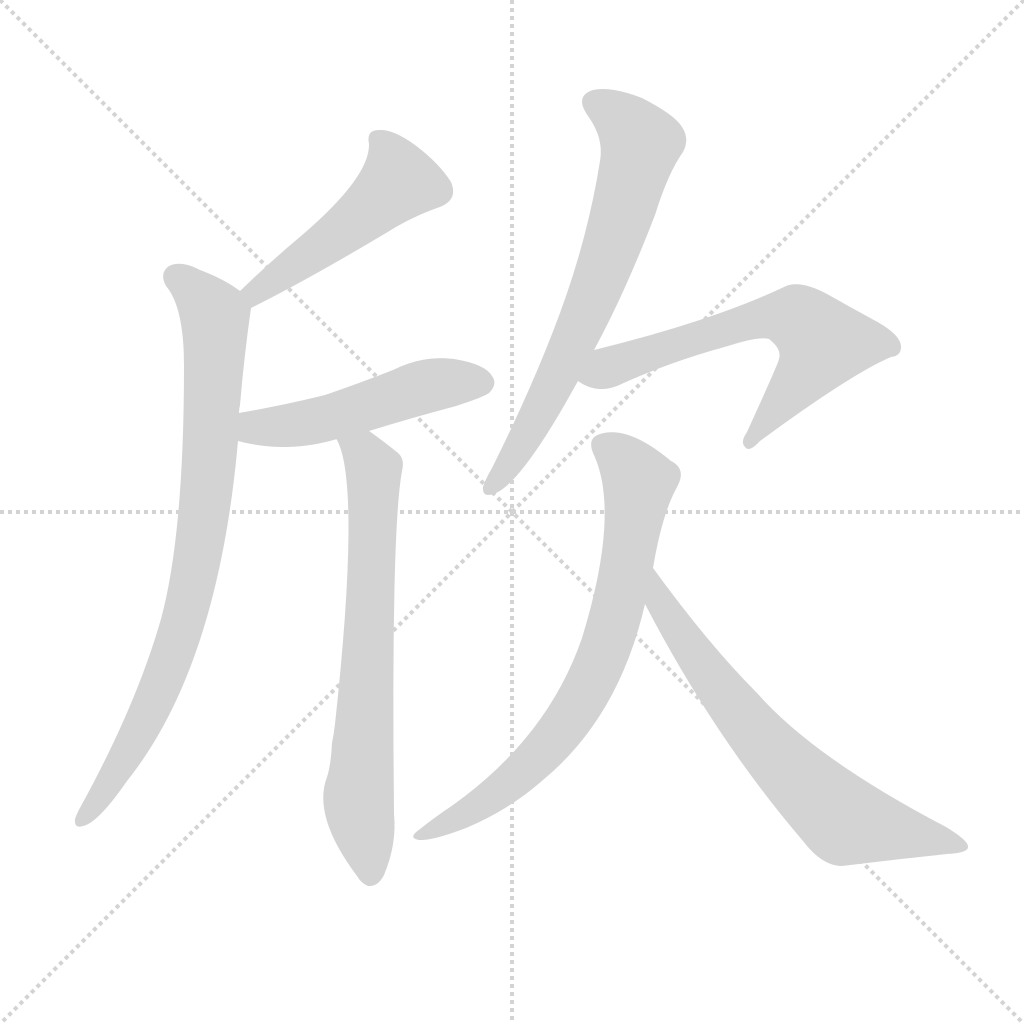
Tang Rhyme (Tangyun), Collection Rhymes (Jiyun), Rhyme Compendium (Yunhui), Correct Rhymes (Zhengyun): Pronounced xin. The pronunciation is the same as the character xin.
Shuowen Jiezi explains this as the appearance of laughter and joy.
Book of Rites (Liji), Monthly Ordinances (Yueling): Rewards and bestowals are carried out; there is no one who does not feel joy and pleasure.
Discourses of the States (Guoyu), Discourses of Zhou (Zhouyu): Serving the spirits and protecting the people; there is no one who does not feel joyous.
There is also the term xinxin, which also denotes the appearance of joy.
Songs of Chu (Chu Ci), Nine Songs (Jiuge): The lord is joyful, happy, and at peace.
Tao Qian, Return to the Fields (Guiqulai Ci): Trees and plants grow in a vibrant and flourishing manner.
Sometimes also written in a variant form (xin).
Book of Han (Hanshu), Biography of Jia Shan: The world is harmonious and joyful, and the way of governing like Yao and Shun is about to rise.
Also written in a variant form (xin).
Records of the Grand Historian (Shiji), Praise for the Biography of Guan and Yan: To hold the whip and drive the carriage for him is something I also admire and delight in.
It is also a name for the strength of animals.
Erya, Explaining Beasts (Shishou): A rabbit that is extremely powerful is called xin. An ox that is extremely powerful is called xingao.
It is also the name of a prefecture.
Guangyun: Originally the territory of Yangqu County in the Han Dynasty; the Sui Dynasty established Xin Prefecture, named after the location known as Xinkou.
It is also a surname. Found in the book Comprehensive Account of Unusual Surnames (Qixingtong).
It is also rhymed with xuan.
Lu Yun, Poem for Minister Gu: Flowers are already blooming and shining, but the remaining light is hard to prolong. Meeting is brief and parting is hurried, using sorrow to follow joy.
Jiyun: Sometimes written as xin or xin.