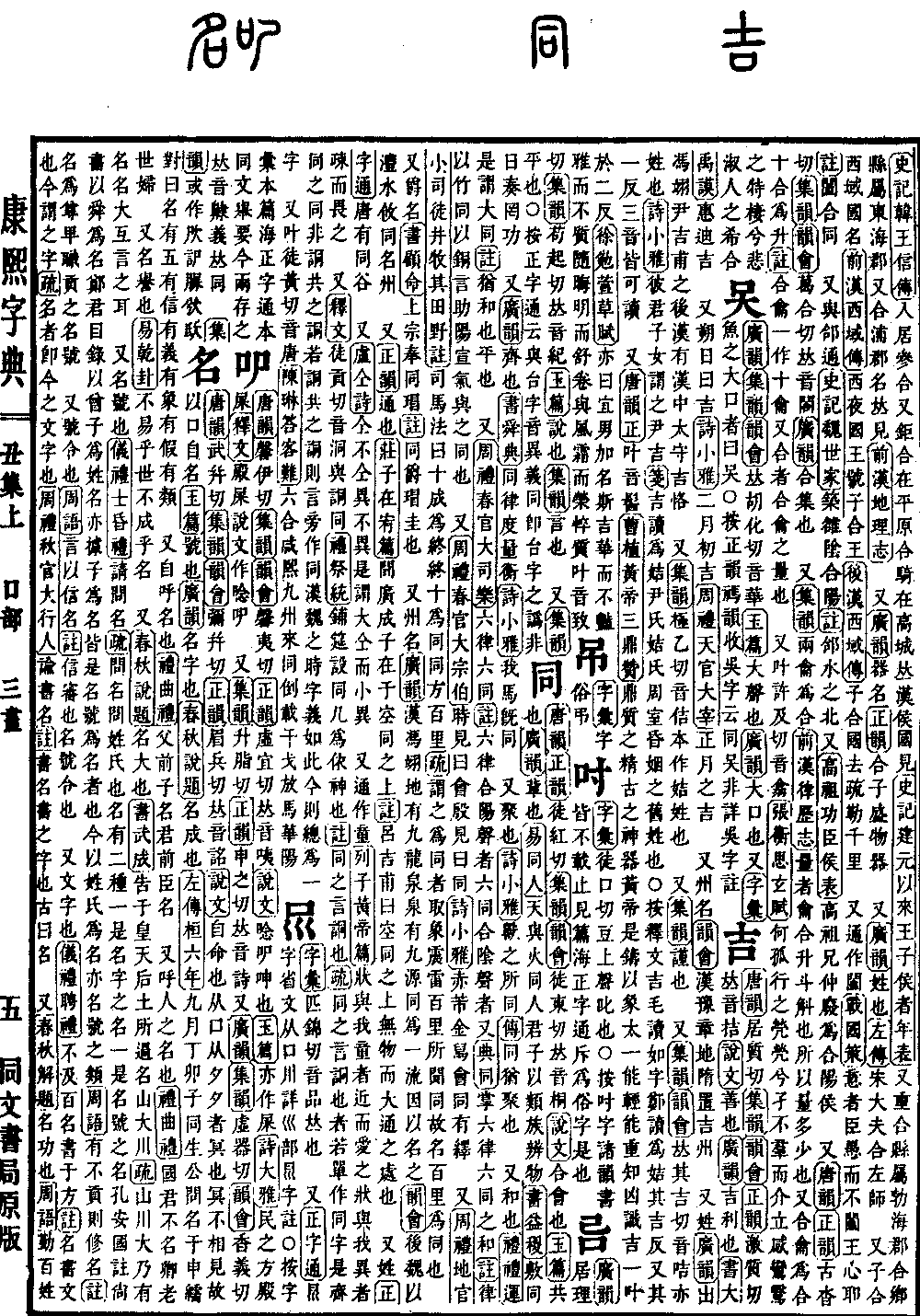
Chou Collection, Upper Volume
Radical: Mouth (kǒu)
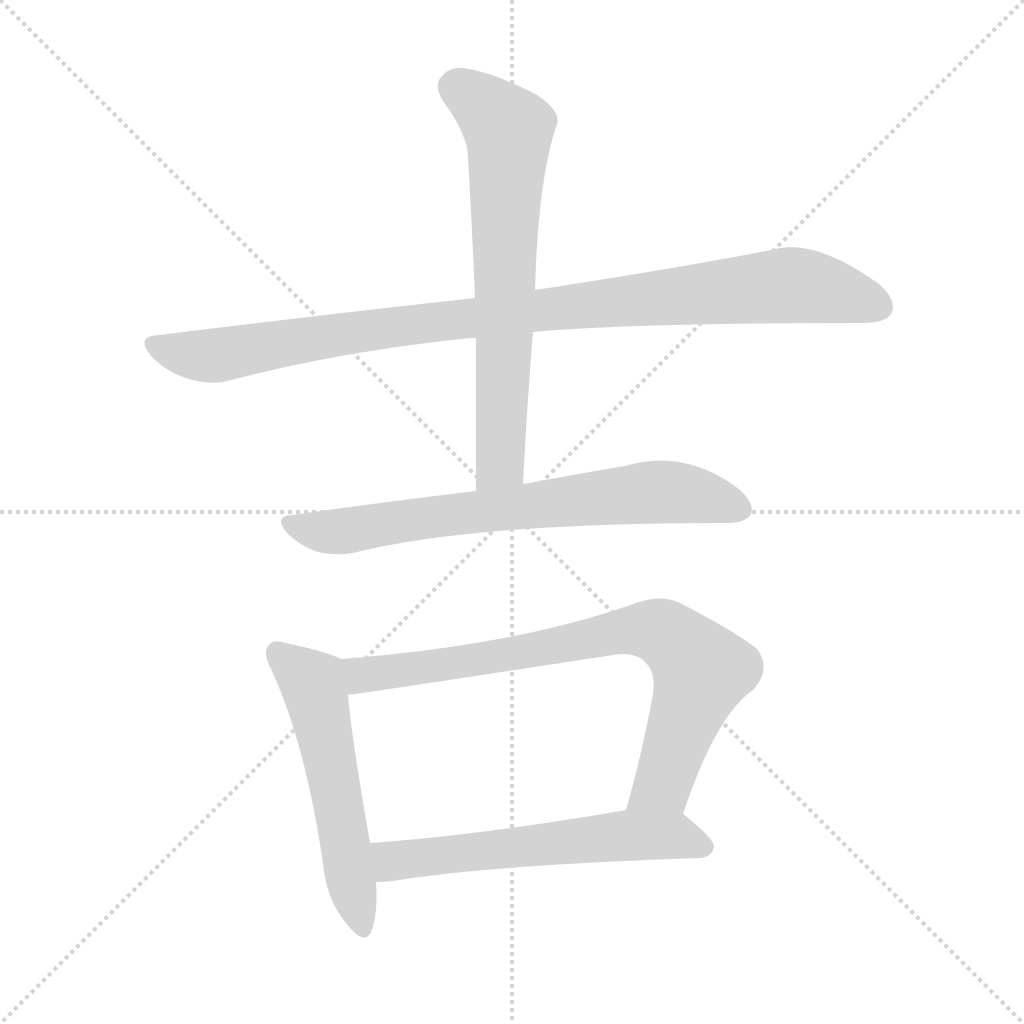
Character: 吉
Kangxi Stroke Count: 6
Page 175, Entry 02
Pronounced jie.
In the Shuowen Jiezi (Shuowen), it means good. In the Guangyun, it means lucky or auspicious.
In the Counsels of the Great Yu (Dayu Mo) of the Book of Documents (Shangshu): Those who follow the path of virtue will have good fortune.
It also refers to the first day of the lunar month. In the Book of Odes (Shijing), Xiaoya section: In the second month, on the first auspicious day. In the Rites of Zhou (Zhouli), Offices of Heaven, Grand Administrator: On the first auspicious day of the first month.
It is also the name of a prefecture. According to the Yunhui, it was originally the land of Yuzhang during the Han dynasty, and established as Jizhou during the Sui dynasty.
It is also a surname. According to the Guangyun, it originated from the descendants of Yin Jifu of Fengyi. During the Han dynasty, there was a Governor of Hanzhong named Ji Ke.
According to the Jiyun, pronounced ji. Originally written as the character for Ji (a surname).
According to the Jiyun, it also means cautious.
According to the Jiyun and the Yunhui, pronounced ji. It is also a surname. In the Book of Odes (Shijing), Xiaoya section: Those noble ladies, they are of the Yin and Ji clans. The commentary states that Ji is read as Ji (the surname). The Yin and Ji clans were long-standing marriage clans of the Zhou royal house.
Note: According to the Shiwen, regarding the character Ji, Mao reads it as written. Zheng reads it as Ji (the surname), pronounced ji, or also pronounced ji; all three readings are acceptable.
According to the Tangyun Zheng, it rhymes with the sound ji. In the Praise of the Three Tripods of the Yellow Emperor by Cao Zhi: The essence of the tripod's substance, an ancient divine vessel. The Yellow Emperor cast it, to symbolize the Great One. Capable of being light or heavy, knowing misfortune and recognizing good fortune.
In the Rhapsody on the Daylily by Xu Mian: Also called the son-bearing plant, its added name is auspicious. Flowery but not gaudy, elegant but not plain. Following the darkness and brightness, it opens and closes, thriving and withering with the wind and frost.