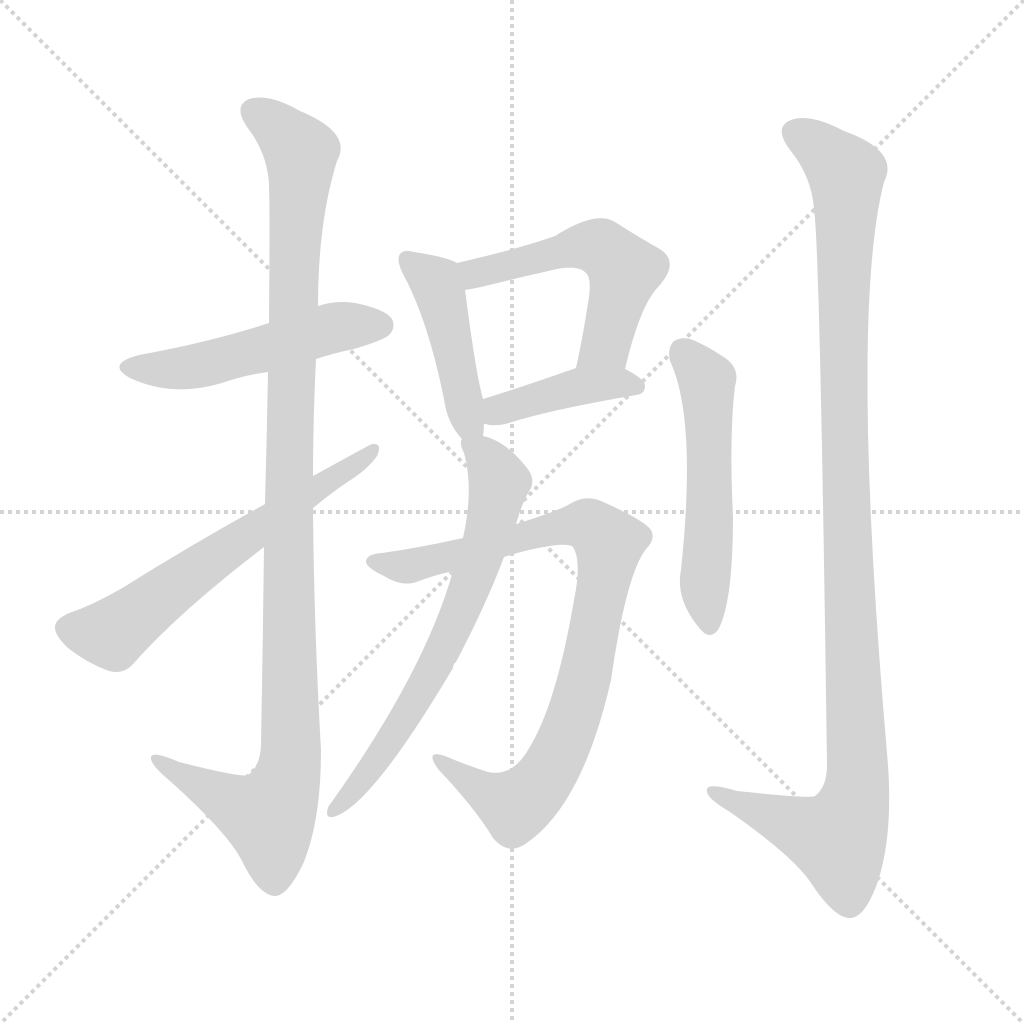
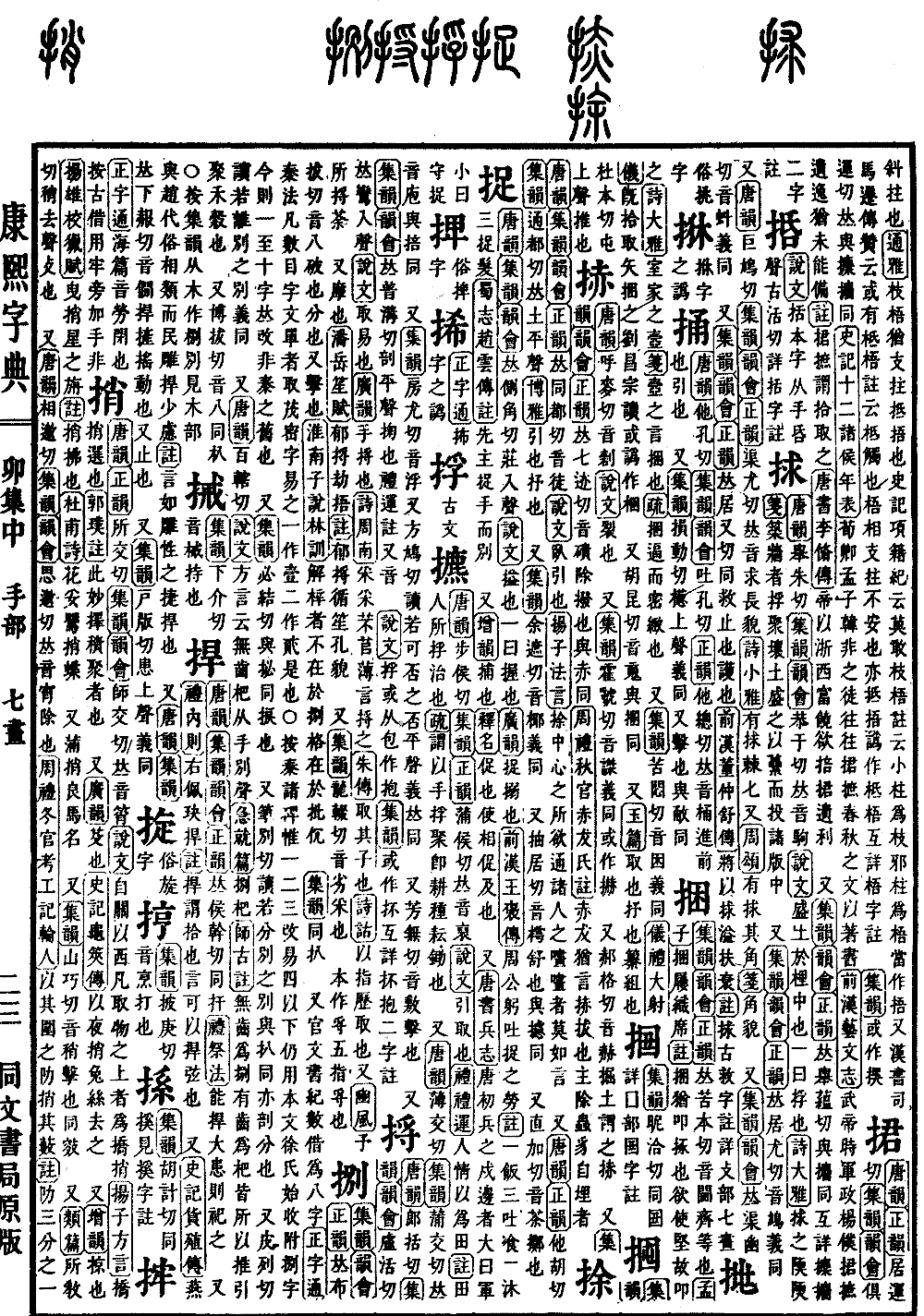
Mao Collection, Middle Volume. Radical: Hand (shǒu). Kangxi strokes: 11. Page 433, Entry 18.
According to Collected Rhymes (Jiyun), Rhyme Meetings (Yunhui), and Orthodox Rhymes (Zhengyun), it is pronounced ba. It means to break or to divide. It also means to strike. In the Huainan Masters (Huainanzi), Shuo Lin Xun chapter: One who understands grappling does not focus on the points of contact but on the vital areas. Collected Rhymes notes it is the same as the character for raking. It is also used in official documents to represent the number eight. According to Orthodox Character Mastery (Zhengzitong), under Qin dynasty law, for all simple numeral characters, more complex characters were used to prevent tampering; for example, one became the character for one, and two became the character for two. Records state that the Qin dynasty only modified the characters for one, two, and three; however, Xu eventually included the character for eight. Today, the characters for one through ten are all modified, which does not reflect the old Qin system.
Also, according to Collected Rhymes, pronounced bie. It is the same as the character for twisting.
Also, pronounced bie. It is read like the word for distinguish. It is the same as the character for raking. It also means to cut or divide.
Also, pronounced bie. It is read like the word for separate. The meaning is the same.
Also, according to Tang Rhymes (Tangyun), pronounced bo. According to Explaining Graphs and Analyzing Characters (Shuowen), the Regional Expressions (Fangyan) states: A rake without teeth. It is formed from the hand radical with a phonetic component. In the Emergency Reference (Jijiupian): eight-rake. Master Gu's commentary notes: A tool without teeth is called a rake, while one with teeth is also a rake. Both are used to push, pull, and gather grain.
Also, pronounced ba. It is the same as the character for a wooden rake. Note: Collected Rhymes writes this with the wood radical, which is seen under the wood radical section.
Textual research: In the Huainan Masters (Huainanzi), Shuo Lin Xun chapter, the text reads: One who understands grappling. The original text has been corrected from the character for catalpa tree to the character for grappling.