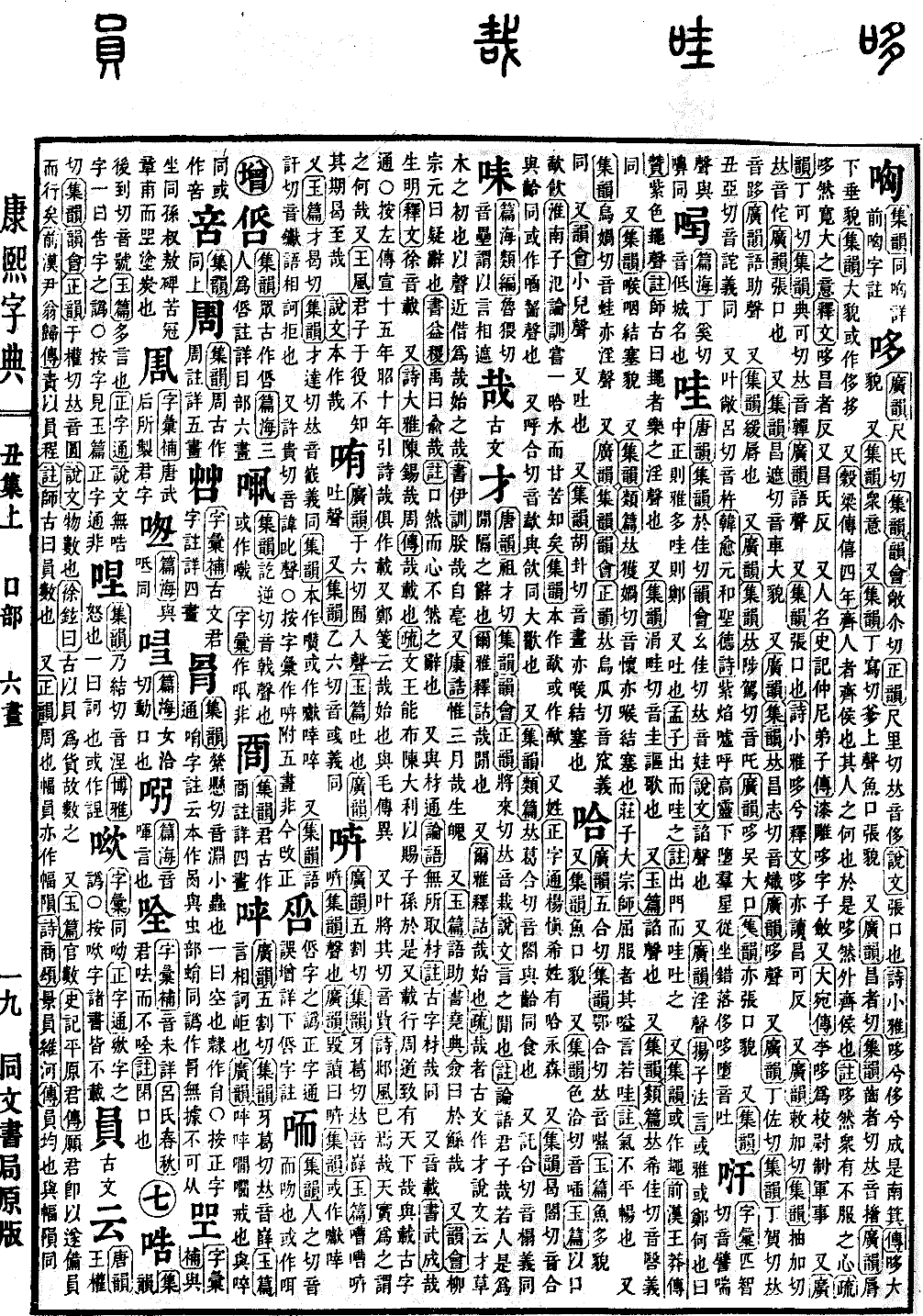
Chou Collection, Upper Volume
Radical: Mouth (kǒu)
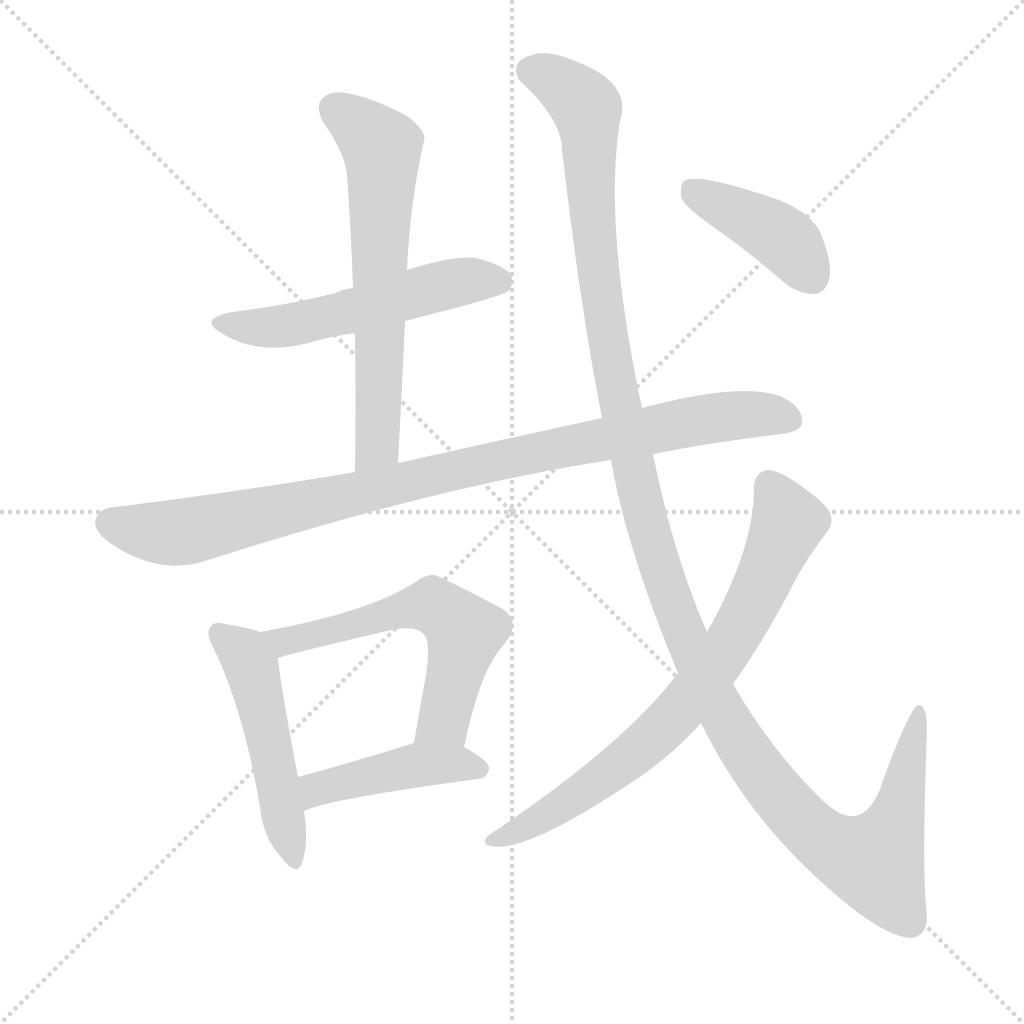
Zai; Kangxi strokes: 9; Page 189, Entry 08
Ancient character for talent (cái).
Pronounced zai.
Shuowen Jiezi (Explaining Graphs and Analyzing Characters) states it is a word indicating an interval.
Note: The Analects of Confucius (Lunyu) states, "The superior man, indeed, is this man," which serves as an expression of pause or separation.
Erya (Approaching Elegance), Interpretation of Ancient Words: Zai means an interval.
Also, Erya, Interpretation of Ancient Words: Zai means to begin.
Commentary: Zai is written as talent (cái) in ancient texts. The Shuowen Jiezi says that talent refers to the beginning of plants and trees; because the sounds are close, it is borrowed for the word zai meaning to begin.
Book of Documents (Shujing), Instructions of Yi: I began from Bo.
Also, Announcement of Kang (Kanggao): In the third month, when the moon began to wane.
Also, Yupian (Jade Chapter): An auxiliary particle for speech.
Book of Documents (Shujing), Canon of Yao: All said, Alas, Gun!
Also, Rhyme Treasury (Yunhui): Liu Zongyuan says: It is a word of doubt.
Book of Documents (Shujing), Benefits of Sovereignty: Yu said, Yes, indeed.
Note: An expression indicating agreement in words but disagreement in the heart.
Also, used interchangeably with material or talent (cái).
The Analects of Confucius (Lunyu): There is no material to be found.
Note: In ancient scripts, the characters for material (cái) and zai were the same.
Also, pronounced zai (falling tone).
Book of Documents (Shujing), Successful Completion of the War: When the light began to appear.
Commentary: Xu reads it as zai.
Also, Book of Odes (Shijing), Great Odes: Bestowed upon the Zhou.
Commentary: Zai means to carry or to act (zài).
Commentary: King Wen was able to spread great benefits to bestow upon his descendants. Thereupon, he again carried out the path of Zhou and attained the world. Zai and the character for carry/act (zài) were used interchangeably in ancient times. According to the Zuo Commentary (Zuozhuan), in the 15th year of Duke Xuan and the 10th year of Duke Zhao, where the Book of Odes is cited, the character zai is used in all instances.
Also, Zheng Xuan's annotations state: Zai means to begin. This differs from Mao's commentary.
Also, rhyming with jiang, pronounced zi.
Book of Odes (Shijing), Odes of Bei: Let it be! Heaven has brought it about; what can be said about it?
Also, Odes of Wang (Wangfeng): The gentleman is away on service, I do not know when he will arrive.
Shuowen Jiezi (Explaining Graphs and Analyzing Characters): Originally written as the character for zai with the mountain radical.