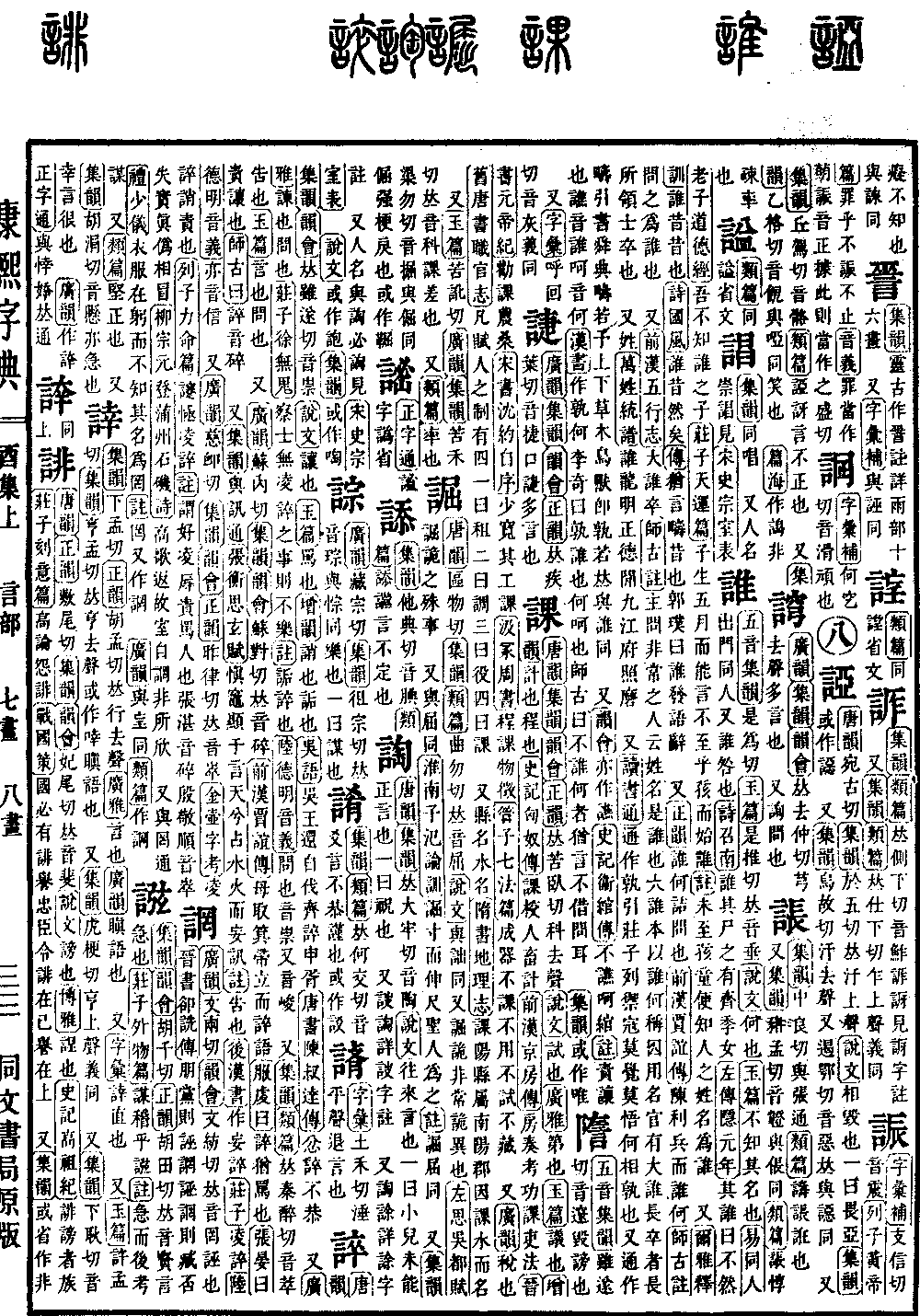
You Collection, Upper Volume
Radical: Speech (yán)
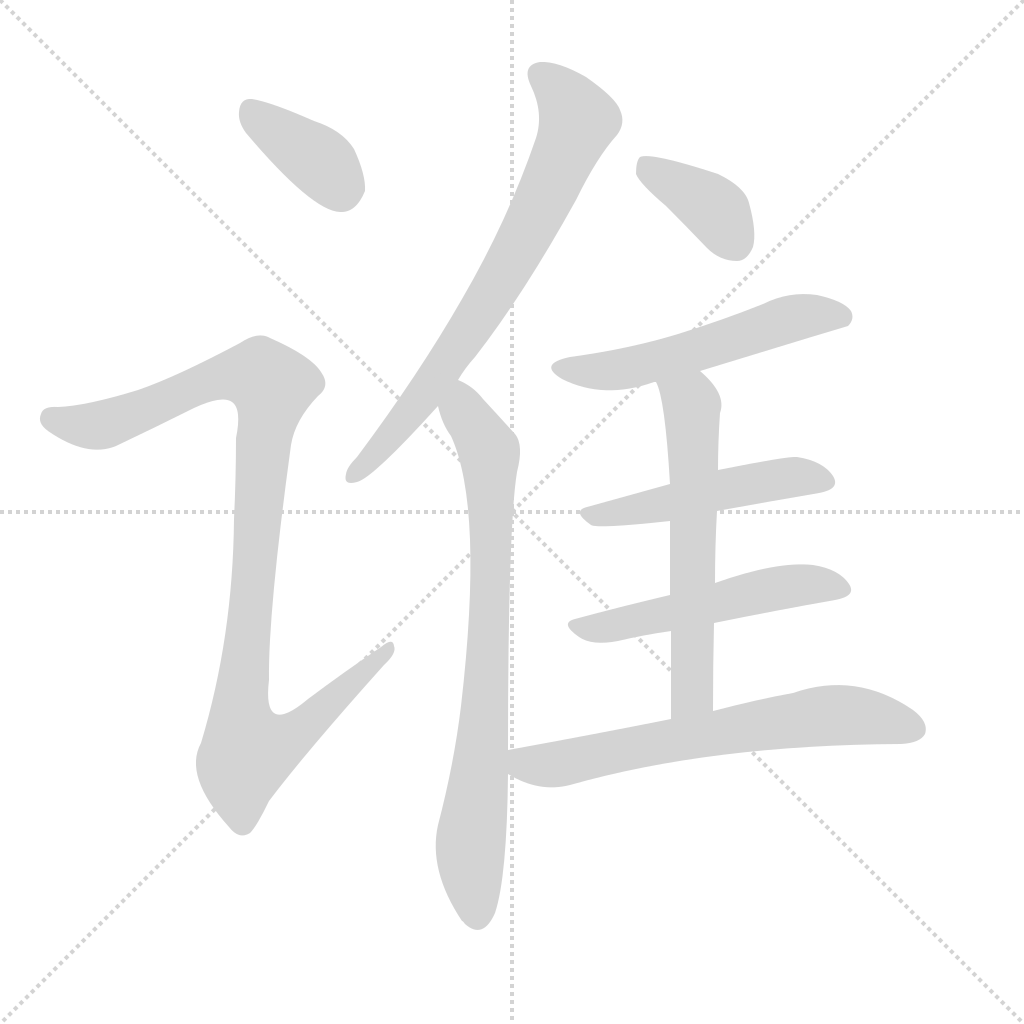
誰
Kangxi strokes: 15
Page 1165, Entry 01
Pronounced chui.
Shuowen Jiezi (Explanation of Graphs and Analysis of Characters): What.
Yupian (Jade Chapters): Not knowing a name.
Book of Changes (Yijing), section on Tongren: Leaving the door to find companions. Also, who is to blame?
Book of Odes (Shijing), section on Shaonan: Who manages this? There is the chaste young maiden.
Zuo Commentary (Zuozhuan), first year of Duke Yin: Who would say it is not so?
Laozi, Dao De Jing: I do not know whose child he is.
Zhuangzi, Tianyun chapter: When the child was born, at five months he could speak; before reaching childhood, he started asking who. Commentary: Before reaching childhood, he already knew how to ask for a person's name by saying "who."
Erya, Interpretation of Teachings: Shui means formerly or in the past.
Book of Odes (Shijing), section on Guofeng: How it was in the past. Commentary: Equivalent to saying "in times past." Guo Pu said: Shui is an introductory particle.
Zhengyun (Correct Rhymes): Shuihe, meaning to interrogate.
Book of Han (Hanshu), Biography of Jia Yi: If the weapons are sharp, then who is to be questioned? Shigu Commentary: Asking who they are.
Book of Han (Hanshu), Treatise on the Five Elements: Great Who soldiers. Shigu Commentary: An officer in charge of questioning unusual people, asking for their names. The Great Who was originally titled based on the term shuihe; hence the office name was used, and there was a Commander of the Great Who. Soldiers are the troops led by the commander.
A surname. Wanxing Tongpu (Comprehensive Genealogy of Ten Thousand Surnames): Shui Long, an official in Jiujiang Prefecture during the Zhengde era of the Ming dynasty.
Dushu Tong (General Guide to Reading): Also written as shu, citing the Lie Yukou chapter of Zhuangzi: None realize, none awaken; who is compatible with whom?
Also written as chou. Citing the Book of Documents (Shujing), Canon of Shun: Who can manage the plants, trees, birds, and beasts of my realm? This is equivalent to shu ruo, meaning the same as shui.
Yunhui (Collection of Rhymes): Also written as qiao. Records of the Grand Historian (Shiji), Biography of Wei Wan: Did not qiao-he Wan. Commentary: To reproach or reprimand. Qiao is pronounced chui; he is pronounced he.
Book of Han (Hanshu) writes it as shu he. Li Qi said: Shu means shui; he means to reprimand. Shigu said: Not shui he is like saying not to question someone.
Jiyun (Collection of Rhymes): Sometimes written as wei.