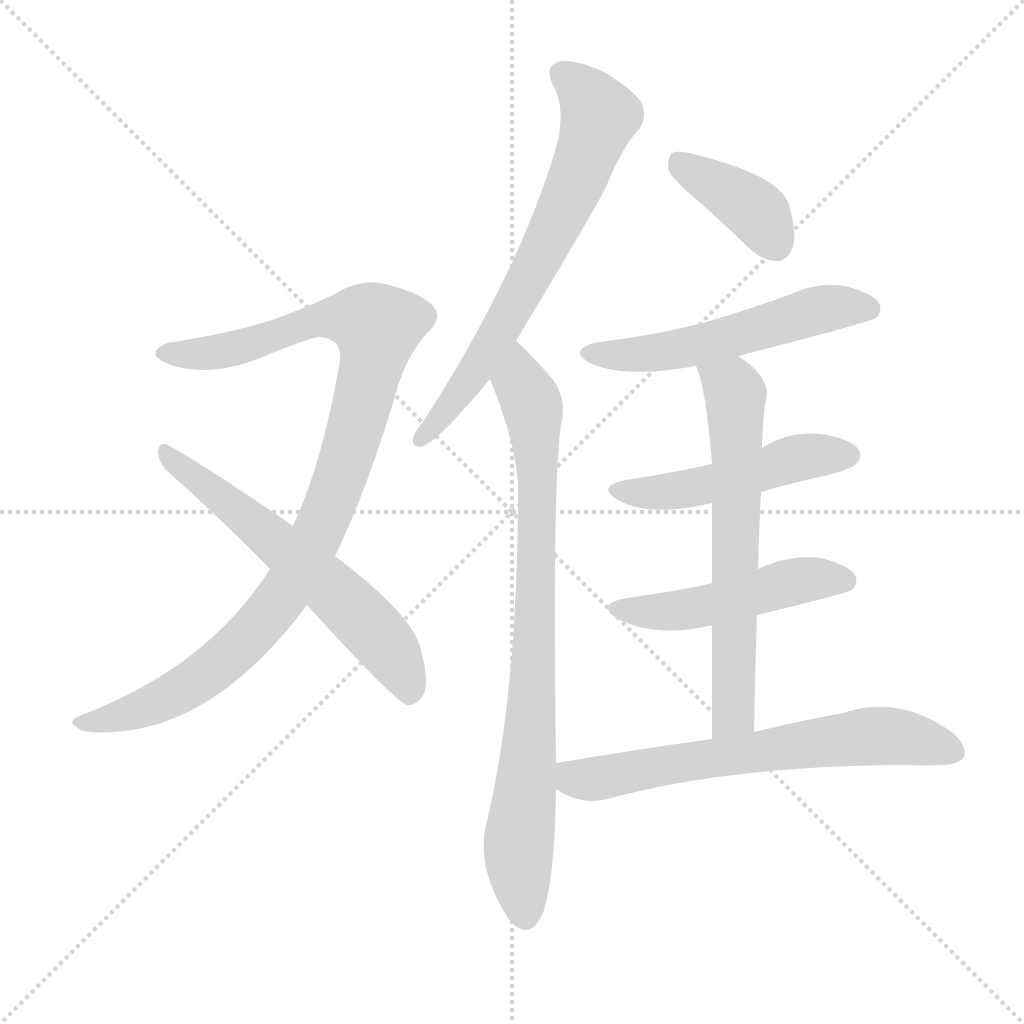
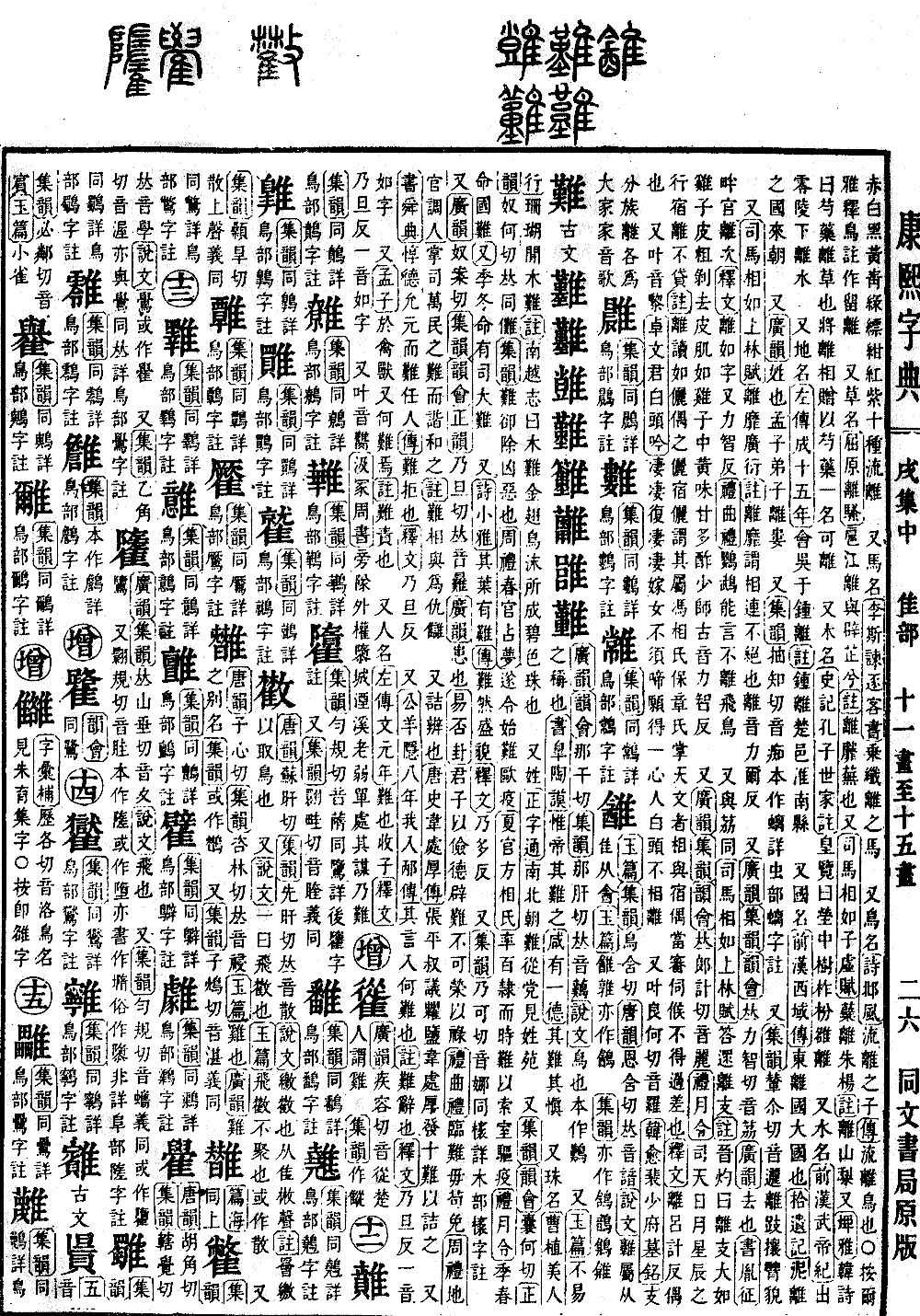
Xu Collection, Middle Volume
Radical: Short-tailed bird (zhuī)
Kangxi stroke count: 19
Page 1370, Entry 03
Ancient characters. According to the Expanded Dictionary of Sounds and Meanings (Guangyun) and the Collected Rhymes (Yunhui), pronounced nan; according to the Collected Rhymes (Jiyun), pronounced nan. According to the Explaining Graphs and Analyzing Characters (Shuowen), it refers to a bird. Originally written as the character for bird. Also, according to the Jade Compendium (Yupian), it is a term for something not easy. As in the Book of Documents (Shujing), Counsels of Gao Yao: The Emperor must act with difficulty regarding this. Also, in The Possession of Pure Virtue (Xianyou Yide): Be difficult and be cautious.
Also refers to a type of pearl. In the poem Beauty by Cao Zhi: Coral interspersed with mu-nan (wood-difficult) pearls. The commentary in the Records of Southern Yue states: Mu-nan is a blue-colored pearl formed from the foam of a golden-winged bird.
Also a surname. According to the Guide to Standard Characters (Zhengzitong), during the Northern and Southern Dynasties, the Nan family followed the Dang family. See the Dictionary of Surnames (Xingyuan).
Also, according to the Collected Rhymes (Jiyun) and the Collected Rhymes (Yunhui), pronounced nuo; according to the Standard Rhymes (Zhengyun), pronounced nuo. Same as the term nuo (to exorcise). According to the Collected Rhymes (Jiyun), nan means to drive away evil and malevolence. As in the Rites of Zhou (Zhouli), Spring Offices, Interpreting Dreams: Then order the initiation of the exorcism to drive away plagues. In the Summer Offices, Director of Exorcism: Lead the hundred officials to perform the seasonal exorcism to search the rooms and drive away plagues. In the Book of Rites (Liji), Monthly Ordinances: In the last month of spring, command the state-wide exorcism. Also: In the last month of winter, command the officials to perform the grand exorcism.
Also, in the Book of Odes (Shijing), Lesser Odes: Its leaves are nan-nan (luxuriant). The commentary states: Nan-nan is the appearance of being luxuriant. The Explanatory Text (Shiwen) states: Pronounced duo.
Also, according to the Collected Rhymes (Jiyun), pronounced na. Same as the character nuo (a species of tree). See the entry for the character nuo in the Wood radical.
Also, according to the Expanded Dictionary of Sounds and Meanings (Guangyun), pronounced nan; according to the Collected Rhymes (Jiyun), the Collected Rhymes (Yunhui), and the Standard Rhymes (Zhengyun), pronounced nan. According to the Expanded Dictionary of Sounds and Meanings (Guangyun), it means misfortune. As in the Book of Changes (Yijing), Hexagram of Obstruction: The superior man uses frugal virtue to avoid misfortune, and must not be honored with salary. In the Book of Rites (Liji), Summary of the Rites: When facing misfortune, do not seek survival through ignoble means. In the Rites of Zhou (Zhouli), Earth Offices, Regulator of Relationships: Manage the misfortunes of the ten thousand people and harmonize them. The commentary states: Nan means to treat each other as enemies.
Also means to question and debate. In the History of the Tang Dynasty (Tangshi), Biography of Wei Chuhou: Zhang Pingshu proposed the sale of salt, and Wei Chuhou raised ten difficult points to question him.
Also, in the Book of Documents (Shujing), Canon of Shun: Respect virtue and trust the worthy, and be difficult when appointing people. The commentary states: Nan means to refuse. The Explanatory Text (Shiwen) states: Pronounced nan.
Also, in the Gongyang Commentary (Gongyang Zhuan), 8th year of Duke Yin, Commentary on "I entered the state of Bin": Why does the text say "entered"? Nan is a particle used in discourse. The Explanatory Text (Shiwen) states: Pronounced nan; another pronunciation is as the character is read.
Also, in the Mencius: What is the difficulty in dealing with birds and beasts? The commentary states: Nan means to reproach.
Also used as a person's name. In the Zuo Commentary (Zuozhuan), 1st year of Duke Wen: Nan held the son. The Explanatory Text (Shiwen) states: Pronounced duo; another pronunciation is as the character is read.
Also, rhymed as ni. In the Book of Zhou (Zhou Shu) found in the Jizhong tomb: Sides and surroundings are outside, destroying cities and flooding streams. The old and the weak reside alone; their strategies are difficult.
Verification: In the Zuo Commentary (Zuozhuan), 1st year of Duke Wen: Nan held the son. The Explanatory Text (Shiwen) states: Pronounced nan. Following the original text, corrected from nan to duo.