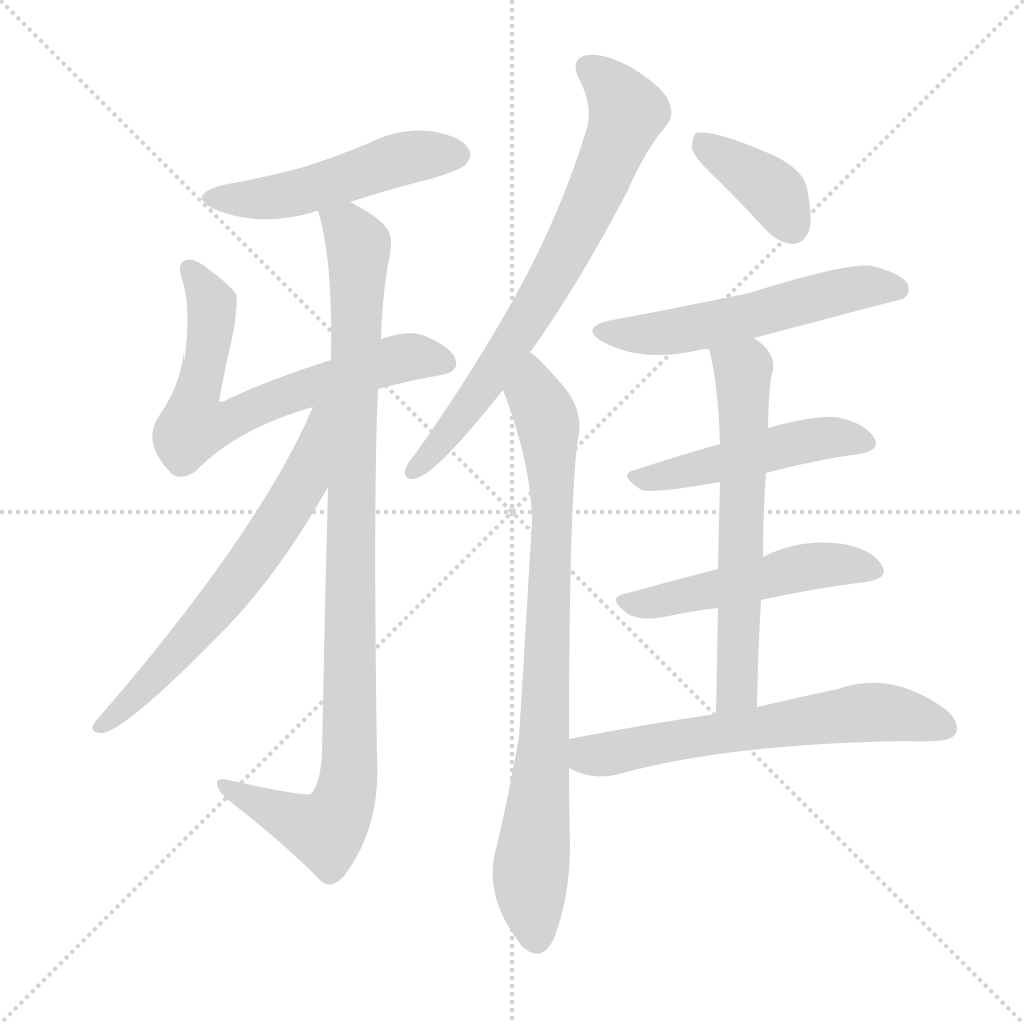
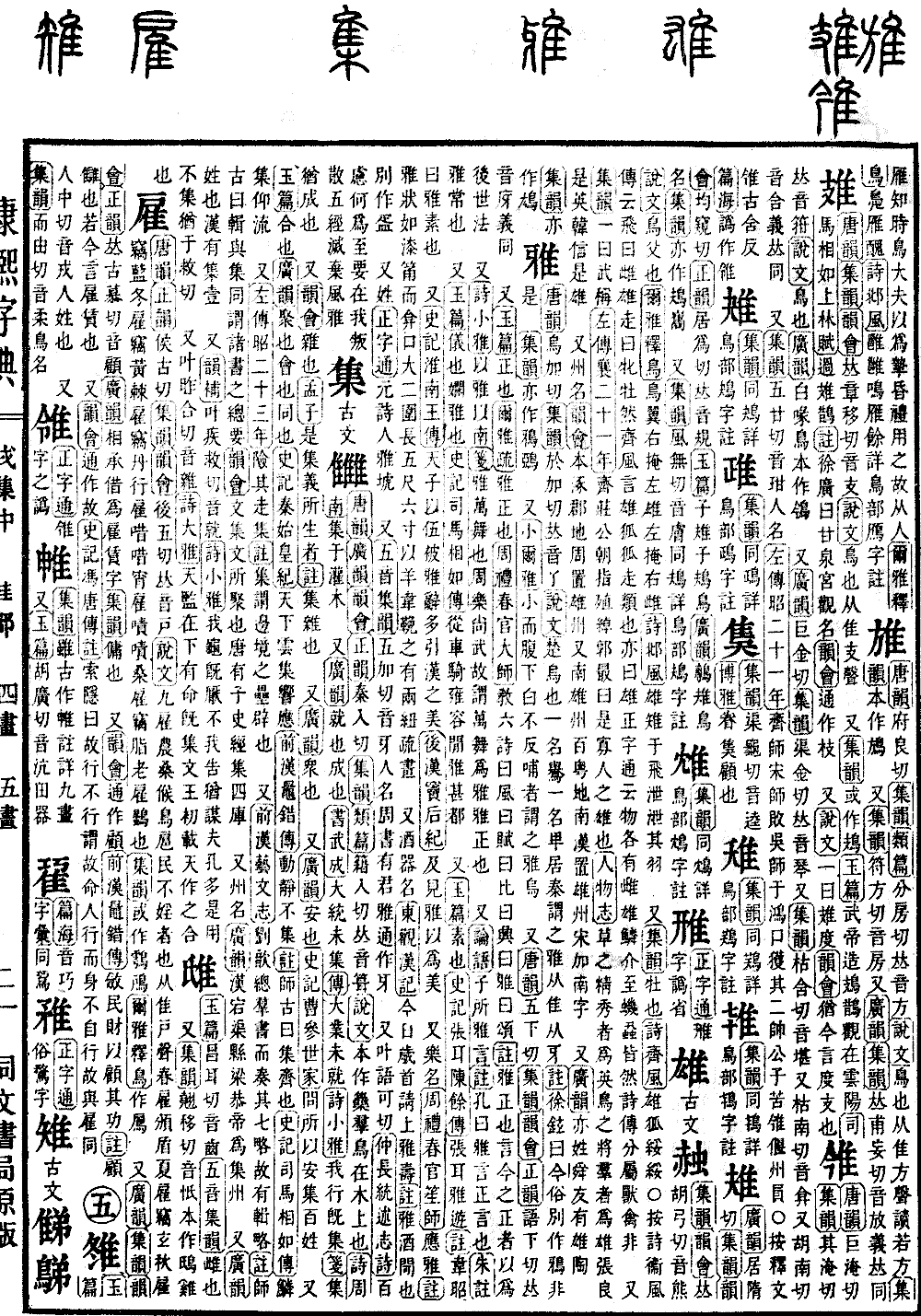
Xu Collection, Middle Volume; Radical: Short-tailed bird (zhuī); 12 Kangxi strokes; Page 1365, Entry 14
Pronounced ya. Pronounced ya. Pronounced ya.
According to the Explaining and Analyzing Characters (Shuowen Jiezi), it refers to a crow from the Chu region. Also known as the lesser crow or the resident bird. In the Qin region, it is called ya. The character form is composed of the radical for a short-tailed bird and the element for tooth.
Note: Xu Xuan states that the common contemporary variant form written with the bird radical is incorrect.
The Collected Rhymes (Jiyun) also records the variant forms written with the bird radical.
Furthermore, the Small Manual of Refined Usage (Xiao Erya) states: A crow that is small in size with a white belly and does not practice filial feeding of its parents is called a ya-crow.
Pronounced ya (dipping tone). Pronounced ya (dipping tone). The meaning is the same as above.
Additionally, according to the Jade Chapters (Yupian), it means: correct.
The Commentary on the Erya (Erya Shu) states: Ya means correct.
In the Rites of Zhou (Zhouli), Spring Offices, Grand Master: Teaches the six poems, which are the Feng, Fu, Bi, Xing, Ya, and Song.
Note: Ya means correct. It refers to the refined and standard poetry of the time, serving as a model for future generations.
Additionally, in the Book of Odes (Shijing), Lesser Odes of the Kingdom, there is the line: With the Ya and the Nan music.
Commentary: Ya refers to the Wan dance. The music of the Zhou dynasty venerated martial virtue, thus the Wan dance was called Ya. Ya means correct.
Furthermore, the Analects (Lunyu) records that Confucius used the refined language (ya).
Note: Kong Anguo states: The refined language refers to the standard language.
Zhu Xi's Commentary states: Ya means the customary or standard.
Additionally, the Jade Chapters (Yupian) defines it as: bearing, refined and elegant.
The Records of the Grand Historian (Shiji), Biography of Sima Xiangru, records: Following the carriages and cavalry, his bearing was graceful and elegant, appearing exceptionally handsome.
Furthermore, the Jade Chapters (Yupian) defines it as: habitual, always.
The Records of the Grand Historian (Shiji), Biography of Zhang Er and Chen Yu, records: Zhang Er was always fond of associating with others.
Note: Wei Zhao states: Ya means always or all along.
Additionally, the Records of the Grand Historian (Shiji), Biography of the King of Huainan, records: The Emperor, because the words of Wu Bei had always been upright, frequently cited the excellent governance of the Han dynasty.
The Book of the Later Han (Hou Hanshu), Annals of Empress Dou, records: Upon meeting her, he had always considered her to be beautiful.
It also refers to the name of a musical instrument.
The Rites of Zhou (Zhouli), Spring Offices, Sheng Master, mentions the musical instrument known as the ying-ya.
Note: The Ya is shaped like a lacquered tube with a constricted mouth, five feet and six inches long, covered with sheepskin, featuring two rings, and decorated with colorful paintings.
It also refers to a type of wine vessel.
The Records of the Eastern Han (Dongguan Hanji) records: Today is the beginning of the year, please allow me to offer an offering of Ya-longevity wine.
Note: Ya is a type of wine vessel. It is also written with other characters.
It is also a surname.
The Correctness of Characters (Zhengzitong) records: There was a poet in the Yuan dynasty named Ya Hu.
Additionally, in the Five Sounds Collected Rhymes (Wuyin Jiyun), it is pronounced ya, used in personal names. The Book of Zhou (Zhoushu) mentions Jun Ya, which is also written interchangeably with the character for tooth.
Additionally, rhyme-adapted pronunciation is ya (rising tone).
In the Poem on Expressing Intentions by Zhongchang Tong: Why exhaust the mind with a hundred worries? The most essential thing lies within oneself. Departing from and abandoning the Five Classics, casting aside and destroying the Odes (Feng and Ya).