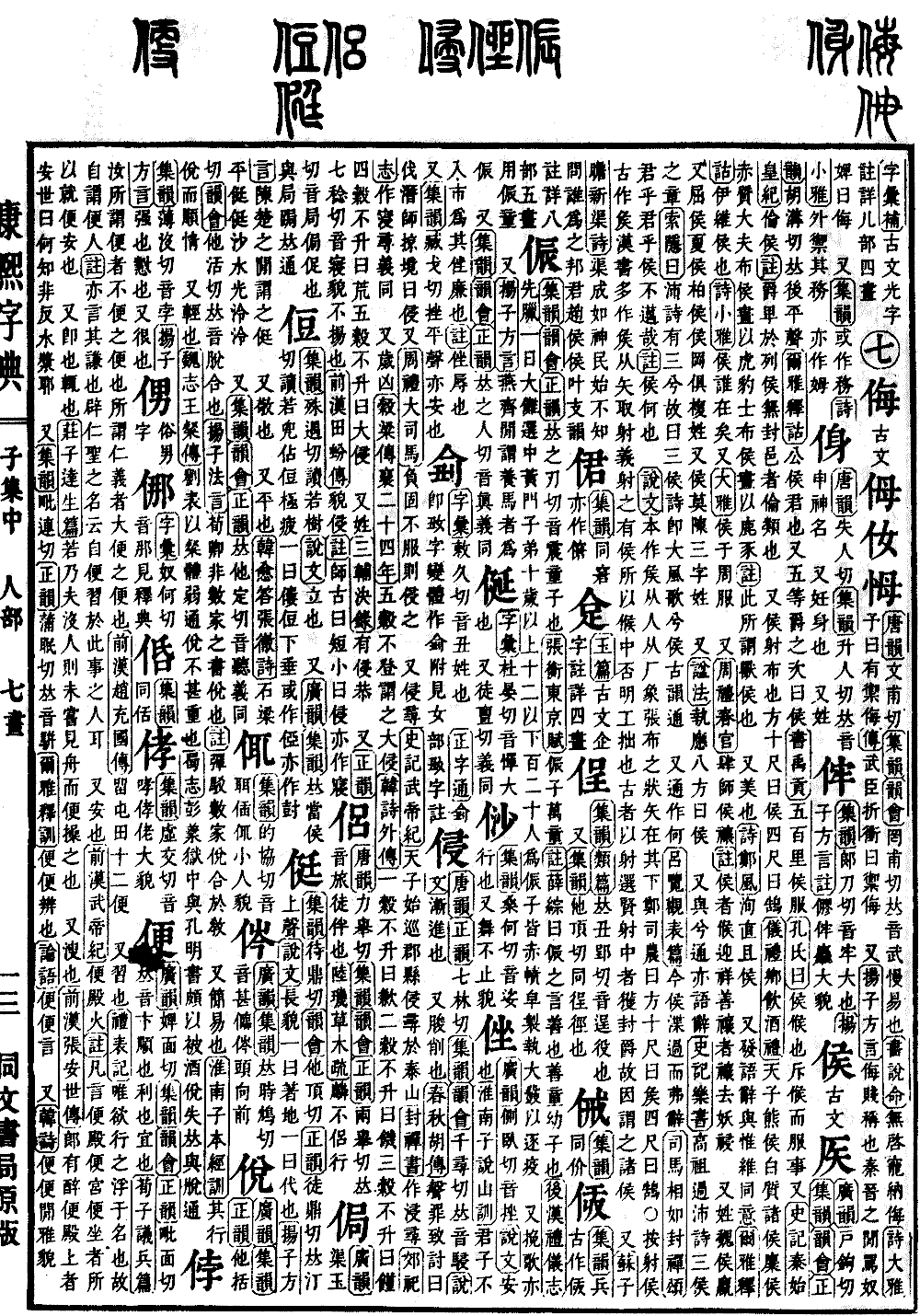
Zi Collection, Middle Volume
Radical: Person (rén)
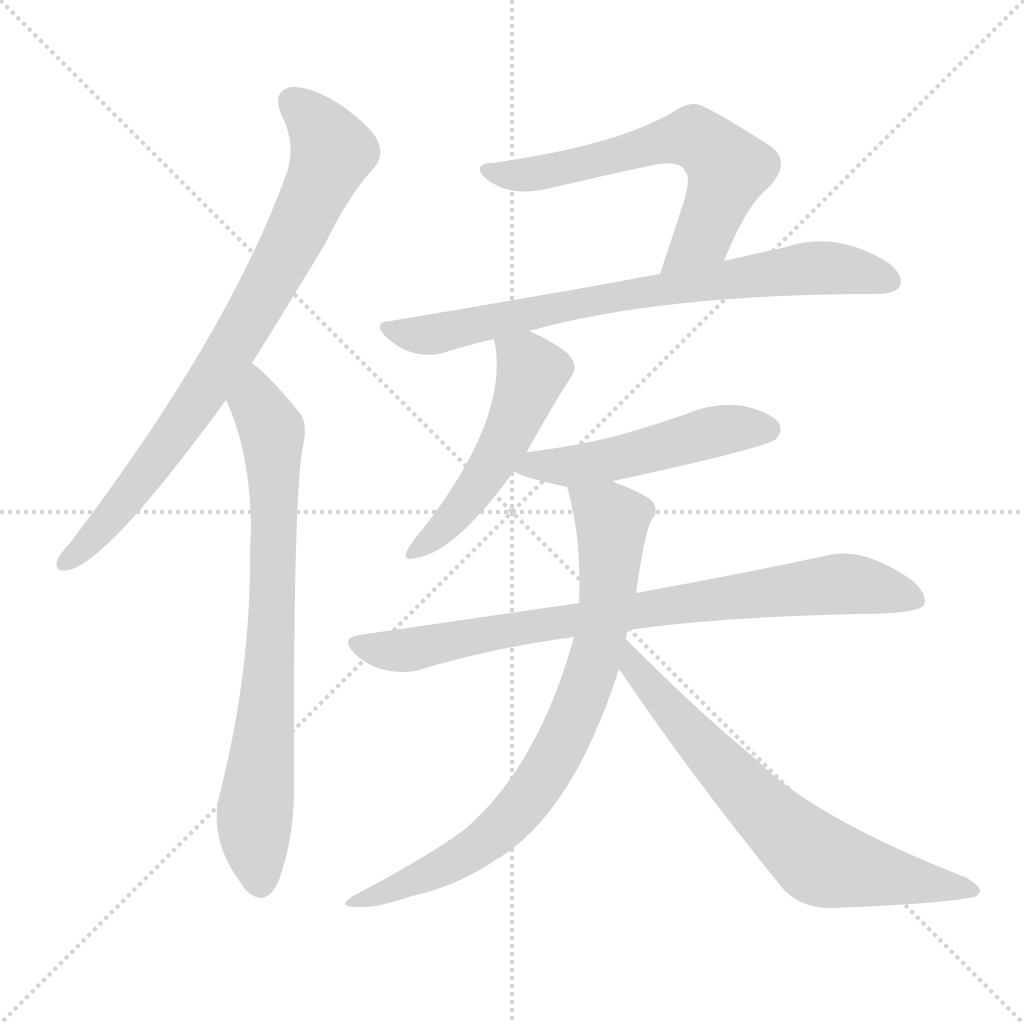
Hou; Kangxi strokes: 9; Page 103, Entry 07
Ancient script. Pronounced gou (level tone). Pronounced gou (level tone). Pronounced hou (level tone).
Book of Rites (Erya), Explanation of Ancient Words (Shigu): Gonghou, means ruler. Also, the second of the five ranks of nobility is called Hou.
Book of Documents (Shujing), Tribute of Yu (Yugong): Five hundred li of the Hou domain (territory of the nobility).
Kong says: Hou, means to spy or scout. To serve the Son of Heaven from the territory of the scouts.
Also, Records of the Grand Historian (Shiji), Annals of the First Emperor of Qin (Qin Shihuang Ji): Lunhou.
Commentary: A rank equal to the nobility (liehou) but without a fief. Lun means to be of the same class.
Also, Hou, a target for archery. A target ten feet square is called a Hou, and the four-foot center is called a Gu.
Book of Etiquette and Ceremonial (Yili), Archery Rites of the Local Communities (Xiangsheli): The Son of Heaven uses a Hou adorned with bear skin on a white background; the feudal lords use a Hou adorned with elk skin on a red background. High officials (dafu) use a cloth Hou decorated with tigers and leopards; scholars (shi) use a cloth Hou decorated with deer and pigs.
Commentary: These are what are called the beast-targets.
Also, meaning beautiful.
Book of Odes (Shijing), Odes of Zheng (Zhengfeng): Truly upright and beautiful.
Also, a sentence-initial particle. Same meaning as Wei.
Book of Rites (Erya), Explanation of Ancient Words (Shigu): Yi and Wei are the sentence-initial particles of Hou.
Book of Odes (Shijing), Lesser Odes of the Kingdom (Xiaoya): Who is there?
Also, Greater Odes of the Kingdom (Daya): Thus becoming subjects to the Zhou.
Also, Rites of Zhou (Zhouli), Spring Offices (Chunguan): The Si official manages Hou-sacrifices and Rang-sacrifices.
Commentary: Hou means to welcome good fortune. Rang means to remove the energy of disaster.
Also, a surname. Such as Hou Ying of the State of Wei. There are also compound surnames such as Quhou, Xiahou, Baihou, and Hougang. There is also Houmo, a three-character surname.
Also, Law of Posthumous Titles (Shifa): One who is able to respond to the needs of the eight directions is given the posthumous title Hou.
Also, interchangeable with the particle Xi. It is also an utterance particle.
Records of the Grand Historian (Shiji), Treatise on Music (Yueshu): Emperor Gaozu of Han passed through Pei and composed the Three Hou Chapter.
Suoyin Commentary: The poems of Pei contained three Xi characters, so they were called the Three Hou Poems. This refers to the Song of the Great Wind. Xi and Hou are phonetically interchangeable in ancient rhyming.
Also, interchangeable with He (what).
Lu Family Spring and Autumn (Lvshi Chunqiu), Guanbiao Chapter: Now why (Hou) are there faults that are not denied?
Sima Xiangru, Eulogy on the Feng and Shan Sacrifices (Fengshan Song): O Ruler, O Ruler, why (Hou) do you not go?
Commentary: Hou means He.
Shuowen Jiezi: The original character is written as Hou. Composed of Person and Cliff. It looks like a piece of cloth spread out, with an arrow beneath it. Zheng Sinong said: Ten feet square is called Hou, four feet is called Gu.
Note: For the archery target, the ancient character was written as Hou. The History of Han (Hanshu) frequently writes it as Hou. The inclusion of the Arrow radical captures the meaning of archery; archery involved the use of a Hou, which was used to determine whether a target was struck, thereby indicating the level of skill. In ancient times, archery was used to select the worthy; those who struck the target received titles of nobility, and thus they were known as the feudal lords (zhuhou).
Also, Su Zizhan’s Poem on the New Canal: The water canal was completed as if by divine assistance, and the common people did not initially know who had done it. Upon asking, it was the Prefect, Zhao Hou. Here, the character Hou rhymes with the Zhi category.
Textual Criticism:
Book of Etiquette and Ceremonial (Yili), Drinking Rites of the Local Communities (Xiangyinjiuli): The Son of Heaven used the bear-target with white quality. I have carefully corrected this from Drinking Rites of the Local Communities to Archery Rites of the Local Communities as per the original book.
Rites of Zhou (Zhouli), Spring Offices (Chunguan): The Si official and the Hou/Rang sacrifices.
Commentary: Hou, welcoming good fortune. Rang, to ward off evil energies. I have carefully corrected the commentary from the original text: Good fortune (shanshang) corrected to Auspiciousness (shangshan); Evil energy (yangqi) corrected from original text.