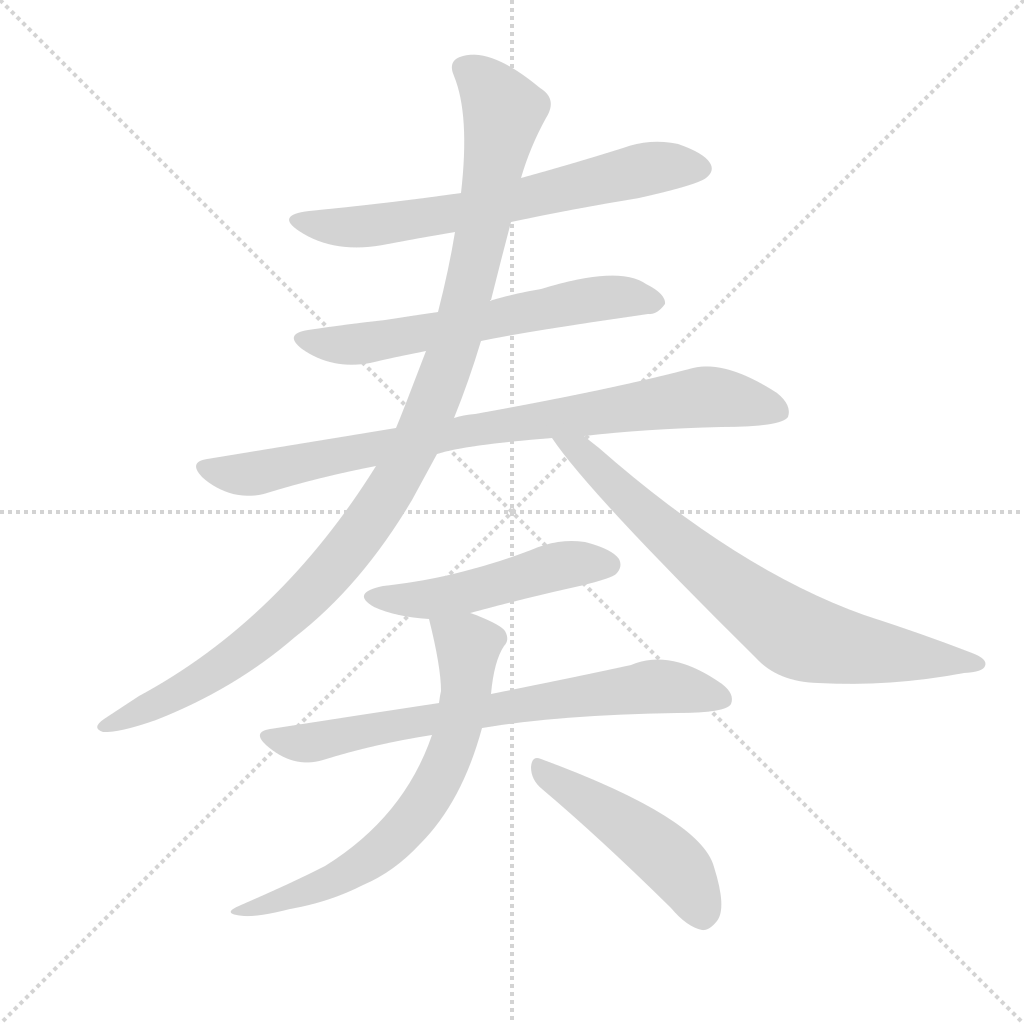
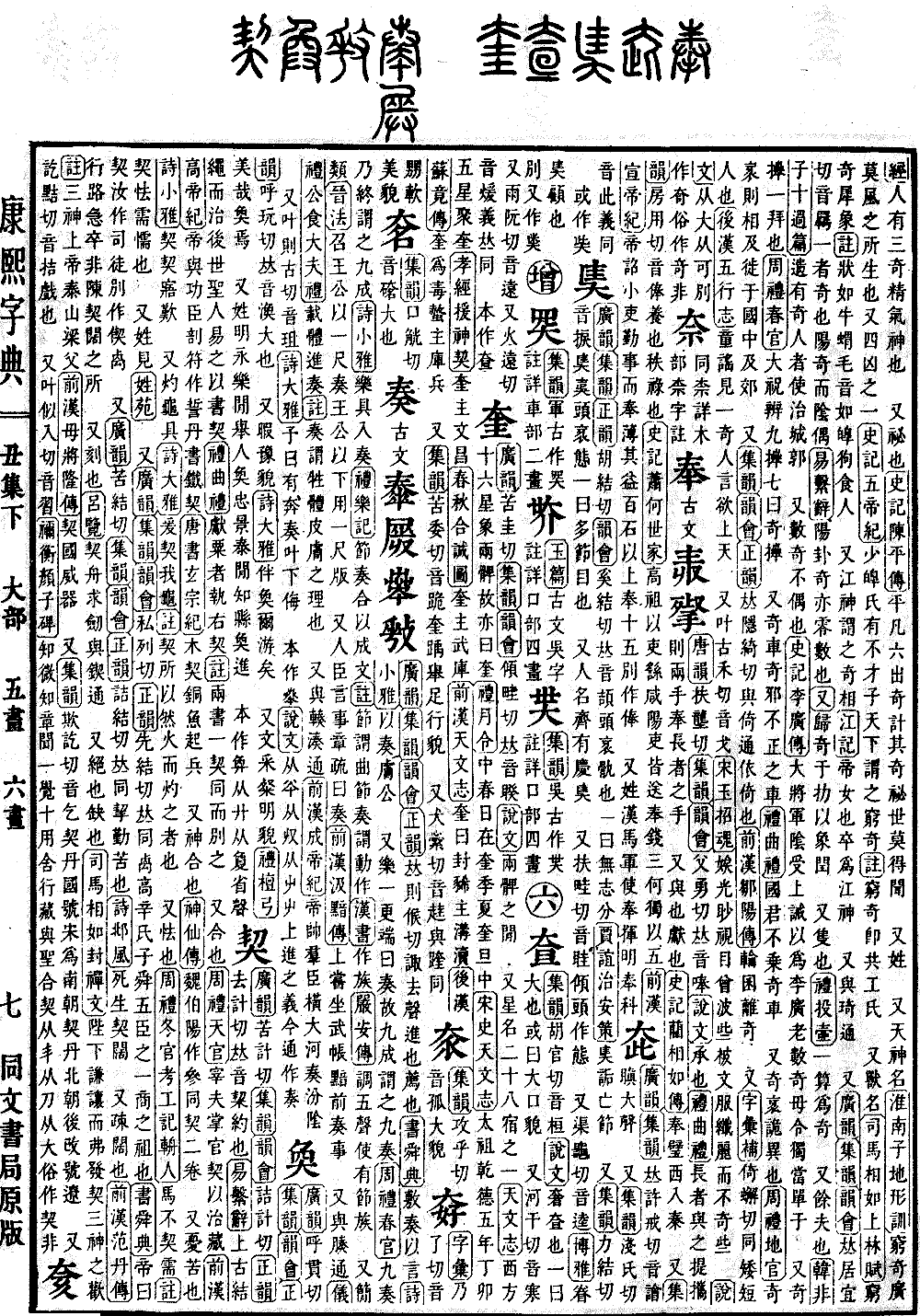
Chou Collection, Lower Volume
Radical: Big (dà)
Kangxi stroke count: 9
Page 251, Entry 15
Pronounced zou (falling tone). To present, to recommend. Book of Documents (Shijing), Shun Canon: To state opinions and present them to the superior. Book of Odes (Shijing), Lesser Odes: To achieve great merit.
Also, each section of a musical piece is called a zou, therefore nine sections are called nine zou. Rites of Zhou (Zhouli), Spring Officials: When nine zou are completed, it is called nine cheng. Book of Odes (Shijing), Lesser Odes: Musical instruments are brought out to perform. Book of Rites (Liji), Record of Music: Rhythms coordinate to form a musical movement. Annotation: Rhythm refers to the sections of a melody; zou refers to the changes in movement. Book of Han (Hanshu) writes this as a variant form (zú). Biography of Yan An: Harmonize the five sounds so that they have rhythm.
Also, a category. Statutes of the Jin Dynasty: When summoning princes and dukes, use a one-foot-long tablet; for those below princes and dukes, use a one-foot-long board.
Also, documents submitted by officials to the ruler are called zou. Book of the Former Han (Qian Hanshu), Biography of Ji An: The Emperor was once sitting in a military tent, and Ji An came forward to present matters.
Also, interchangeable with the character meaning skin pores (cou). Book of Etiquette and Ceremonial (Yili), Public Food for Grandee Rites: Presenting the body of a sacrificial animal. Annotation: Zou refers to the texture of the skin of the sacrificial animal.
Also, interchangeable with the characters meaning to gather or to assemble (cou). Book of the Former Han (Qian Hanshu), Annals of Emperor Cheng: The Emperor led his officials to cross the Yellow River and assemble at Fenyin.
Also, pronounced zu (rising tone). Book of Odes (Shijing), Greater Odes: I speak of those who run about and exert effort. Rhymes with the word wu in the following sentence.
Originally written as a variant form. Explaining Simple and Analyzing Compound Characters (Shuowen): Composed of the character for advance and the character for sprout. The sprout represents the meaning of advancing upward. It is now commonly used as zou.