Xu Collection, Lower Volume
Radical: Food (shí)
Kangxi stroke count: 15
Page 1419, Entry 26
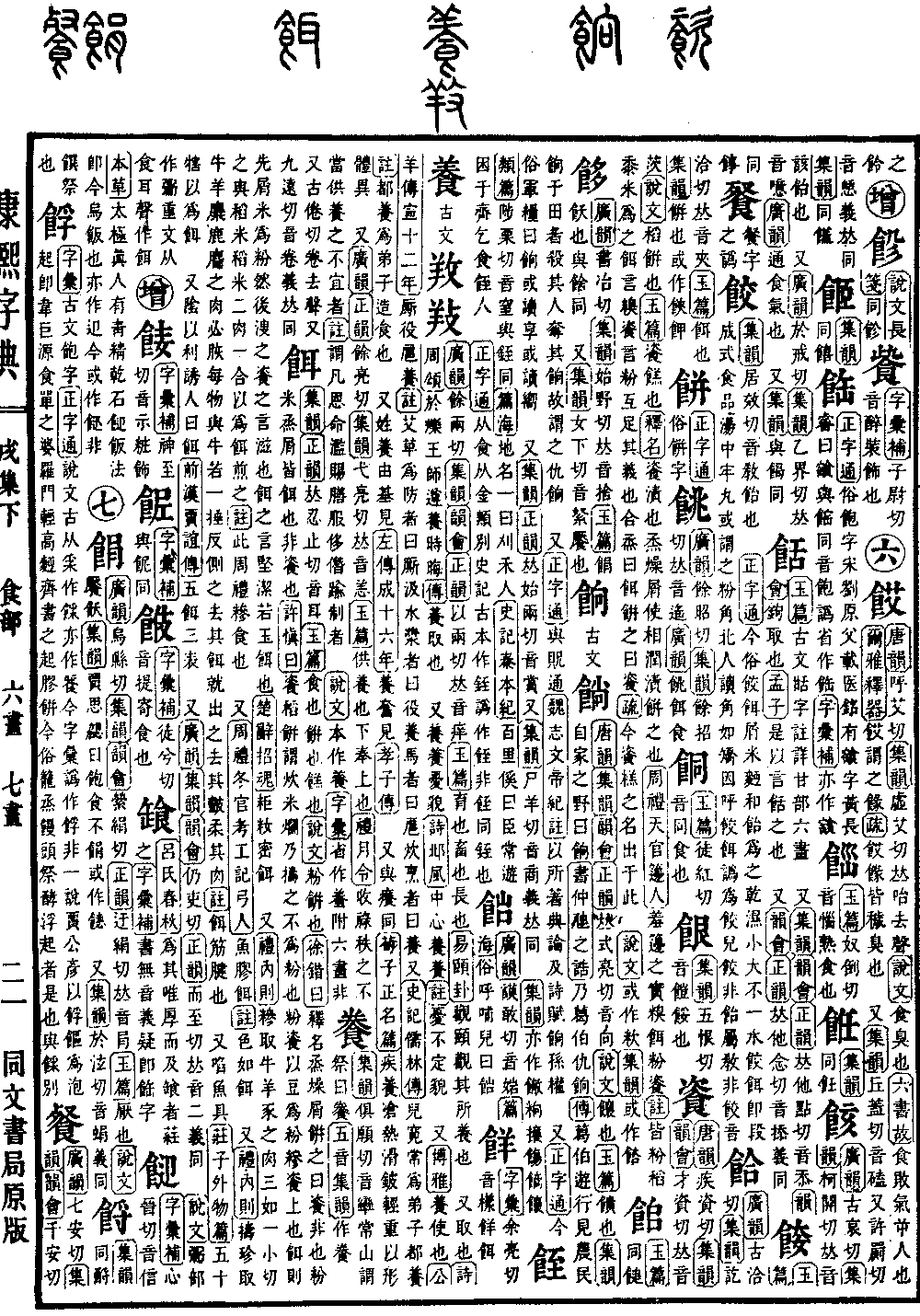
Ancient form. According to Guangyun (Broad Rhymes), pronounced yang (rising tone). According to Jiyun (Rhymes Collected), Yunhui (Collection of Rhymes), and Zhengyun (Correct Rhymes), pronounced yang (rising tone). According to Yupian (Jade Chapters), it means to nurture, to rear, or to grow. In the Book of Changes (Yijing), regarding the Yi hexagram: Observe the jaw, observe what it nurtures. It also means to take. In the Book of Odes (Shijing), Zhou Song section: How bright the royal army, following and cultivating these dark times. The commentary states: Yang means to take. It also means to be anxious, appearance of worry. In the Book of Odes (Shijing), Beifeng section: My heart is anxious. The commentary notes: Appearance of worry and instability. According to Boya, it means to employ. In the Gongyang Commentary (Gongyang Zhuan) on the twelfth year of Duke Xuan: Servants, water-bearers, horse-tenders, and cooks. The commentary notes: Those who clear weeds for protection are called servants; those who draw water and serve drinks are called water-bearers; those who tend horses are called horse-tenders; those who cook are called cooks. According to the Records of the Grand Historian (Shiji), Biography of Confucian Scholars: Er Kuan was often a disciple who served food. The commentary notes: Serving food means preparing meals for disciples. It is also a surname. Yang Youji appears in the Zuo Commentary (Zuozhuan) on the sixteenth year of Duke Cheng. Yang Fen appears in the Biographies of Filial Sons (Xiaozi Zhuan). It is also the same as the character for itchy. In the Xunzi, Zhengming chapter: Sickness, itch, cold and heat, smooth and rough, heavy and light, are differentiated by the physical body. According to Guangyun and Zhengyun, pronounced yang (falling tone). According to Jiyun, pronounced yang (falling tone). According to Yupian, it means to provide support, for those below to serve those above. In the Book of Rites (Liji), Monthly Ordinances: To collect emoluments that are not appropriate, and to provide support that is not proper. The commentary notes: This refers to all extravagant or illegal gifts of food or clothing that exceed regulations. According to the Shuowen Jiezi, the original form is this character. According to the Zihui (Compendium of Characters), this is a simplified form written with six strokes, which is incorrect.
Textual research: In the Book of Odes, Zhou Song section, the text originally read bright; it has been corrected to shining according to the original text.