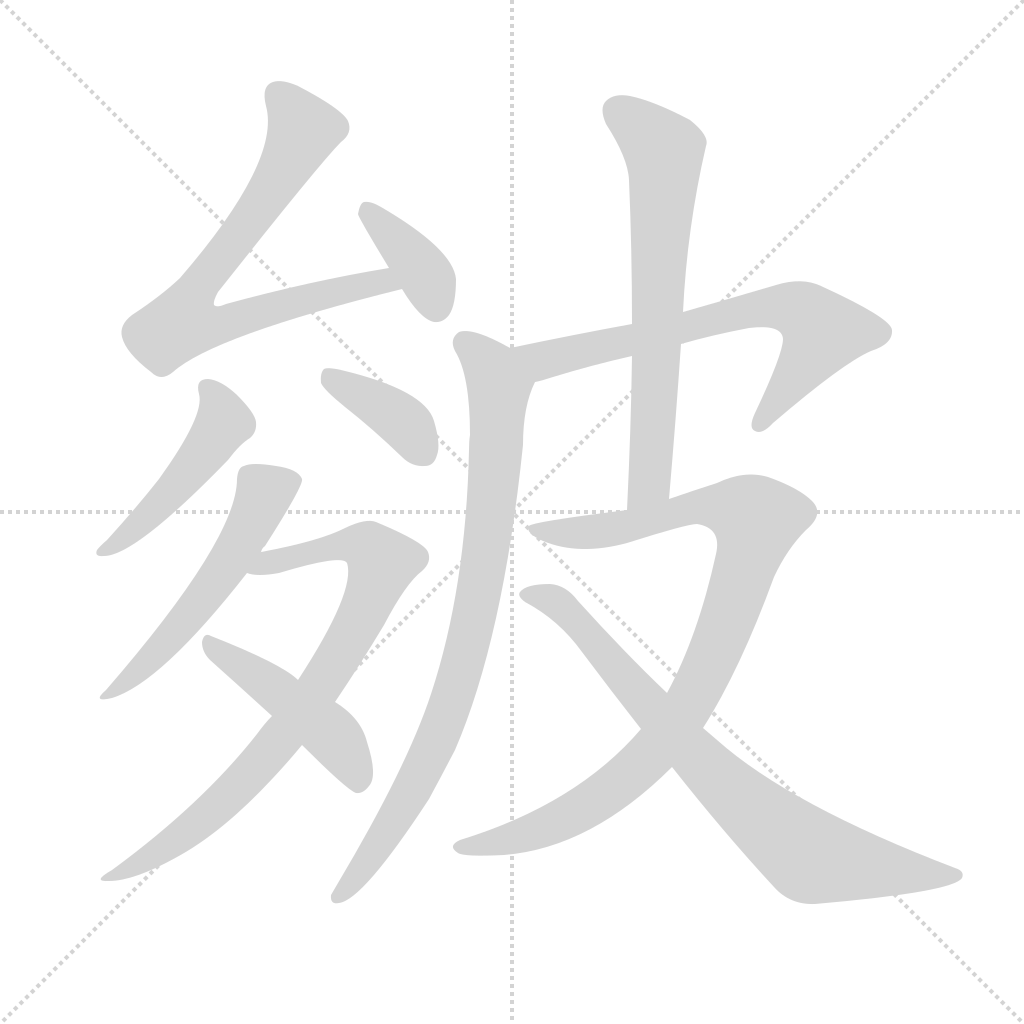
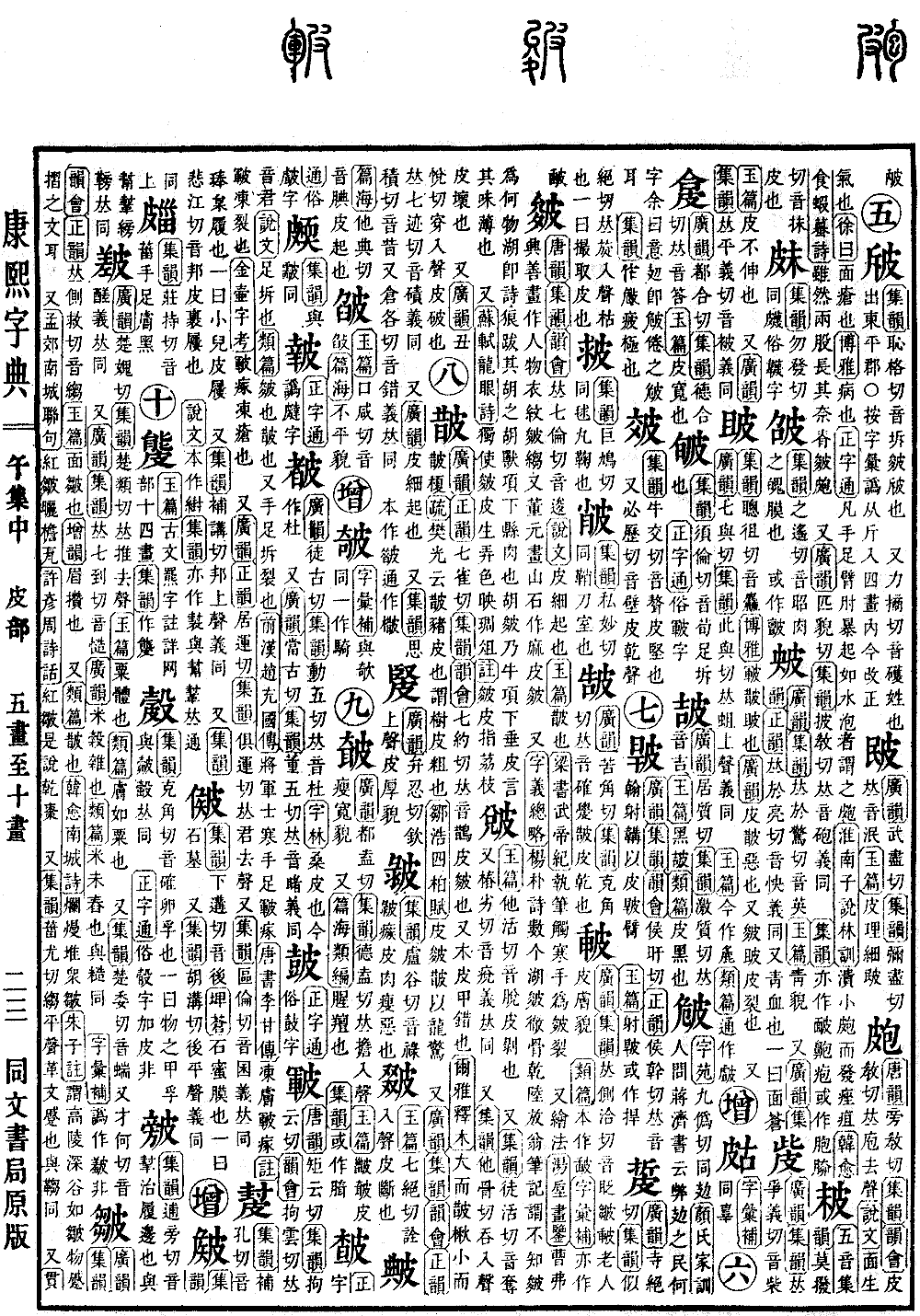
Wu Collection, Middle Volume
Radical: Skin (pí)
Cun
Kangxi Strokes: 12
Page 791, Entry 22
Tang Rhymes (Tangyun), Collected Rhymes (Jiyun), and Dictionary of Rhymes (Yunhui) all state the pronunciation is qun.
According to the Explaining Graphs and Analyzing Characters (Shuowen), it refers to fine wrinkles that appear on the skin due to cold or dryness.
Jade Chapters (Yupian) defines it as skin that is dry and cracked.
Book of Liang (Liangshu), Annals of Emperor Wu: When holding a brush in the cold, the skin on the hands becomes dry and cracked.
It also refers to a painting technique. In the Book of Appreciation (Shujian) by Tang Hou, it is noted that Cao Buxing excelled at painting and used a specific folding method when depicting the drapery of figures. Additionally, Dong Yuan used a hemp-fiber-like method to paint mountain rocks.
According to the General Summary of Word Meanings (Ziyizonglüe), in a poem by Yang Pu: A few folds on the dewlap, dry to the bone. Lu Fangweng notes that he did not know what cun meant. Here, the dewlap refers to the hu mentioned in the Book of Odes (Shijing) in the line wolves treading on their dewlaps, referring to the loose skin hanging under the neck of an animal. Therefore, dewlap folds refers to the hanging skin under a cow's neck, describing a flavor that is thin or bland.
In Su Shi's Poem on Longan Fruit: It alone causes wrinkled skin to form, displaying its color upon the carved offering platter. The commentary notes that wrinkled skin refers to the litchi fruit.