Wei Collection, Lower Volume
Radical: Meat (ròu)
Kangxi Strokes: 12
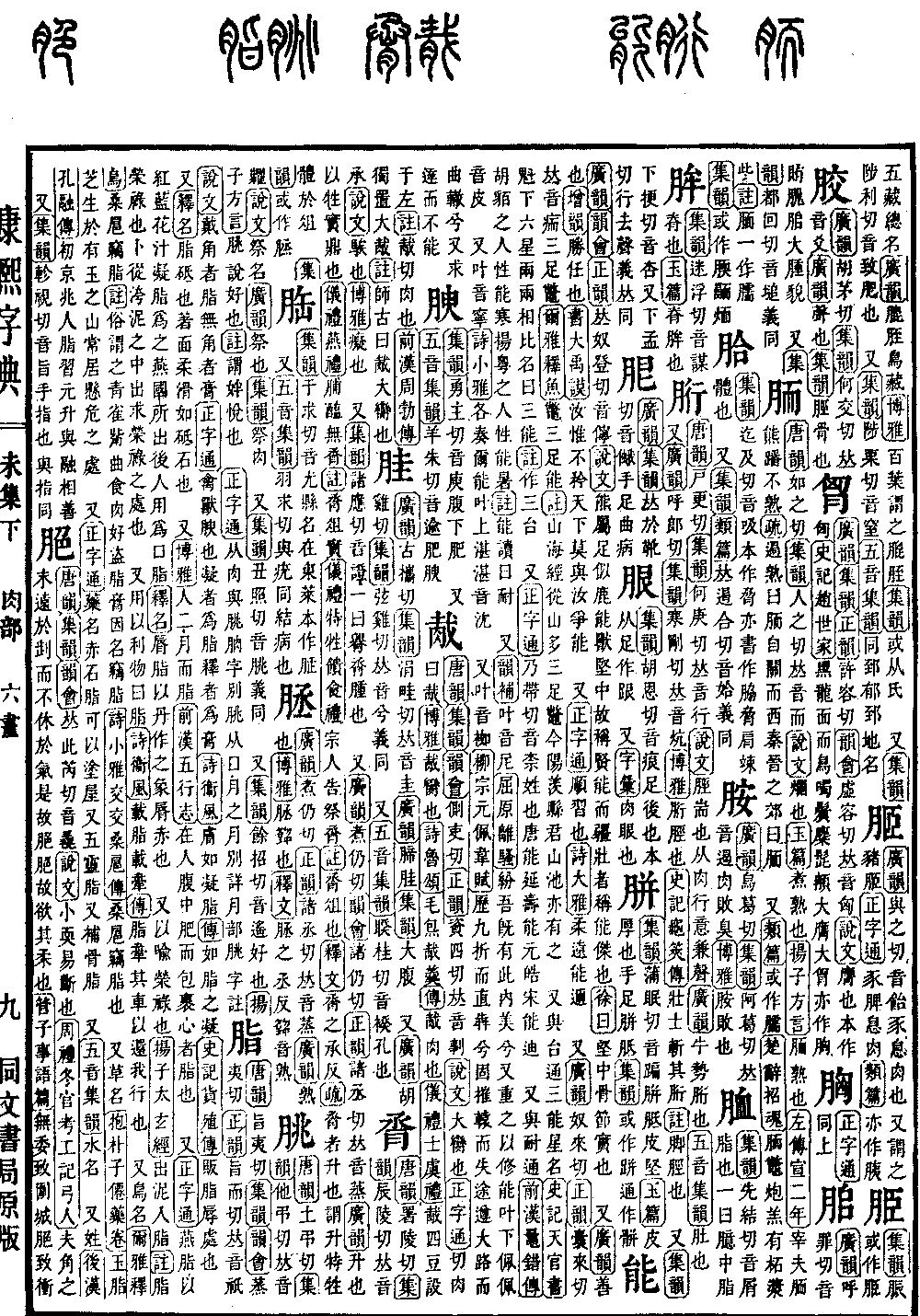
Page 981, Entry 16
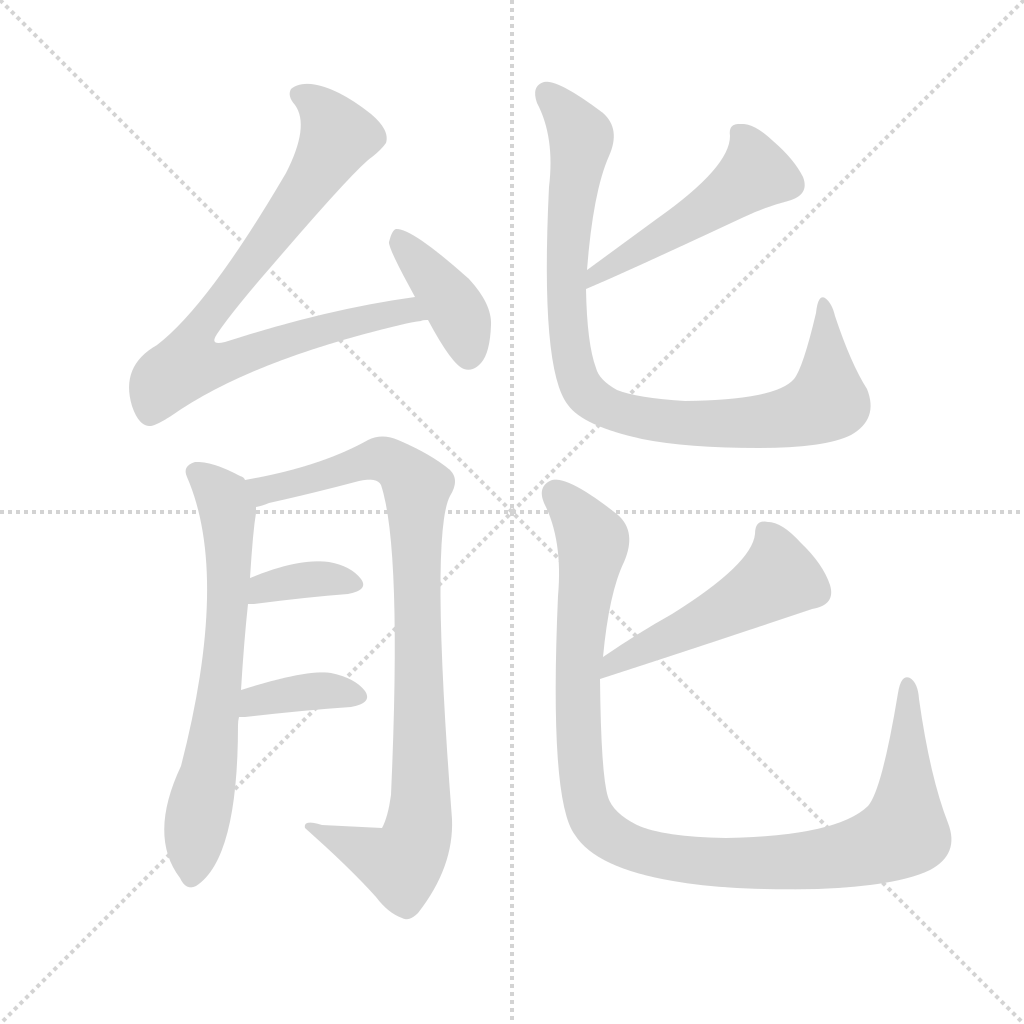
According to the Guangyun (Guangyun), Jiyun (Jiyun), and Zhengyun (Zhengyun), it is pronounced neng, with the same sound as ning. The Shuowen Jiezi (Shuowen Jiezi) explains it as an animal of the bear family, with feet resembling those of a deer. Because this animal has sturdy bones, it is called neng. Later, capable and strong people were referred to as nengjie. Xu says that firm in the middle refers to sturdy joints.
Also, according to the Guangyun, it indicates being skilled or good at something. The Zengyun (Zengyun) indicates being competent. From the Book of Documents (Shujing), Great Plan of Yu (Dayu Mo): If you do not boast, no one in the world can compete with you.
Also, according to the Zhengzitong (Zhengzitong), it indicates submission or closeness. From the Book of Odes (Shijing), Great Odes (Daya): To soothe those afar and be close to those nearby.
Also, according to the Guangyun, it is pronounced nai, and according to the Zhengyun, it is pronounced nang, with the same sound as [variant form]. It refers to a three-legged turtle. From the Erya (Erya), Interpretation of Fishes (Shiyu): A turtle with three feet is called a neng. Note: The Classic of Mountains and Seas (Shanhaijing) records that there are many three-legged turtles on Mount Cong; they also exist today in the ponds of Mount Jun in Yangxian County.
Also, it is interchangeable with tai. It refers to the Three Neng, a name for constellations. From the Records of the Grand Historian (Shiji), Treatise on the Celestial Offices (Tianguanshu): The six stars below the Kui constellation, arranged in pairs, are called the Three Neng. Note: Also written as Three Tai.
Also, according to the Zhengzitong, it is pronounced nai. It is a surname. In the Tang Dynasty, there were Neng Yanshou and Neng Yuanhao; in the Song Dynasty, there was Neng Di.
Also, it is interchangeable with nai (to endure). From the History of the Former Han (Qian Hanshu), Biography of Chao Cuo: People in the Hu and Mo regions are naturally able to endure the cold, and people in the Yang and Yue regions are naturally able to endure the heat. Note: Neng is pronounced the same as nai.
Also, according to the Yunbu (Yunbu), it is pronounced ni as a rhyme. From Qu Yuan, Li Sao (Lisao): Since I possess so many inner virtues, and in addition possess excellent talents. It rhymes with the following line pei, where pei is pronounced pi.
Also, it is pronounced ning as a rhyme. From the Book of Odes (Shijing), Lesser Odes (Xiaoya): Each of you displays your own talents. It rhymes with the preceding line zhan, where zhan is pronounced chen.
Also, it is pronounced ru as a rhyme. From Liu Zongyuan, Peiwei Fu (Peiwei Fu): Proceeding straight ahead despite many setbacks, one will certainly wreck the carriage and lose the way. Traveling along the main road but taking a detour, yet wishing to seek success and failing to do so.