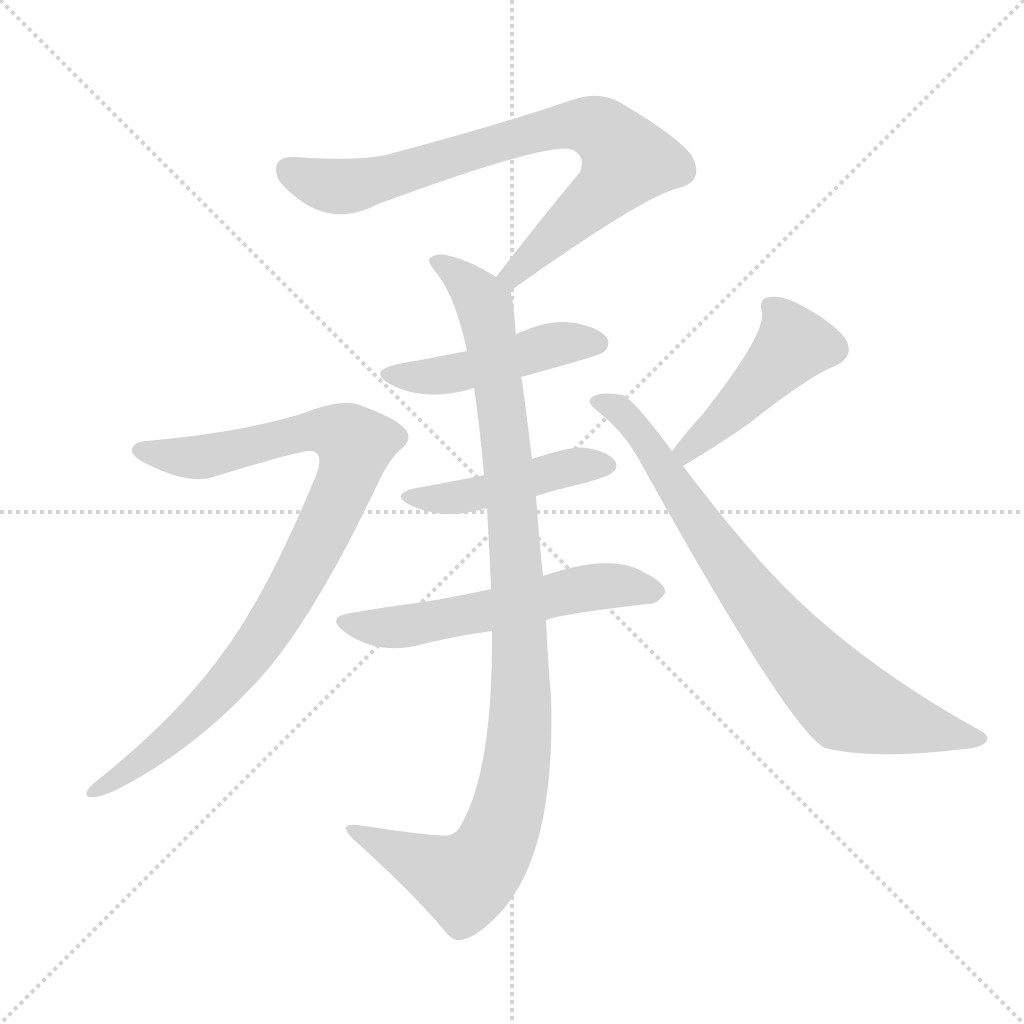
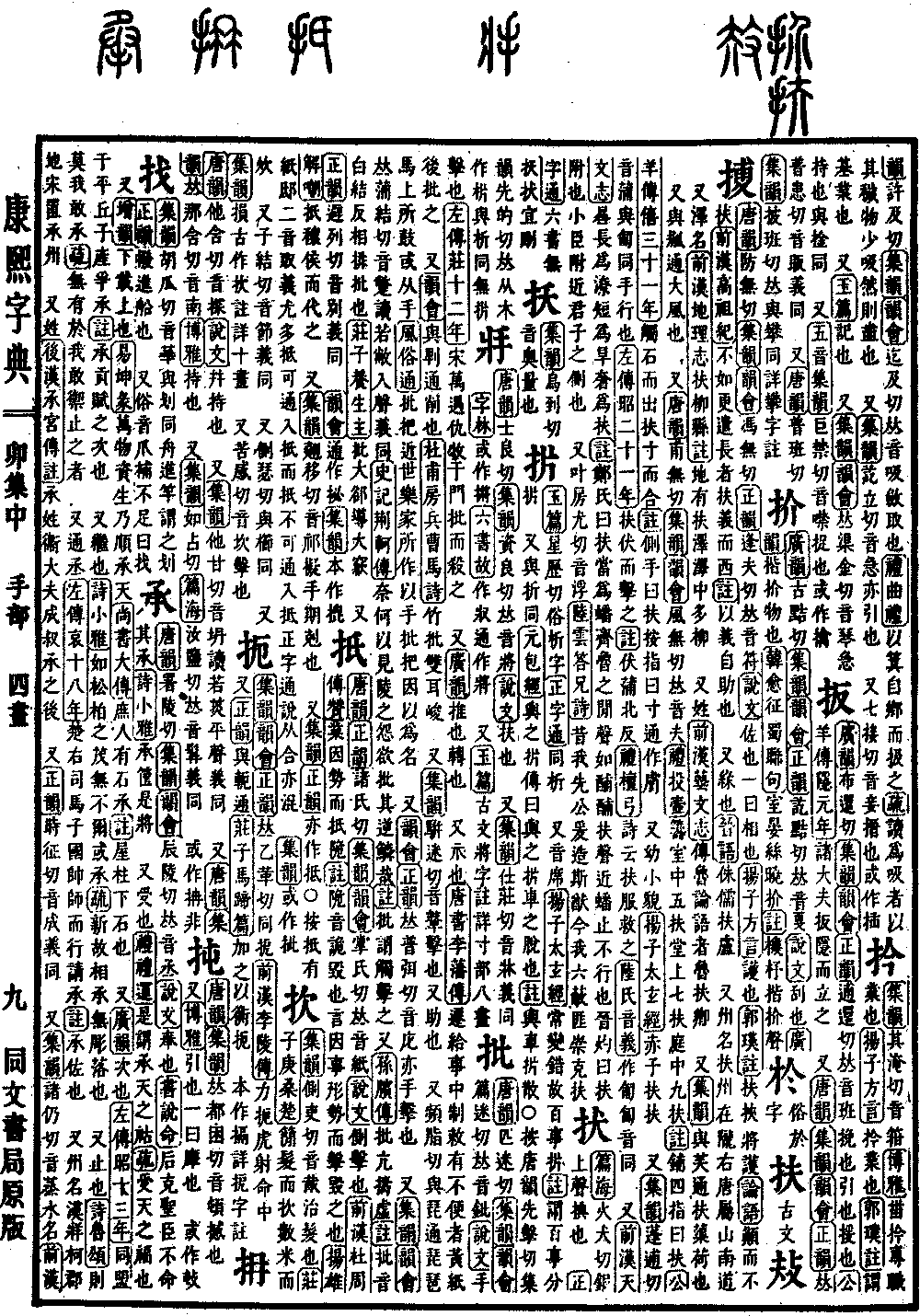
Mao Collection, Middle Volume. Radical: Hand (shǒu). Kangxi strokes: 8. Page 419, Entry 19.
Pronounced chéng.
According to the Shuowen Jiezi (Explaining Graphs and Analyzing Characters), it means to present or serve.
In the Book of Documents (Shangshu): If the sovereign can be sage, the minister will not need to be commanded to serve.
In the Book of Odes (Shijing): Presenting baskets and containers.
It also means to receive.
In the Book of Rites (Liji): This is called receiving the blessings of Heaven. The commentary notes it means to receive the good fortune of Heaven.
According to the Zengyun (Expanded Rhymes), it means to support from below.
In the I Ching (Book of Changes): All things derive their life from it, and they submit and receive the mandate of Heaven.
In the Shangshu Dazhuan (Great Commentary on the Book of Documents): The commoners have stone bases. The commentary notes these are the stones under the pillars of a house.
According to the Guangyun (Broad Rhymes), it means the order or sequence.
In the Zuo Zhuan (Chronicle of Zuo): The allies met at Pingqiu, and Zichan argued about the sequence. The commentary notes this refers to the order of tribute and taxes.
It also means to continue or follow.
In the Book of Odes (Shijing): Like the flourishing of pines and cypresses, there is nothing that does not continue. The commentary notes that new and old follow one another, without decay or falling.
It also means to stop or resist.
In the Book of Odes (Shijing): Then no one dares to resist me. The commentary notes that no one dared to oppose or stop me.
It is also used interchangeably with the character meaning to assist (chéng).
In the Zuo Zhuan (Chronicle of Zuo): The Chu official Ziguo led the army and requested assistance. The commentary notes that to assist means to aid.
It is also the name of a prefecture. It was land in the Han dynasty Zangke Commandery, and the Song dynasty established Cheng Prefecture.
It is also a surname. In the commentary to the Biography of Cheng Gong in the History of the Later Han (Hou Hanshu), it is noted that the Cheng surname is descended from Cheng Shu of the state of Wei.
According to the Zhengyun (Correct Rhymes), it is pronounced chéng, with the same meaning.
According to the Jiyun (Collected Rhymes), it is pronounced zhēng, and is the name of a river.
In the Book of Han (Hanshu) Geography Records: The Cheng-Yang County of the Changsha Kingdom. The commentary notes the Cheng River originates in the border of Yongchang County in Lingling and flows east into the Xiang River.
According to the Jiyun (Collected Rhymes) and the Yunhui (Collection of Rhymes), it is pronounced chéng.
In the Zuo Zhuan (Chronicle of Zuo): Marquis Zhao of Cai went to Wu, and the great officers feared he would move again, so they persuaded him. The commentary notes that this is likely a Chu dialect term.
According to the Jiyun (Collected Rhymes) and the Leipian (Classified Chapters), it is pronounced zhěng (rising tone), and is interchangeable with the term for rescuing (zhěng).
In the Liezi: Confucius observed the Lu Liang waterfall and saw a man swimming; he sent his disciples to rush into the water to rescue him. The commentary notes that pulling someone out of drowning is to rescue, here written as zhěng.
According to the Yunhui (Collection of Rhymes) and the Zhengyun (Correct Rhymes), it is pronounced zèng, meaning to give or send as a gift.
In the Book of Rites (Liji): Funeral gifts, presents, and offerings for the deceased all have set rules. The commentary notes that the character should be read as gift, as the original text contained a phonetic error.
According to the Jiyun (Collected Rhymes) and the Yunhui (Collection of Rhymes), it is pronounced zhèng, and is the name of a county.
In the Book of Han (Hanshu) Geography Records: Cheng County in the Donghai Commandery. The commentary notes this is the reading provided by Ying Shao.
Also rhymed as cháng, pronounced cháng. In the work by Ban Gu concerning the Sishui Pavilion of Emperor Gaozu: Noble merits and manifest blessings, eternal and without boundary. At this glorious old pavilion, the descendants continue this. The Jiyun (Collected Rhymes) notes it is sometimes written as another form or as another variant.