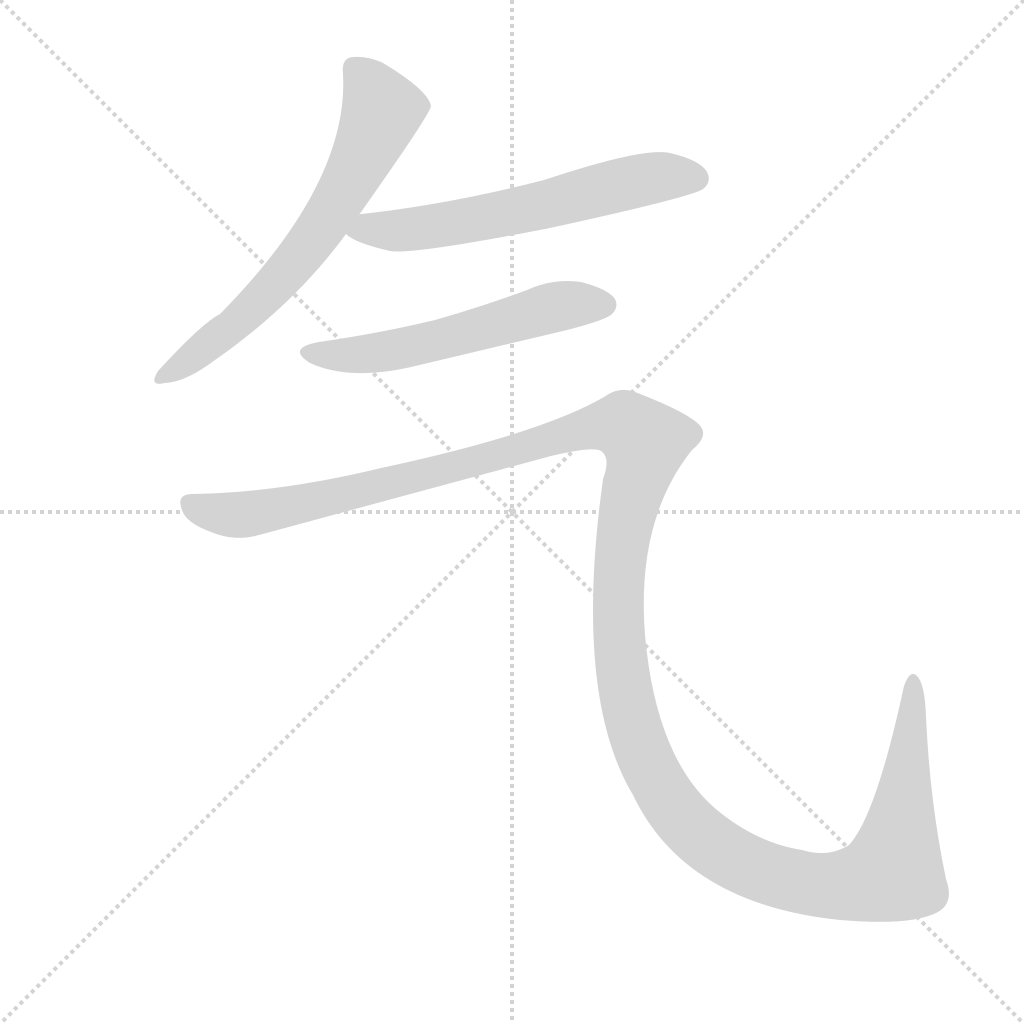
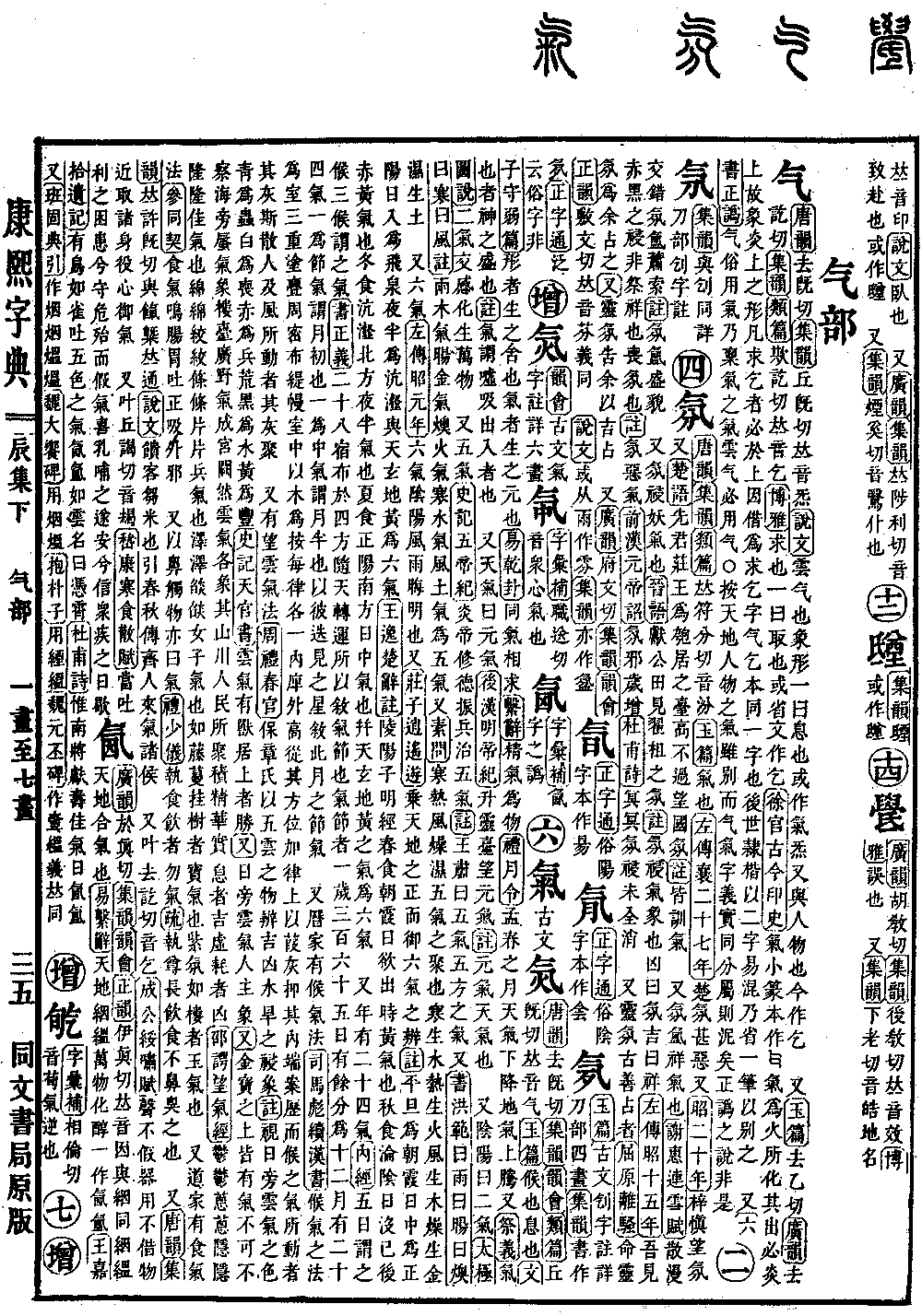
Chen Collection, Lower Volume, Radical: Breath (qì); Kangxi stroke count: 10; Page 599, Entry 03.
Pronounced qu (falling tone). According to Collected Rhymes (Jiyun), pronounced qiu (level tone). The pronunciation is identical to that of the character qi (炁).
Explained in Explaining Graphs and Analyzing Characters (Shuowen Jiezi) as cloud vapor. The character is a pictograph. Another theory suggests it refers to the breath of respiration. Sometimes written in the variant forms of qi (氣) or qi (炁). It also carries the meaning of giving wealth or items to others, for which the character qi (乞) is now used.
Pronounced qu (falling tone). According to Broad Rhymes (Guangyun), pronounced qu (falling tone). According to Collected Rhymes (Jiyun) and Categorized Characters (Leipian), pronounced qi (level tone). The pronunciation is identical to that of the character qi (乞).
Defined in Broad Elegant (Boya) as to request or seek. Another theory defines it as to take. It may also be written in a simplified form as qi (乞).
Xu Guan, in History of Ancient and Modern Seals (Gujin Yinshi), states: The character qi (气) was originally written in small seal script as such. The character qi (氣) is derived from the element of fire, appearing as flames rising upward, thus the shape represents fire ascending. Since those who beg must look upward, it was borrowed for the character qi (乞) meaning to beg. Originally, qi (气) and qi (乞) were the same character. In later clerical and regular scripts, they were distinguished by omitting a stroke due to the ease of confusing the two.
Six Writings and Corrected Errors (Liushu Zheng’e) states: The character qi (气) uses the common form qi (氣), which refers to the received vitality. Cloud vapor must use the character qi (气). Note: Although the qi of heaven, earth, people, and objects differ, the meanings of qi (气) and qi (氣) are actually the same; to insist on distinguishing them is to be overly pedantic, and the statement in Corrected Errors is incorrect.
The ancient form of the character qi (氣). Pronounced qu (falling tone). According to Collected Rhymes (Jiyun), Rhyme Compendium (Yunhui), and Categorized Characters (Leipian), pronounced qiu (level tone). The pronunciation is identical to that of the character qi (气).
Defined in Jade Compendium (Yupian) as breath or respiration.
Master Wen’s Teachings: Guarding Weakness (Wenzi: Shuruo Pian) states: The body is the lodging place of life. Qi is the root of life.
Book of Changes (Yijing): Qia Gua states: Breath of the same kind seek each other out.
Appended Interpretations (Xici) states: Refined qi coalesces to form things.
Book of Rites (Liji): Monthly Ordinances (Yueling) states: In the first month of spring, the qi of heaven descends and the qi of earth ascends.
Sacrificial Meaning (Jiyi) states: Qi is the manifestation of vigorous spirit.
Commentary states: Qi refers to the breath moving in and out through respiration.
Also, the qi of heaven is called primordial qi.
Book of the Later Han (Hou Hanshu): Chronicle of Emperor Ming states: Ascending the Lingtai tower to observe the primordial qi.
Commentary states: Primordial qi is the qi of heaven.
Also, yin and yang are called the two qi.
Discourse on the Supreme Ultimate (Taiji Tushuo) states: The two qi of yin and yang respond to and intermingle with each other, generating all things.
Also, there are the five qi.
Records of the Grand Historian (Shiji): Chronicle of the Five Emperors states: Emperor Yan cultivated virtue, organized armies, and managed the five qi.
Commentary: Wang Su states: The five qi are the qi of the five directions.
Book of Documents (Shangshu): Hung Fan Commentary on Rain, Sunshine, Heat, Cold, and Wind states: Rain is wood qi, sunshine is metal qi, heat is fire qi, cold is water qi, and wind is earth qi; these are the five qi.
Essential Questions (Suwen) states: Cold, heat, wind, dryness, and dampness are the aggregation of the five qi. Cold generates water, heat generates fire, wind generates wood, dryness generates metal, and dampness generates earth.
Also, there are the six qi.
Zuo Tradition (Zuozhuan): First Year of Duke Zhao states: The six qi are yin, yang, wind, rain, darkness, and brightness.
Zhuangzi: Free and Easy Wandering states: Complying with the correct way of heaven and earth, driving the changes of the six qi.
Commentary states: Early morning is morning glow, noon is direct yang, sunset is flying fountain, midnight is cold mist; adding the qi of heaven and earth makes the six qi.
Wang Yi, in Commentary on the Songs of Chu (Chu Ci), cites the Scripture of Lingyang Ziming: Eating morning glow in spring is the yellow qi of the sun about to rise. Eating the sinking darkness in autumn is the reddish-yellow qi after sunset. Eating cold mist in winter is the qi of the northern midnight. Eating direct yang in summer is the southern noon qi. Adding the qi of heaven and earth, these are the six qi.
Also, a year has twenty-four qi.
Inner Canon (Neijing) states: Five days are called one hou, and three hou are called one qi.
Corrected Meanings of the Book of Documents (Shangshu Zhengyi) states: The twenty-eight constellations, distributed in the four directions and rotating with the heavens, are used to arrange the order of the seasonal qi. The seasonal qi consist of 365 and a fraction days in a year, divided into twelve months and twenty-four qi. One is the solar term at the beginning of the month, and one is the middle qi in the middle of the month. Use the sequentially appearing constellations to arrange the seasonal qi of the month.
Also, calendar makers have the method of waiting for the qi.
Sima Biao, in Continuation of the History of the Han (Xu Hanshu), states: The method of waiting for the qi involves building a triple-walled room, sealing it tightly, hanging orange-colored curtains inside, and making wooden stands to hold each pitch pipe, with the interior lower than the exterior. Arrange the pipes according to their directions, place ash from reed membranes at the inner ends of the pipes, and observe them according to the calendar. When the qi affects them, the ash disperses; when affected by people or wind, the ash clusters together.
There is also the method of observing cloud vapor.
Rites of Zhou (Zhouli): Office of Spring states: The Officer of Baozhang distinguishes the omens of good and bad fortune and disasters of flood and drought based on the five types of cloud vapor phenomena.
Commentary states: Observe the color of the cloud vapor beside the sun; blue indicates insect disasters, white indicates funerals, red indicates war and famine, black indicates floods, and yellow indicates a bountiful harvest.
Records of the Grand Historian (Shiji): Treatise on the Celestial Offices states: Cloud vapor shaped like wild beasts signifies that the side on which they appear will be victorious.
Also: Cloud vapor beside the sun symbolizes the sovereign.
Also: Above gold and silver treasures there is always qi; one must observe carefully. Mirages by the sea look like towers, and qi in wide plains forms palaces. However, cloud vapors each symbolize the circumstances of the mountains, rivers, and people gathered there; those where the essence is full and vigorous are auspicious, and those that are empty and depleted are ominous.
Shao E, in Scripture of Observing Qi (Wangqi Jing), states: Lush and dense, hidden and lofty, is auspicious qi. Continuous and twisted, like strips or pieces, is the qi of warfare. Glossy and flame-like is the qi of women. Like vines hanging on trees is the qi of treasures. Purple cloud vapor shaped like pavilions is the qi of jade.
Also, Daoists have the method of eating qi.
Token for the Alignment of the Three (Cantongqi) states: Consume the breath to make the intestines rumble, exhaling the correct qi and inhaling external evil.
Also, smelling things with the nose is called qi.
Book of Rites (Liji): Minor Ceremonies (Shaoyi) states: When taking food and drink for superiors, do not smell it with your nose.
Commentary states: When taking food and drink for superiors, do not sniff it.
Also, pronounced xu (rising tone). Interchangable with the character xi (饩).
Explaining Graphs and Analyzing Characters (Shuowen Jiezi) defines this as forage and grain presented to guests. Cites the Spring and Autumn Annals: "The people of Qi came to present forage (qi) to the feudal lords."
Also, in rhyming verse, pronounced qu (falling tone).
Cheng Gongsui, in Rhapsody on Whistling (Xiao Fu), states: The sound does not rely on instruments, and the movement does not rely on external objects. Taking it directly from oneself, using the mind to drive the breath (qi).
Also, in rhyming verse, pronounced qiu (rising tone).
Ji Kang, in Rhapsody on Cold Food Powder (Hanshi San Fu), states: Oh, when suffering from the misery of vomiting and diarrhea, holding onto danger while barely sustaining one's breath (qi). Rejoicing in the safety of nourishment, trusting that all illnesses are gradually ceasing.