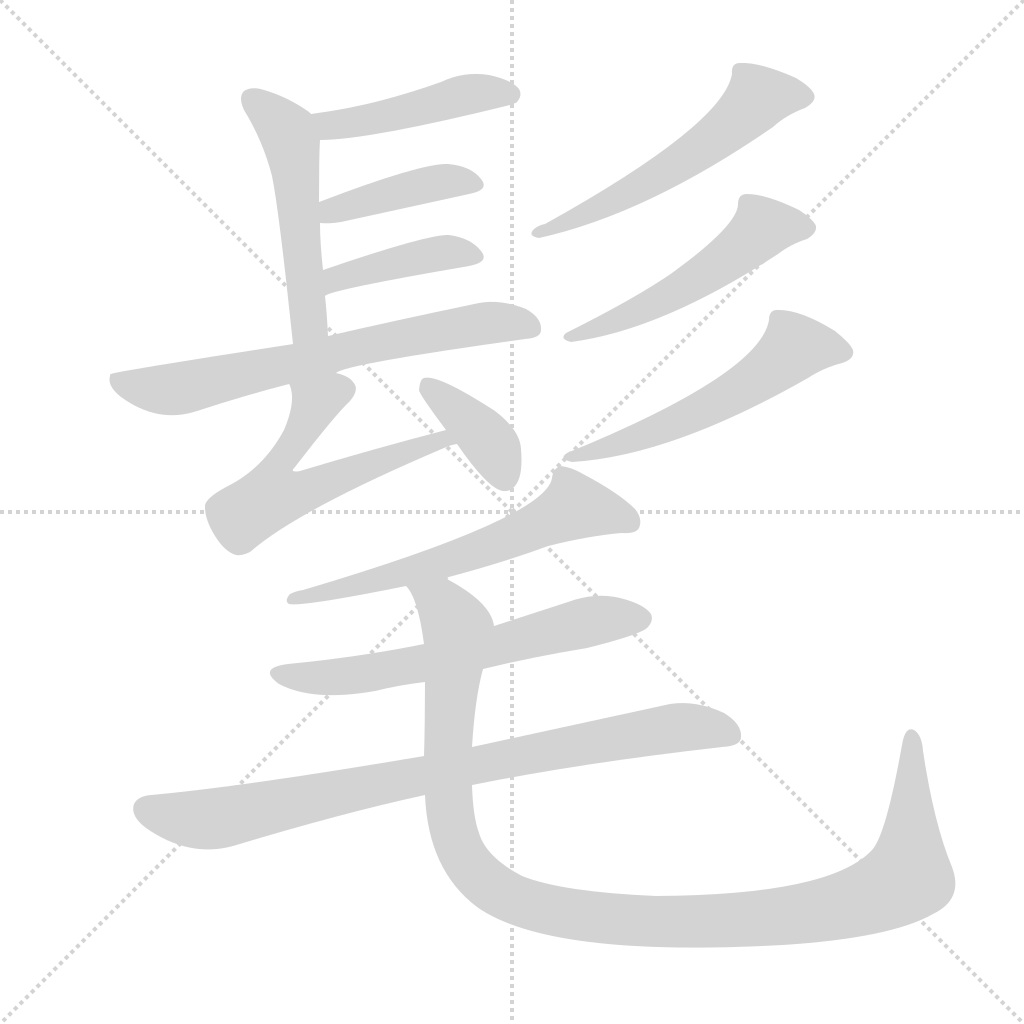
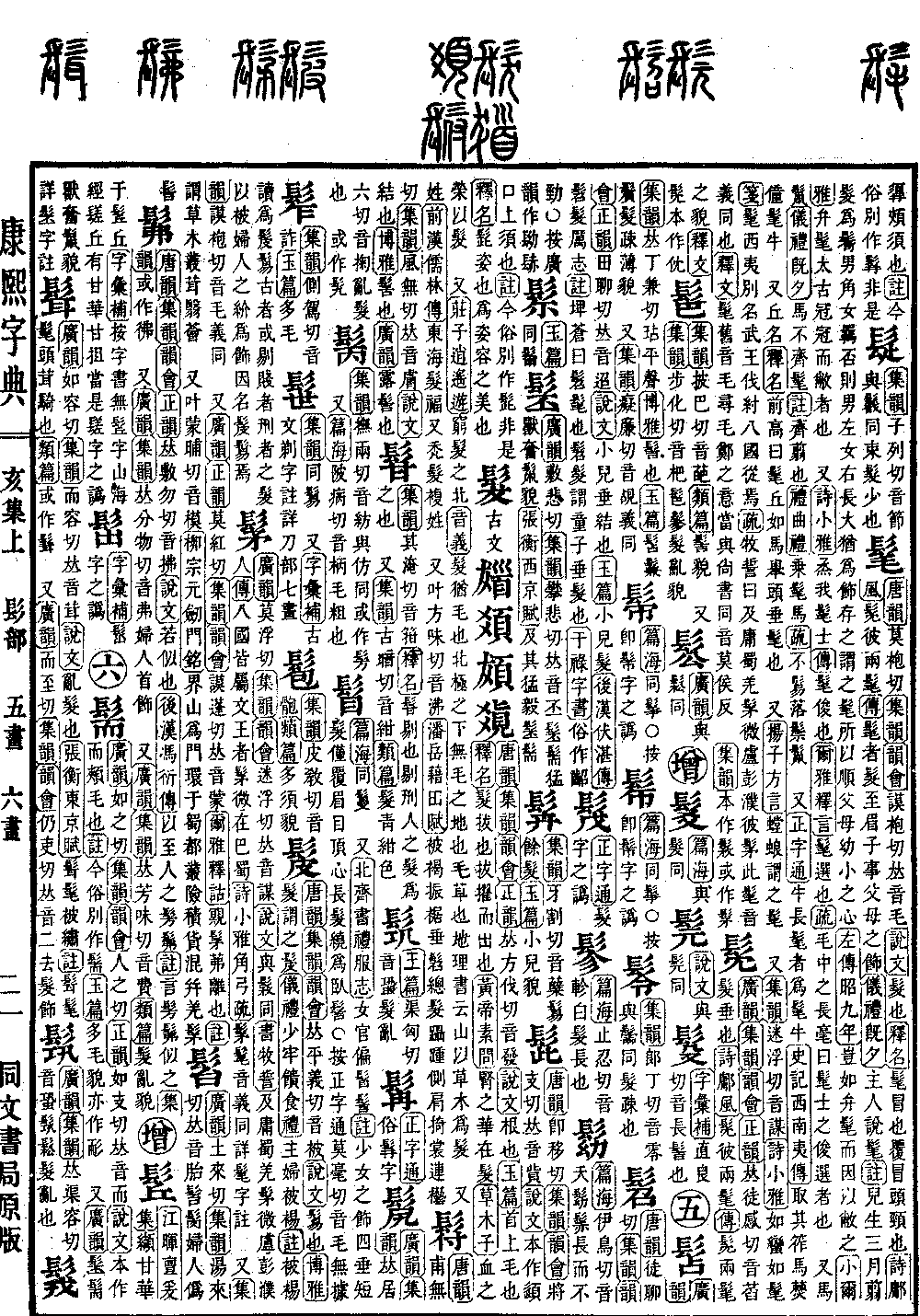
Hai Collection, Upper Volume
Radical: Hair (biāo)
Kangxi Strokes: 14
Page 1453, Entry 02
Pronounced mao.
Shuowen Jiezi (Explanation of Simple and Compound Characters): Hair.
Shiming (Explanation of Names): Mao means to cover. It covers the head and neck.
Book of Odes (Shijing), Odes of Yong: Dangling are those two tufts of hair.
Commentary: Mao refers to hair hanging down to the eyebrows, used as an adornment for children attending to their parents.
Book of Etiquette and Ceremonial (Yili), Rites After Death: The host loosens the hair.
Note: When a child is three months old, hair is cut and arranged into small tufts; boys kept them on the corners, girls in small knots, or otherwise boys on the left and girls on the right. When grown, these were kept as adornments, called mao. This was done to follow the loving feelings of parents toward young children.
Zuo Commentary (Zuo Zhuan), Ninth Year of Duke Zhao: How can it be like a ceremonial cap and hair tufts, which are discarded when worn out?
Xiao Erya (Small Literary Expositor): Bianmao (ceremonial cap and hair tufts) refers to ancient hats that were later discarded and no longer used.
Book of Odes (Shijing), Minor Odes: Nourishing my talented men.
Commentary: Mao means people of outstanding talent.
Erya (Literary Expositor): Mao refers to the elite who are selected.
Sub-commentary: The long hairs among the soft hair are called mao; it refers to the outstanding people among the scholars.
It also refers to the long hair on a horse's neck.
Book of Etiquette and Ceremonial (Yili), Rites After Death: The horse does not have trimmed hair.
Note: Qi means to cut evenly.
Book of Rites (Liji), Summary of the Rules of Propriety: Riding a horse with a full mane.
Sub-commentary: Failing to trim or neaten the fallen mane and hair.
Zhengzitong (Correct Character Guide): Cattle with long hair are called maoniu (yak).
Records of the Grand Historian (Shiji), Account of the Southwestern Barbarians: Obtaining their Zuo horses, servants, and yaks.
Also refers to a type of hill.
Shiming: High in the front is called maoqiu, resembling a horse lifting its head and drooping its mane.
Yangzi Fangyan (Regional Speech): A praying mantis is called mao.
Pronounced mou.
Book of Odes (Shijing), Minor Odes: Like the Man, like the Mao.
Commentary: Mao is another name for the Western Yi tribes. When King Wu attacked King Zhou of Shang, eight nations followed him.
Sub-commentary: The Mushi (Speech at Mu) states: And the Yong, Shu, Qiang, Mao, Wei, Lu, Peng, and Pu. The Mao there and the Mao here have the same sound and meaning.
Shiwen (Explanation of Sounds): Mao was traditionally pronounced mao. Investigating the intent of Mao Heng and Zheng Xuan, it should be the same as in the Book of Documents (Shangshu), pronounced mou.
Originally written as a variant form. Or written as mao.