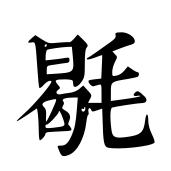
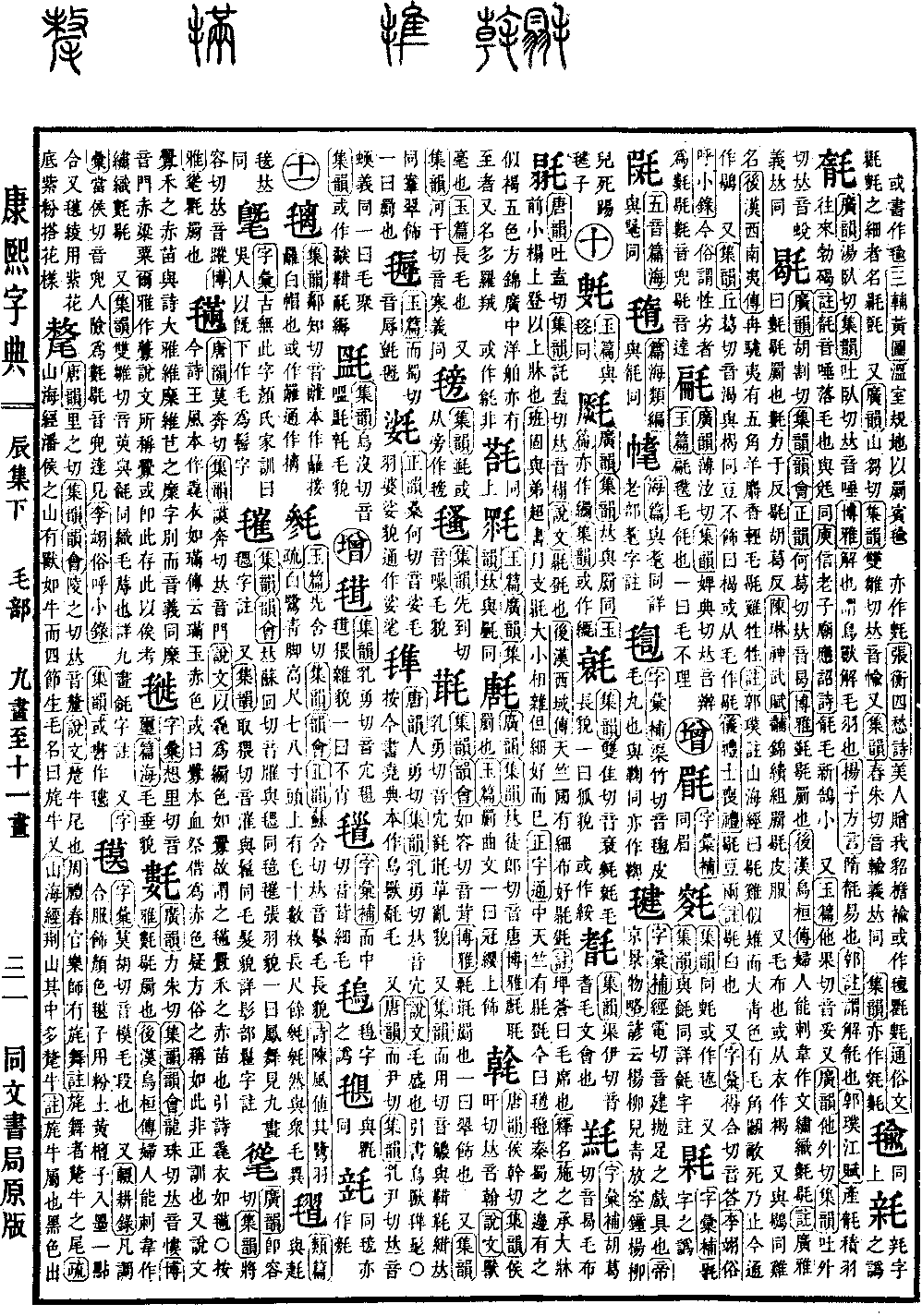
Chen Collection, Lower Volume
Radical: Hair (máo)
Kangxi stroke count: 13
Page 595, Entry 04
Pronounced he.
Extensive Dictionary (Guangyun): A type of woolen fabric.
According to the Book of Diverse Matters (Boya): The term refers to a woven woolen textile.
Book of the Later Han (Hou Hanshu), Biography of the Wuhuan: The women are skilled in stitching leather, creating embroidered patterns, and weaving woolen textiles.
Commentary: The Extensive Record of Matters (Guangya) states that the textile is a woolen fabric.
Chen Lin, Odes on the Divine Martial: Embroidered brocades and woven ribbons, woolen garments and leather attire.
Also refers to coarse woolen cloth. Sometimes written with the garment radical as a variant form.
Also identical to the character for a type of bird (he).
Book of the Later Han (Hou Hanshu), Biography of the Southwest Barbarians: The Ranmang tribes possess five-horned sheep, musk, fine-haired cloth, and the bird known as he.
Commentary: Guo Pu notes that the Classic of Mountains and Seas (Shanhaijing) states that the bird resembles a pheasant but is larger, blue in color, possesses feathered horns, and will fight until death. Now commonly written as the character for this bird.
Also pronounced ke. Identical to the character (jie). Refers to unadorned wooden serving vessels. Sometimes written with the hair radical.
Ceremonial Rites (Yili), Rites for the Burial of a Scholar: Two unadorned serving vessels.
Commentary: The term implies plain or white.
Also pronounced da.
Li Yi, Record of Common Colloquialisms: Today, the term is commonly used to describe someone with an inferior nature.