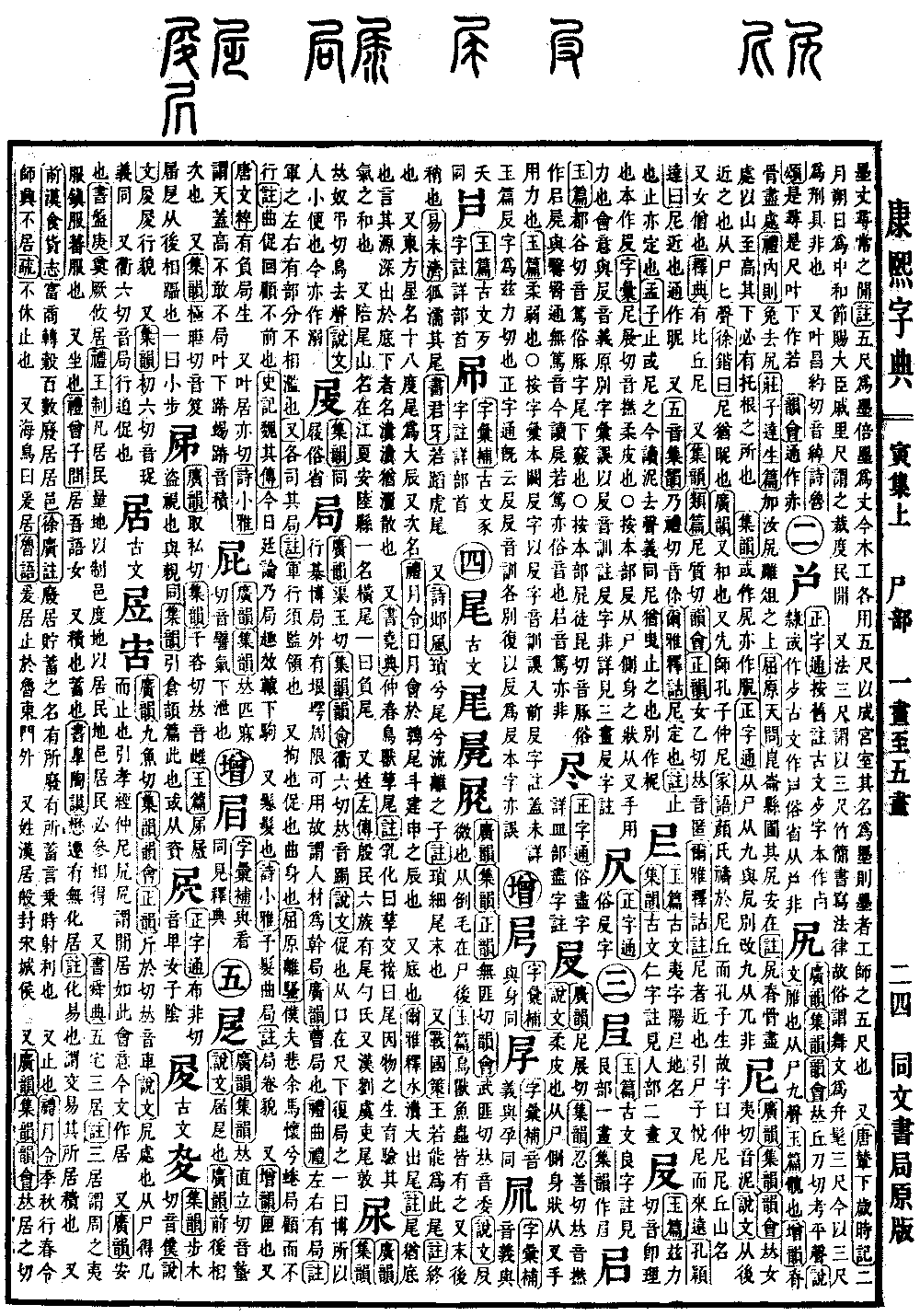
Yin Collection, Upper Volume
Radical: Corpse (shī)
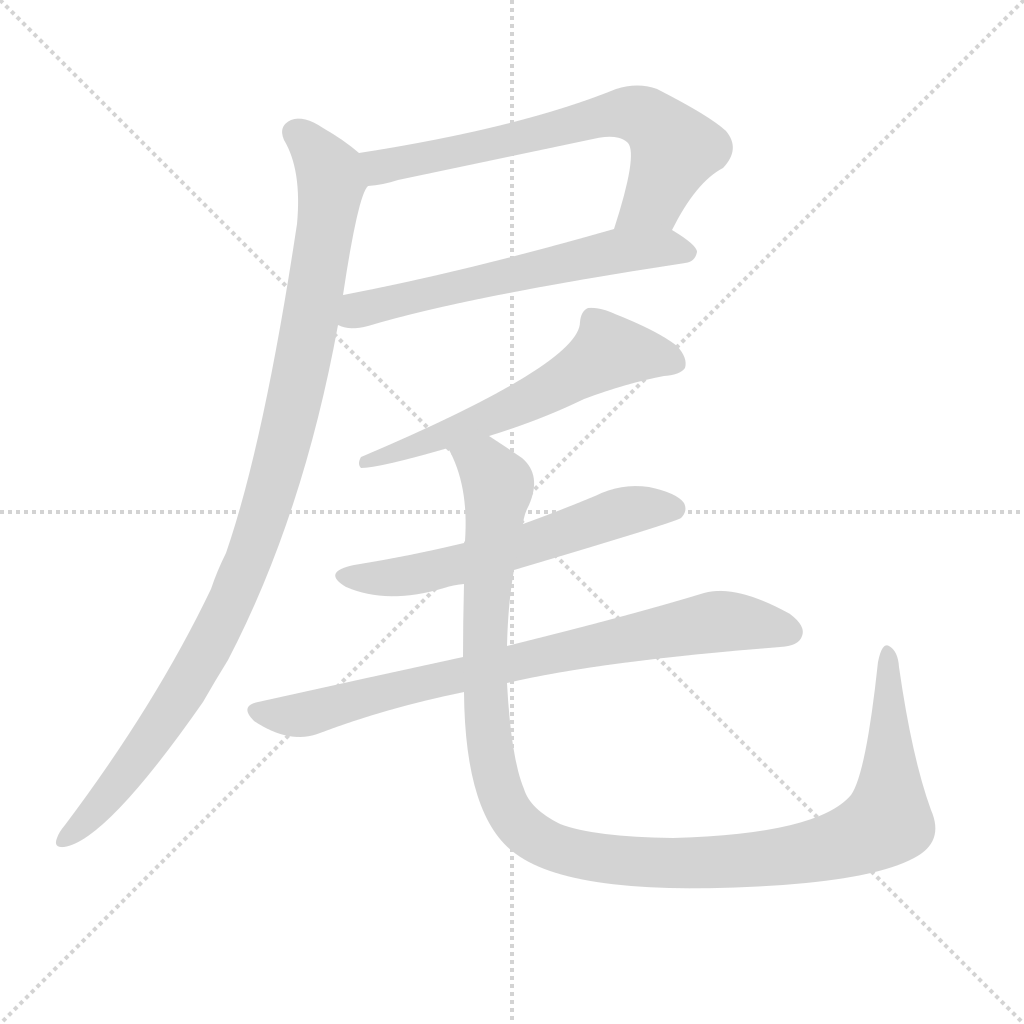
Wei
Kangxi Stroke Count: 7
Page 300, Entry 16
Ancient form.
According to the Broad Rhymes (Guangyun), Collection Rhymes (Jiyun), and Correct Rhymes (Zhengyun), pronounced wei (rising tone); according to the Rhyme Compendium (Yunhui), pronounced wei (rising tone).
According to the Explaining Graphs and Analyzing Characters (Shuowen): small or slight. Composed of inverted hair situated behind the corpse.
According to the Jade Chapters (Yupian): exists on all birds, beasts, fish, and insects. Also refers to the end or the tip.
Book of Changes (Yijing), section on Not Yet Completed: The fox wets its tail.
Book of Documents (Shujing), Jun Ya: As if treading on a tiger's tail.
Also, Book of Odes (Shijing), Odes of Bei: Small and ending, the child of the wandering ones.
Annotation: Small. Tail means end.
Also, Strategies of the Warring States (Zhanguo Ce): If the King acts thus in the end.
Annotation: End.
Also, the name of a star in the East; the eighteen degrees of the Tail constellation form the Great Celestial Body.
Also, a name of an order.
Book of Rites (Liji), Monthly Ordinances: The sun and moon meet at the Quail Tail, which is the celestial body aligned with the ladle in the Shen month.
Also, bottom.
Erya, Explanations of Water: A spring that emerges powerfully beneath the bottom.
Annotation: Tail is synonymous with bottom. This refers to a source that emerges from deep underneath, called a spring. A spring is like scattering water.
Also, Book of Documents (Shujing), Canon of Yao: In the middle of spring, birds and beasts mate.
Annotation: Giving birth and transforming is called zi; copulation is called wei. By the reproduction of creatures, one tests the harmony of the cosmic breath.
Also, Peiwei, a mountain name, located in Anlu County, Jiangxia. Also known as Hengwei. Another name is Fuwei.
Also, a surname.
Zuo Tradition (Zuo Zhuan): Among the six clans of the Shang people, there is the Weishao clan.
Also, Wei Dun, an official under Liu Yu of the Han dynasty.
Textual Research: In the Erya, Explanations of Water, it says a spring emerges powerfully from the tail. Per the original text, the character for bottom has been added after tail.