Shen Collection, Upper Volume
Radical: Grass (cǎo)
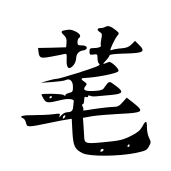
Mao
Kangxi Strokes: 10
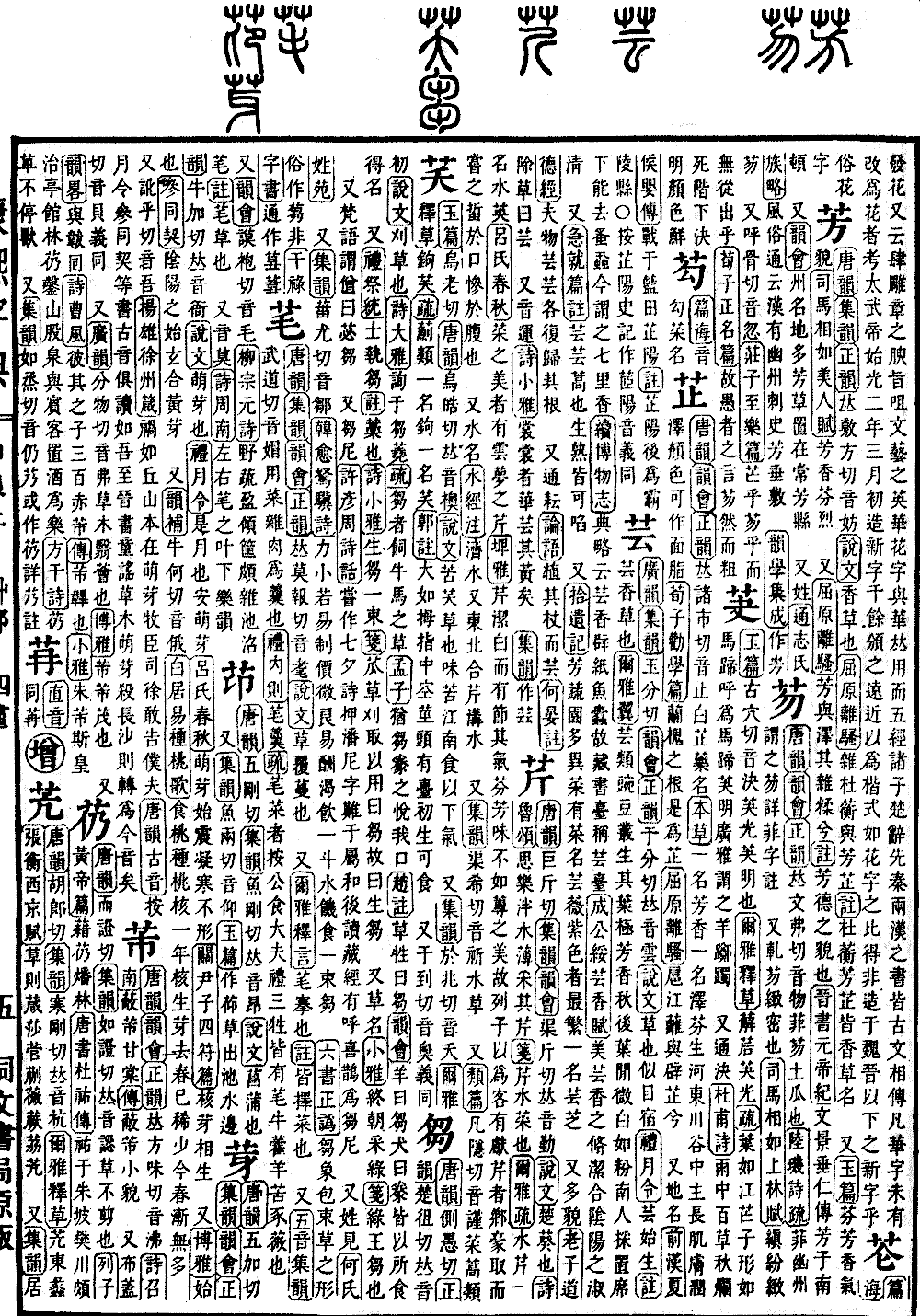
Page 1021, Entry 11
Tang Rhymes (Tangyun), Collected Rhymes (Jiyun), Dictionary of Rhymes (Yunhui), and Orthodox Rhymes (Zhengyun) state the pronunciation is mao (falling tone).
Shuowen Jiezi states it refers to grass spreading and covering the ground.
Also, in the Erya (Erya), the section Explaining Words (Shiyan) defines mao as pulling or plucking. The commentary notes that this refers to selecting vegetables.
Furthermore, the Five Tones Collected Rhymes (Wuyin Jiyun) states the pronunciation is mao (falling tone). It refers to mixing vegetables with meat to make a soup or stew.
Record of Rites (Liji), Inner Rules (Neize) section mentions mao soup. The commentary notes that mao refers to greens. According to the Etiquette for Officials Dining (Gongshi Daifu Li), three types of sacrificial animals are each paired with specific mao greens: the ox with soybean leaves, the sheep with bitter greens, and the pig with bracken ferns.
Also, the Dictionary of Rhymes (Yunhui) states the pronunciation is mao (rising tone). In a poem by Liu Zongyuan, it is described as wild vegetables filling a tilted basket, mixed with many grasses gathered from the marshy banks. The commentary notes that mao refers to grass.
Also pronounced mo. In the Book of Odes (Shijing), Zhou South (Zhounan) section, it is used in the phrase they pluck them on the left and the right. This rhymes with the character le in the following passage.