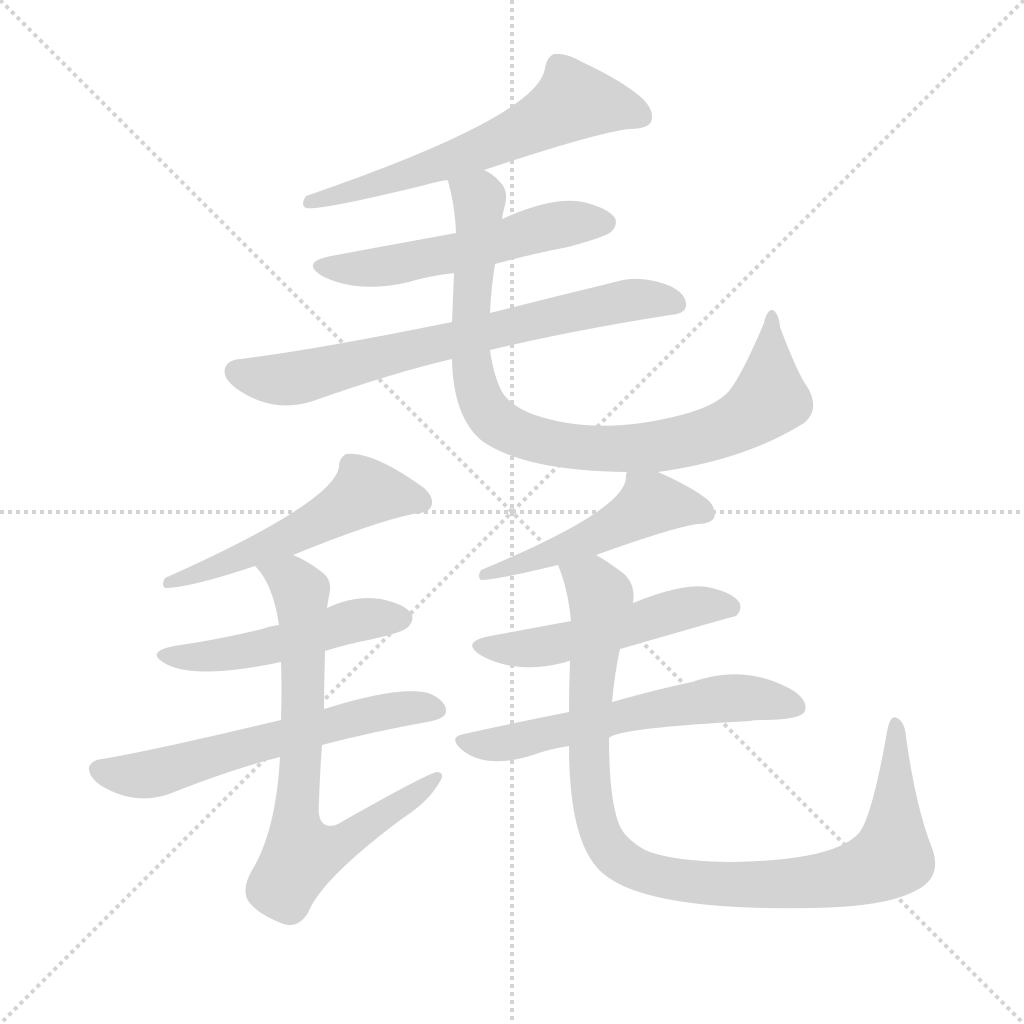
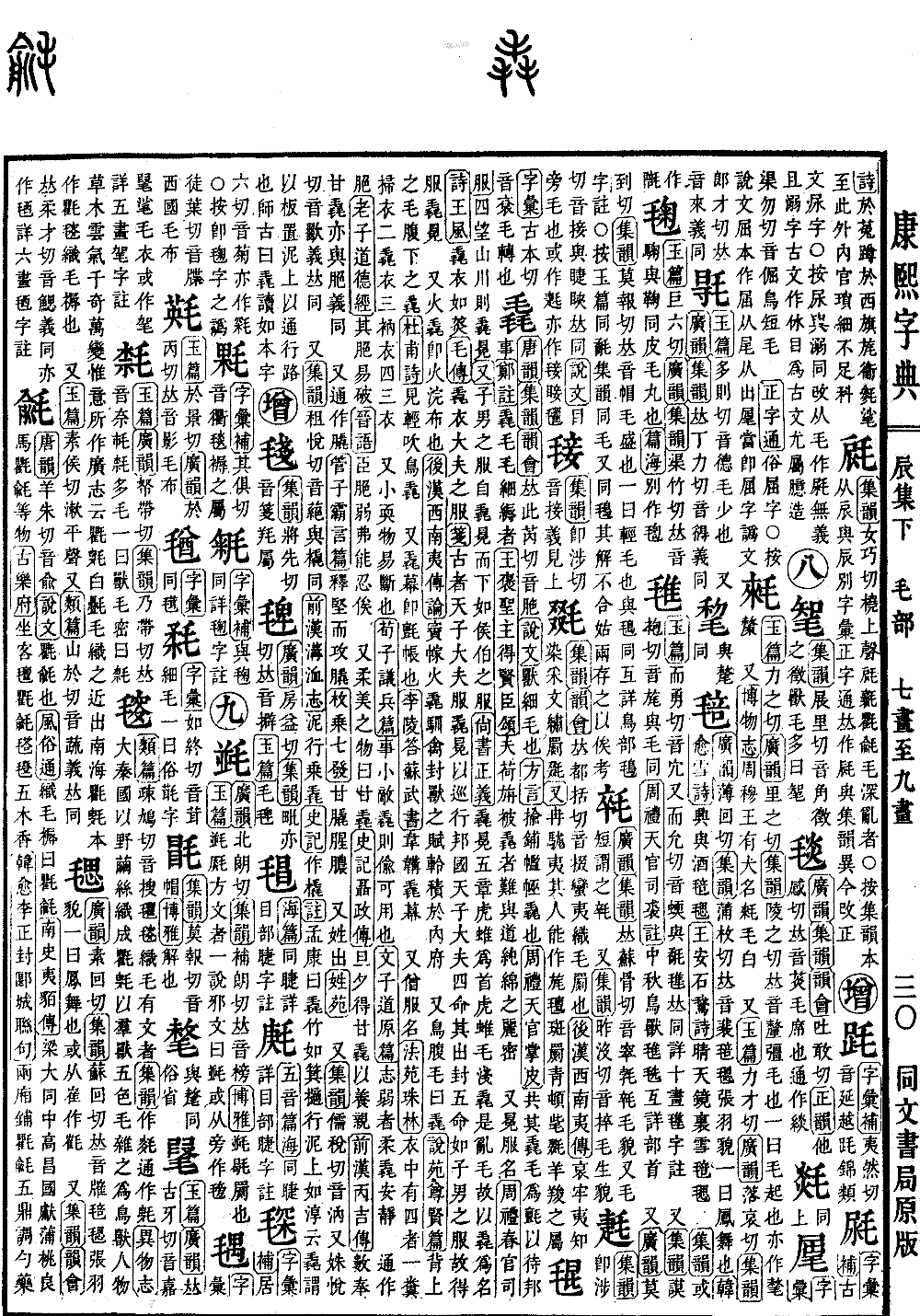
Chen Collection, Lower Volume, Radical: Hair (máo), Kangxi strokes: 12, Page 594, Entry 19
Pronounced cui.
Explaining Characters and Phrases (Shuowen): Fine hair of wild beasts.
Regional Dialects (Fangyan): Yupuo is defined as cui.
Book of Rites (Zhouli), Offices of Heaven (Tianguan), Director of Furs (Zhangpi): Supply those fine hairs to make felt, in preparation for state affairs.
Zheng commentary: Cui hair refers to hair that is fine, dense, and abundant.
Wang Bao, Ode to a Virtuous Minister by a Sage Ruler (Shengzhu De Xianchen Song): It is difficult to discuss the beauty and fine texture of pure silk and cotton with those who carry felt and wear garments of cui.
Also refers to a type of ceremonial crown.
Book of Rites (Zhouli), Spring Offices (Chunguan), Director of Attire (Sifu): Wear the cui crown when offering sacrifices to the mountains and rivers of the four directions.
Also: The ceremonial attire for viscounts and barons, from the cui crown downwards, is the same as that for marquises and counts.
Book of Documents (Shangshu), Correct Meaning (Zhengyi): The cui crown features five types of patterns, with the tiger and the long-tailed ape (you) as the primary designs. The fur of the tiger and the long-tailed ape is shallow; cui refers to mixed or miscellaneous hair, and thus it is named cui.
Book of Odes (Shijing), Odes of Wang (Wangfeng): The cui garment has the color of newly sprouted reeds.
Mao commentary: The cui garment is the ceremonial attire of a grandee.
Zheng commentary: In ancient times, the Emperor's grandees wore the cui crown when inspecting the feudal states. The Emperor's grandees held the fourth rank; when they left the capital to be enfeoffed, they held the fifth rank, thus they were permitted to wear the cui crown.
Also refers to huo cui, which is asbestos cloth.
Book of the Later Han (Houhanshu), Treatise on the Southwestern Barbarians (Xinan Yi Zhuan): Taxes consisting of cong cloth, ka cloth, huo cui, tamed birds, and gifted beasts were piled in the imperial storehouses.
Also, the hair on a bird's belly is called cui.
Garden of Stories (Shuoyuan), Respecting the Virtuous (Zunxian Pian): The hair on the back, the fine hair on the belly.
Du Fu poems: The fine hair on a bird's belly lifted by a light breeze.
Cui mu refers to felt tents.
Li Ling, Letter in Reply to Su Wu (Da Su Wu Shu): Leather arm guards and felt tents.
Also refers to a type of monastic garment.
Forest of Pearls in the Garden of the Law (Fayuan Zhulin): There are four types of garments: first, the rag garment (sewn from discarded cloth scraps); second, the cui garment (woven from the fine hair of birds and beasts); third, the patched garment (sewn together); and fourth, the three garments (the three prescribed monastic robes).
Also refers to something small and soft that is easily broken.
Xunzi, Discussing Military Affairs (Yibing Pian): To deal with a weak enemy, one can use perfunctory methods.
Wenzi, The Source of the Way (Daoyuan Pian): People of soft and weak will are yielding, timid, and fond of tranquility.
Commonly used as cui (fragile).
Laozi, Classic of the Way and Virtue (Daodejing): It is fragile and easily broken.
Discourses of the States (Guoyu), Discourses of Jin (Jinyu): The ministers are fragile and cannot endure the wait.
Also, food that is soft, beautiful, and delicious is called gan cui (delicious food).
Records of the Grand Historian (Shiji), Biography of Nie Zheng: Able to obtain delicious food morning and evening to support one's mother.
History of the Former Han (Qianhanshu), Biography of Bing Ji: Frequently offered delicious food.
Also has the same meaning as cui.
Also commonly written as cui.
Guanzi, Hegemonic Discourse (Bayan Pian): Avoid the solid to strike the fragile.
Mei Cheng, Seven Stimuli (Qi Fa): Sweet and crisp food with fishy, fatty, and thick soup.
Also a surname, from the Garden of Surnames (Xingyuan).
Also, pronounced rui.
Also, pronounced chuo.
Meaning is the same.
Also, pronounced zhui.
Same as qiao (sledge).
History of the Former Han (Qianhanshu), Treatise on Waterways (Gouxue Zhi): Walking and riding on cui (sledges) in muddy terrain.
Records of the Grand Historian (Shiji): Written as cui.
Commentary: Meng Kang says: Cui is like bamboo shaped like a winnowing basket, used for sliding over muddy ground. Ru Chun says: Cui refers to placing wooden boards on mud to travel. Shigushi says: Cui is read according to its original pronunciation.