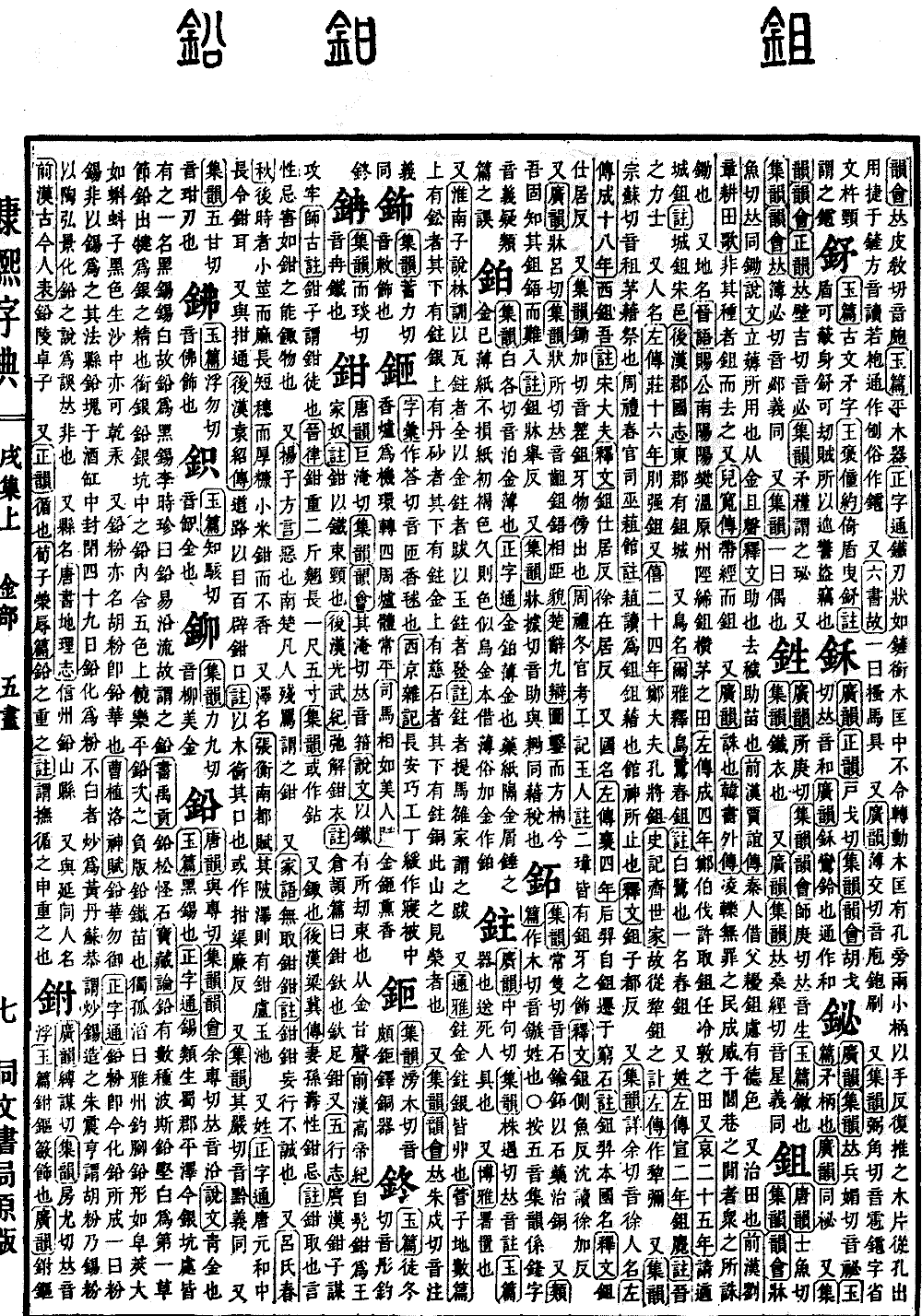
Xu Collection, Upper Volume
Radical: Metal (jīn)
Page 1301, Entry 14
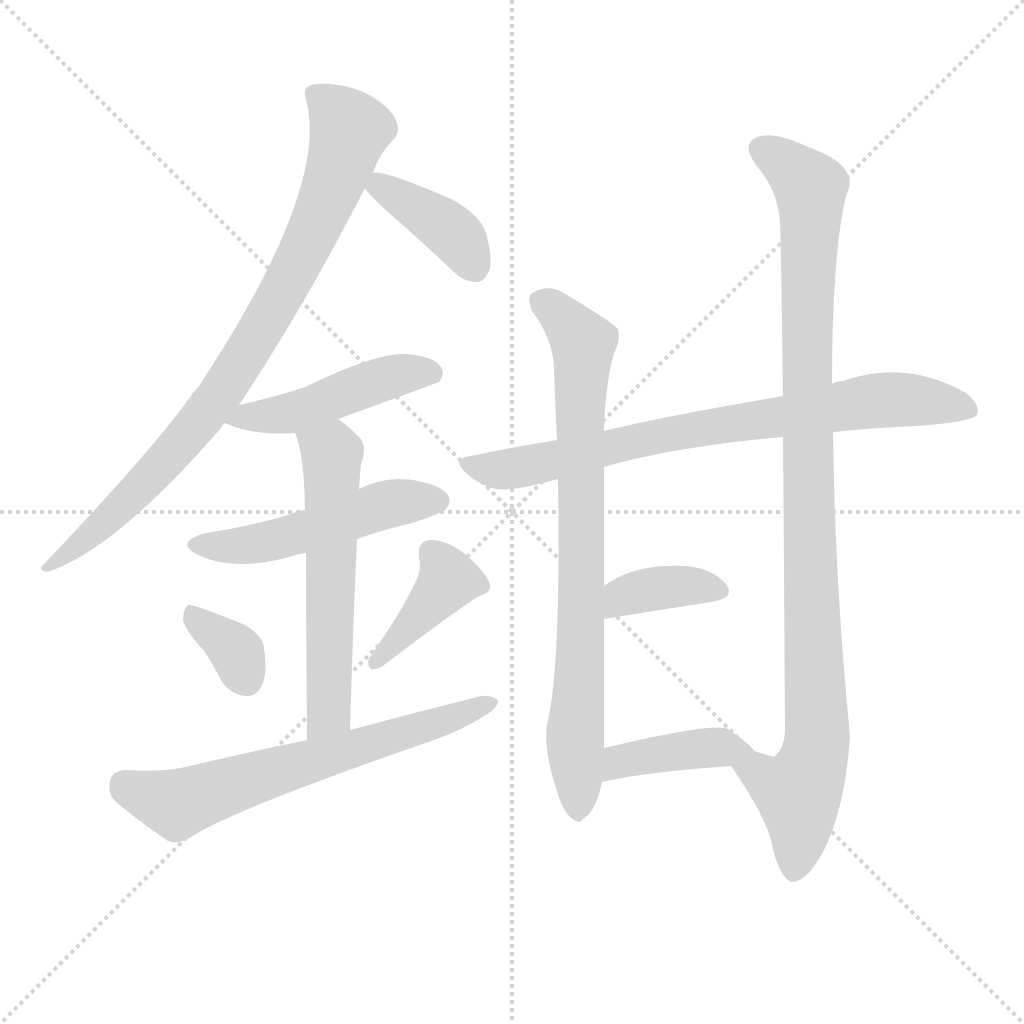
Pronounced qian.
In the Shuowen Jiezi (Shuowen), it means to use iron to force a binding. It is composed of the metal radical with a phonetic component representing sweetness.
In the Annals of Emperor Gaozu of the Former Han (Qian Han Shu), it is recorded: He shaved his own hair and wore iron shackles to become a slave of the royal family. The commentary states: Qian is a penal instrument made of iron used to bind the neck.
In the Annals of Guangwu of the Later Han (Hou Han Shu), it is recorded: Abolish the punishment of neck shackles and prisoner garments. The commentary states: The Cangsang Pian records that qian refers to foot shackles. Foot shackles are what bind the feet.
In the Treatise on the Five Elements (Wuxing Zhi), it is recorded: The shackled prisoners of Guanghan plotted to attack the prison. The commentary by Yan Shigu states: Qiantu refers to prisoners undergoing the punishment of shackling.
In the Jin Code (Jin Lu), it is recorded: The shackles weigh two catties, and the upturned portion is one foot five inches long.
According to the Jiyun (Jiyun), it is sometimes written as the variant form zhan.
It also refers to the act of gripping or nipping. In the Biography of Liang Ji of the Later Han (Hou Han Shu), it is recorded: His wife, Sun Shou, had a jealous and vicious temperament. The commentary states: Qian means to grip or nip. It implies that her temperament for resenting and harming others was like a tool that nips or grips things.
In the Dialects (Fangyan) by Yang Xiong, it refers to something being malicious. In the Southern Chu region, all vicious cursing of others is called qian.
In the School Sayings of Confucius (Kongzi Jiayu), it is recorded: Do not choose those who are empty and unreal. The commentary states: Qianqian refers to conduct that is hollow and insincere.
In the Spring and Autumn of Mr. Lu (Lüshi Chunqiu), it refers to crops that miss the farming season, resulting in thin stalks and long hemp fibers, short ears with thick husks, and small, astringent, unfragrant grains.
It is also the name of a lake or marsh. In the Rhapsody on the Southern Capital (Nan Du Fu) by Zhang Heng, it is written: As for the ponds and lakes there, they have the Qianlu and Yuchi.
It is also a surname. According to the Zhengzitong (Zhengzitong), during the Yuanhe era of the Tang Dynasty, there was a magistrate of Chang'an County named Qian'er.
It is interchangeable with the character qian (meaning to plug the mouth). In the Biography of Yuan Shao of the Later Han (Hou Han Shu), it is recorded: People meeting on the road only dared to exchange glances, and all officials kept their mouths shut. The commentary states: It refers to using a wooden stick to plug their mouths. It is sometimes written as qian. Pronounced qu lian.
According to the Jiyun, it is also pronounced qian, with the same meaning.
According to the Jiyun, it is also pronounced e, referring to the edge of a blade.
Textual Research: Regarding the meaning of extracting or pulling out. In the Biography of Liang Ji of the Later Han, the commentary states: Qian means to grip; it says her jealousy was like a tool that pulls out objects. I have carefully examined the commentary to the Han History (Han Shu) and noted that the character appearing there was originally written as zhe, pronounced zhe or nie, which refers to pulling out hair. The character there was also used for an awl-like instrument, which differs from the meaning of gripping things. Therefore, I have corrected the original text from zhe to zhe, and from zhe wu to zhe wu.