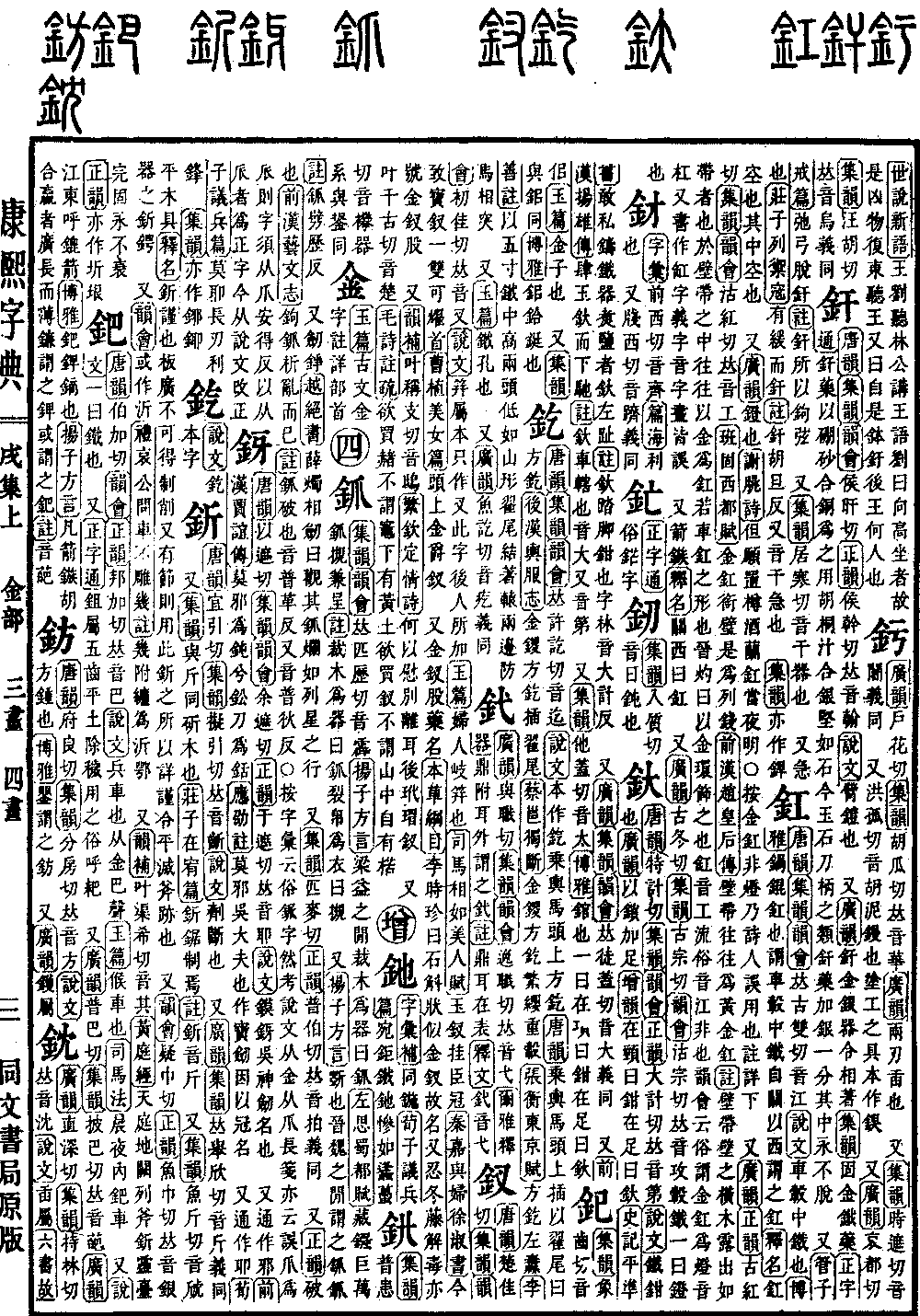
Xu Collection, Upper Volume
Radical: Metal (jīn)
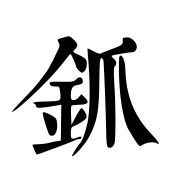
Character: Bi
Kangxi stroke count: 12
Page 1297, Entry 15
Collected Rhymes (Jiyun) and Rhyme Collection (Yunhui): Pronounced pi.
Master Yang's Regional Expressions (Fangyan): In the regions of Liang and Yi, cutting wood to make implements is called bi.
Zuo Si, Rhapsody on the Capital of Shu (Shudu Fu): Storing vast wealth, bi and gui are both displayed. Commentary: Cutting wood to make implements is called bi; cutting silk to make garments is called gui.
Also from Master Yang's Regional Expressions (Fangyan): To hew. In the regions of Jin and Zhao, this is called bi-bi. Commentary: Bi is pronounced pi.
Also, the sharpening of a sword. Lost Records of Yue (Yuejue Shu): Xue Zhu examined the sword and said, observe its bi, shining like the alignment of scattered stars.
Also from Collected Rhymes (Jiyun): Pronounced pai; Correct Rhymes (Zhengyun): Pronounced pai. The meaning is the same.
Also from Correct Rhymes (Zhengyun): To break. History of the Former Han (Qianhan Shu), Treatise on Arts and Letters: To hook, break, analyze, and settle disorder. Commentary: Bi means to break. Pronounced po. Also pronounced pi.
Note: The Dictionary of Characters (Zihui) states this is a vulgar character. However, examining the Explaining Graphs and Analyzing Characters (Shuowen Jiezi), it follows the radical for metal and the component for claw. The Long Annotated Record (Changjian) also states that there is an error in using the component for heart instead of claw, so the character should use the claw component; how can one assume the version using the heart component is the correct character? It is now corrected according to the Explaining Graphs and Analyzing Characters (Shuowen Jiezi).
Textual Research: Master Yang's Regional Expressions (Fangyan): To hew. In the regions of Jin and Wei, this is called bi-bi. According to the original text, Jin and Wei have been corrected to Jin and Zhao.