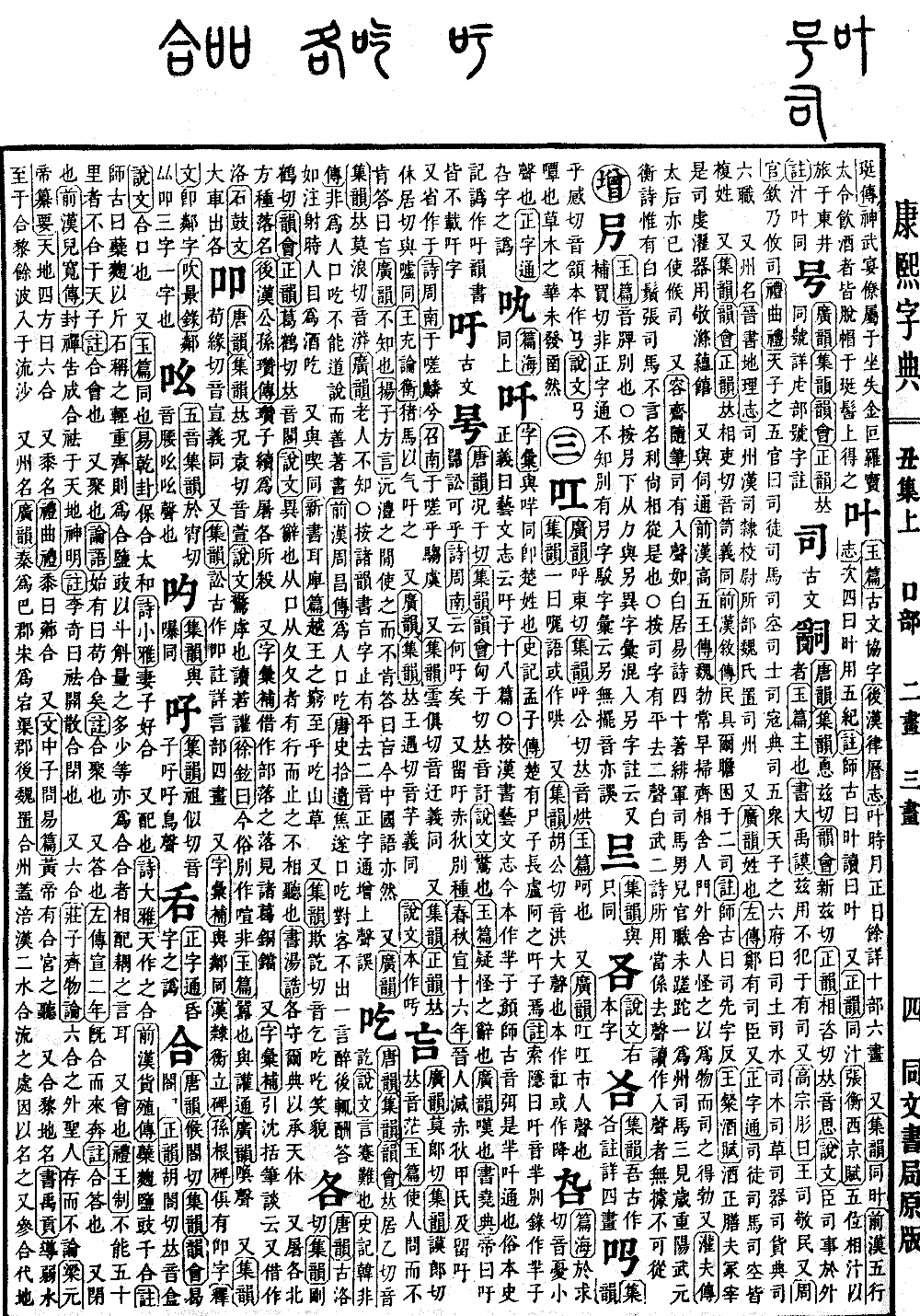
Chou Collection, Upper Volume
Radical: Mouth (kǒu)
Kangxi stroke count: 13
Page 174, Entry 02
The Broad Rhymes (Guangyun), Compendium of Rhymes (Jiyun), Rhyme Meetings (Yunhui), and Correct Rhymes (Zhengyun) all treat this as identical to the character hao. See the note for the character hao under the Tiger (hu) radical for details.
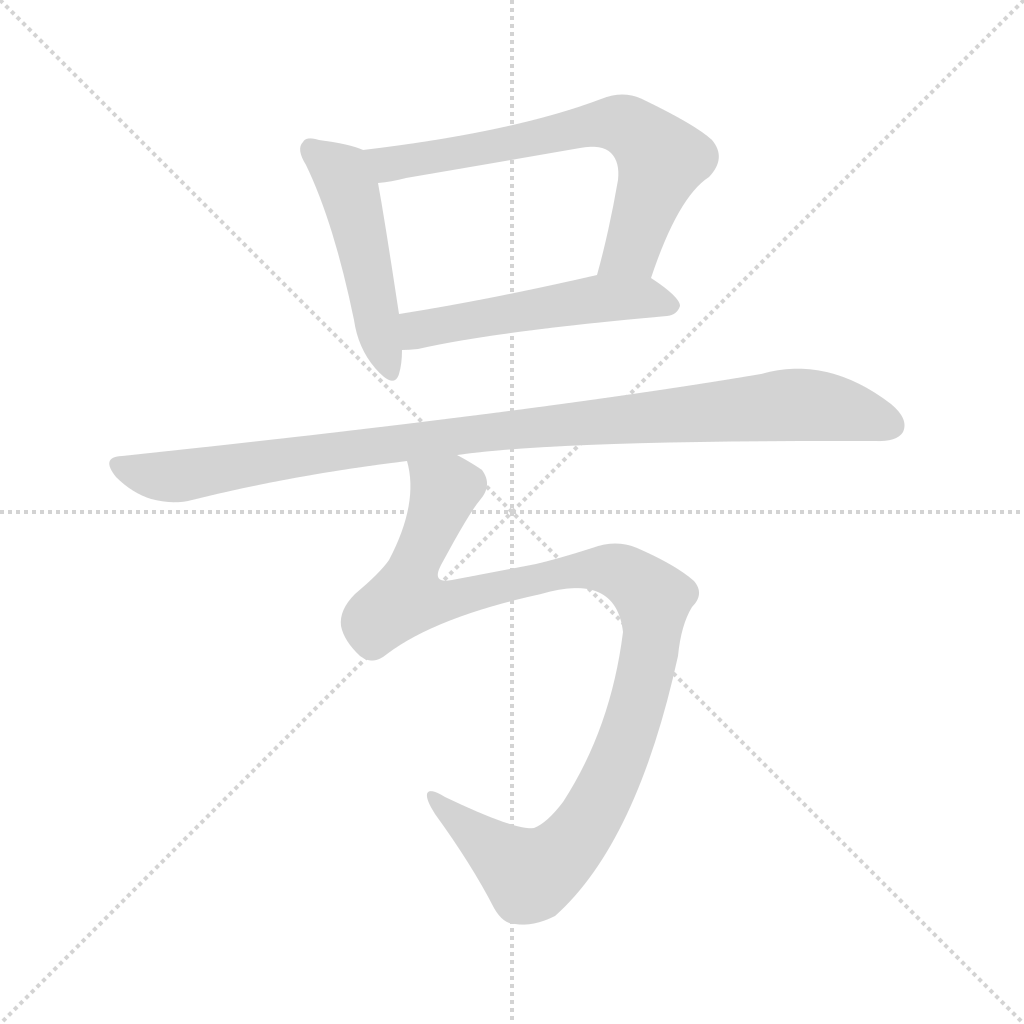
Hao
Pronounced hao
To cry out in a loud voice.
As written in the Book of Odes (Shijing): With calls and cries.
As written in the Book of Odes (Shijing): Calling and clamoring.
The commentary states: Hao nao refers to loud shouting and clamoring.
Also refers to crying and wailing.
As written in the Book of Changes (Yijing): First wailing and crying, then laughing.
As written in the Discourses of the States (Guoyu): A husband and wife were lamenting and crying in the night, and thus they took her and fled to Bao.
Also refers to the crowing of a rooster.
As written in the Book of Jin (Jinshu): The rooster begins to crow at the third watch.
Also pronounced hao (falling tone)
A name or title.
As written in the Gongyang Commentary (Gongyang shu): In the Spring and Autumn period, both the noble and the base did not avoid having the same title.
The note states: To be called by the same name or title.
As written in the Comprehensive Discussions in the White Tiger Hall (Baihu tong): The Spring and Autumn Commentary states: When a king receives the mandate of heaven, he must select a beautiful name from the world to serve as his title.
As written in the Rites of Zhou (Zhou li): To distinguish the six titles.
The note states: Titles refer to honoring their names and bestowing beautiful designations.
Also, as written in the Rites of Zhou (Zhou li): Families are designated by titles.
The note states: For those within the village or district, the term used is name; for those within the family, the term used is title.
Also, as written in the Rites of Zhou (Zhou li): To announce their titles.
The note states: This refers to posthumous titles.
Also refers to commands or orders.
As written in the Book of Changes (Yijing): Sweating like water spreading, such are his great commands.
Also refers to calling upon or summoning.
As written in the Discourses of Qi (Qi yu): He sent men to travel the four corners of the earth to summon the worthy scholars of the world.
Also pronounced gou (rhyming variant)
As written in the poem by Pi Rixiu: Approaching the vastness of the Miluo River, contemplating the hidden sorrows of holding the sand. Dense trees intertwine lushly, while at times the monkeys appear and wail to one another.
The Compendium of Rhymes (Jiyun) notes this was originally written as hao, and also as hu. Master Mao states: It is composed of the radical for mouth and the character for kao, which is pronounced kao. The vulgar form follows the character hao, which is incorrect. It is also written as a variant form, though this is a vulgar character. The character hao is derived from the standard form.