Shen Collection, Upper Volume
Radical: Grass (cǎo)
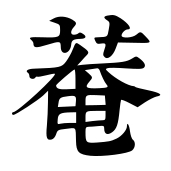
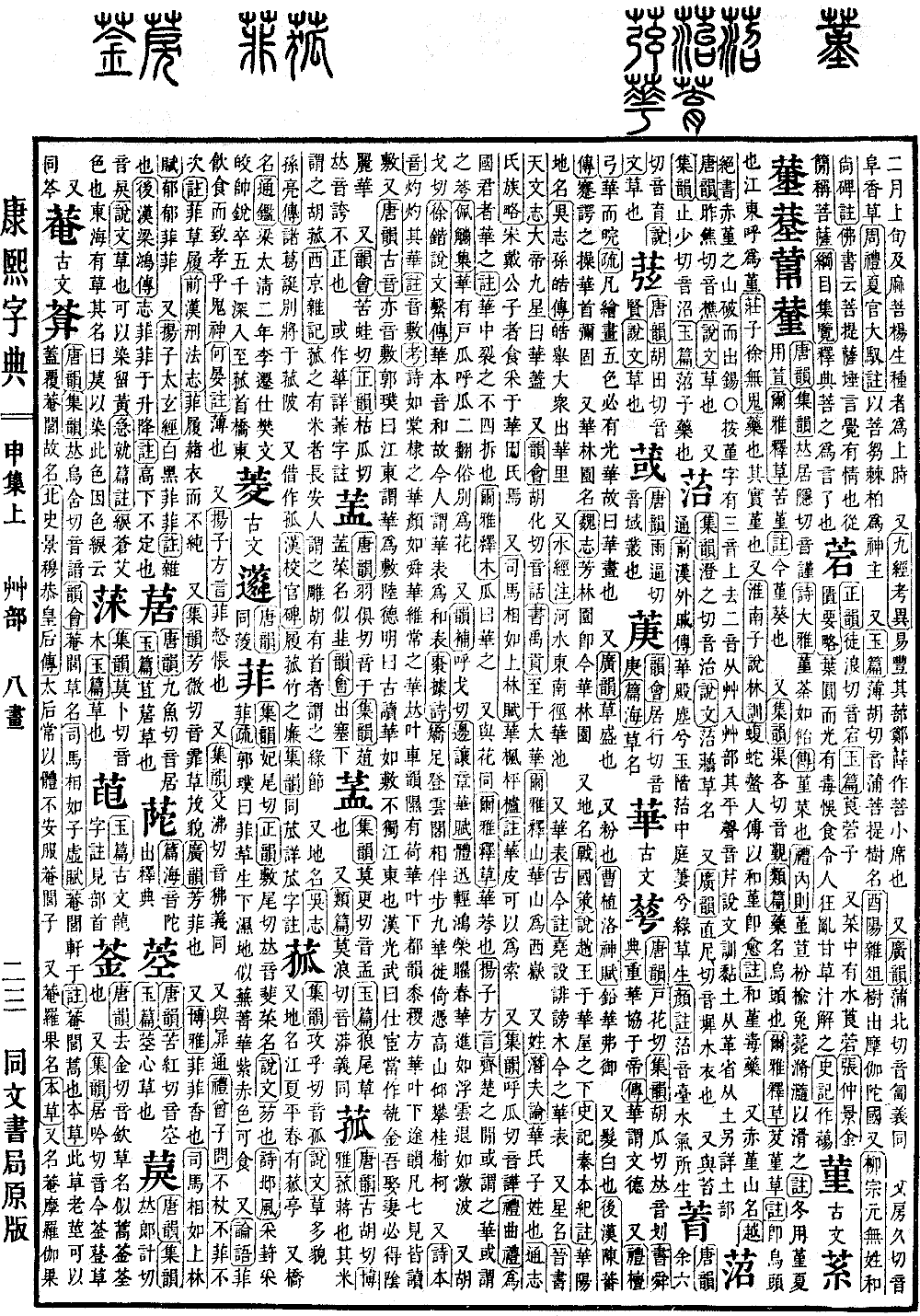
An; Kangxi strokes: 14; Page 1039, Entry 30
The archaic form is written as an.
According to the Tang Rhymes (Tangyun) and the Collected Rhymes (Jiyun), the pronunciation is an (level tone).
The Rhyme Compendium (Yunhui) records that anlü is the name of a type of plant.
In the Rhapsody of the Son of Heaven (Zixu fu) by Sima Xiangru, there is the phrase "anlü flourishes."
Note: Anlü refers to artemisia.
The Materia Medica (Bencao) explains: The dried old stalks of this plant can be used to thatch huts, which is how it earned its name.
The History of Northern Dynasties (Beishi), Biography of Empress Jingmugong, records: The Empress Dowager once took anlüzi when she was feeling unwell.
It also refers to anluo, which is the name of a fruit.
The Materia Medica (Bencao) also calls it anmoluojia fruit.
In the Rhapsody on Living in the Mountains (Shanju fu) by Xie Lingyun, it is written: Longing for the steadfast and stable forest, anticipating the fragrant orchards of anluo.
Also, according to the Jade Compendium (Yupian), the pronunciation is yan (level tone). The meaning is the same.
Also, according to the Rhyme Compendium (Yunhui), the pronunciation is an (falling tone).
In the Rhapsody on the Capital of Shu (Shudu fu) by Zuo Si, there is the phrase "the eight regions are lush and an'ai."
The Correct Rhymes (Zhengyun) explains: An'ai refers to the appearance of lush, shady, and overhanging vegetation.
It is also read in the rising tone, pronounced an. The meaning is the same.
Also, the Classified Compilation (Leipian) records it as identical to the character an.
The Guide to Correct Characters (Zhengzitong) explains: The original character is written as an, and the simplified form is written as an. The character originally derives from the grass radical and does not originate from the component an.