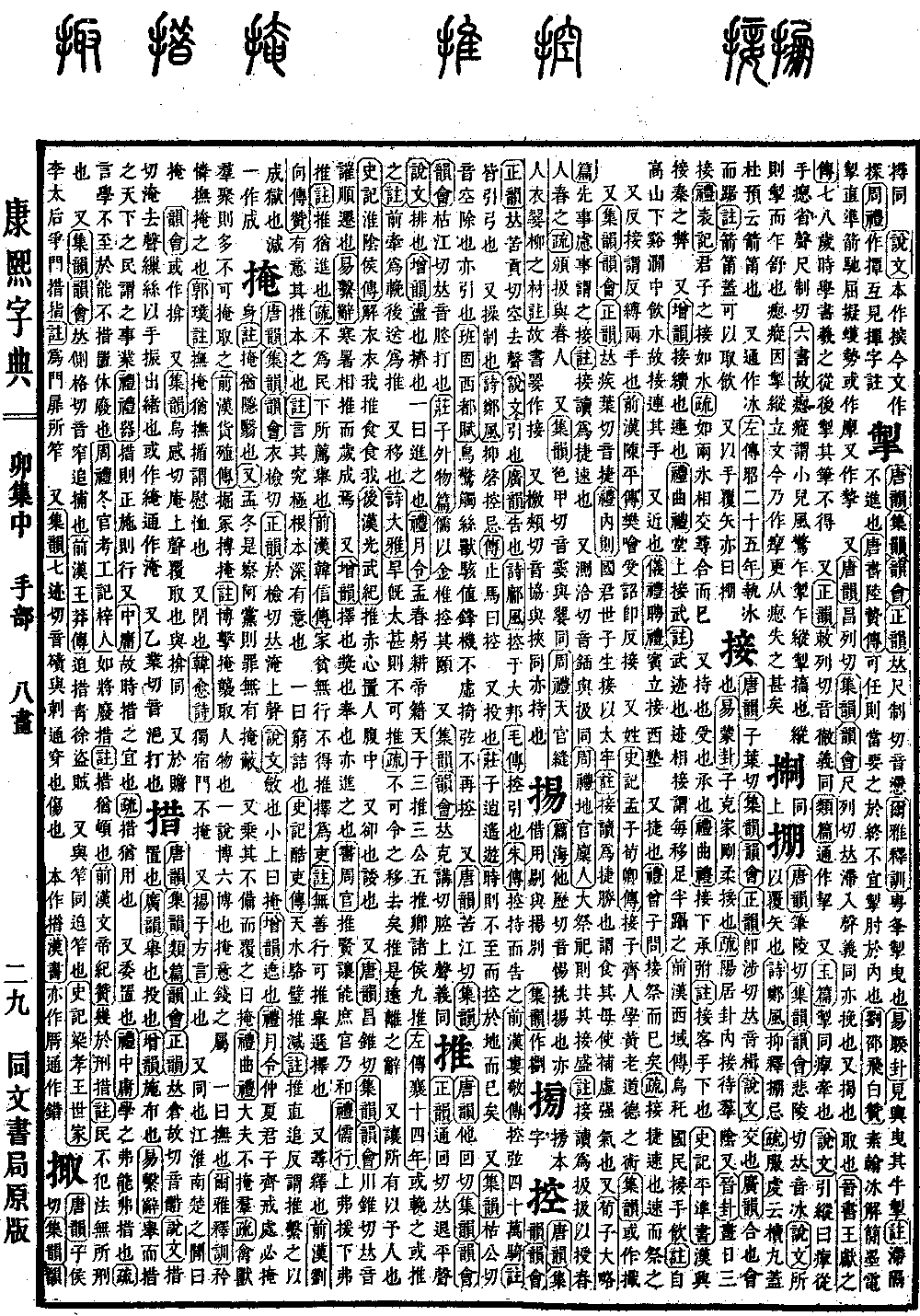
Mao Collection, Middle Volume
Radical: Hand (shǒu)
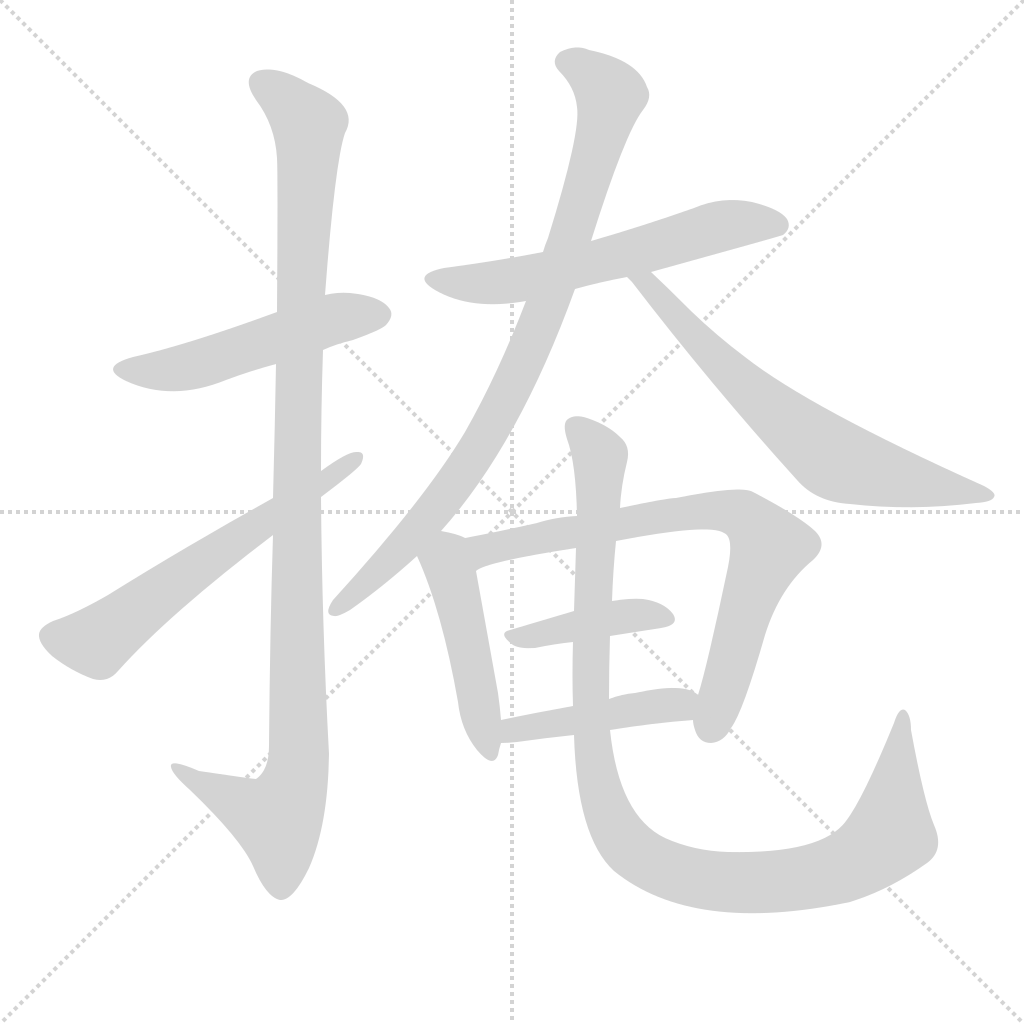
掩
Kangxi stroke count: 12
Page 439, Entry 09
Tangyun, Jiyun, Yunhui: Pronounced yan (rising tone).
Zhengyun: Pronounced yan (rising tone).
Shuowen: To collect or restrain. To close slightly upward is called yan.
Zengyun: To cover or obstruct.
Book of Rites (Liji), Monthly Ordinances (Yueling): During the mid-summer season, a gentleman practices purification; his residence must be one that covers and shields the body.
Commentary: Yan means to hide or shield.
Also: In the first month of winter, if one investigates favoritism and bias, then crimes cannot be covered or hidden.
Also: To attack or cover someone when they are unprepared is called yan.
Book of Rites (Liji), Summary of the Rules of Propriety (Quli): An officer does not launch a surprise attack on a herd of animals.
Sub-commentary: When animals gather in a group, one cannot launch a surprise attack to hunt them.
History of the Former Han Dynasty (Qianhan Shu), Biography of Money-makers (Huozhi Zhuan): Tomb raiding, gambling, and robbery.
Commentary: Bo refers to combat and surprise attacks to seize others' property. One interpretation is that Bo refers to the Liubo board game. Yan refers to gambling activities such as Yiqian. One interpretation is that it means to comfort.
Erya, Explanation of Teachings (Shixun): To pity and comfort.
Guo Pu commentary: To stroke and yan is like stroking and patting, referring to comfort and sympathy.
Also: To close.
Han Yu poetry: Staying the night alone, the door is not closed.
Also: Yangzi, Dialects (Fangyan): To stop.
Also: To be the same. In the regions of the Yangtze, Huai, and the south of the Yellow River in the Chu state, the dialect uses yan.
Yunhui: Sometimes written in a variant form (yǎn).
Also: Jiyun: Pronounced an (rising tone). To cover and seize. The same as (yǎn).
Also: Pronounced yan (departing tone). The act of using one's hand to vibrate and draw out the thread head when reeling silk. Sometimes written as. Commonly used as (yān).
Also: Pronounced yi (entering tone). To strike. The original form of the character. The character is derived from (zuò).
Textual Research:
Erya, Explanation of Teachings (Shixun), Guo Pu commentary: To stroke and yan is like stroking and patting, referring to comfort and sympathy. Following the original text, patting is used to replace stroking.