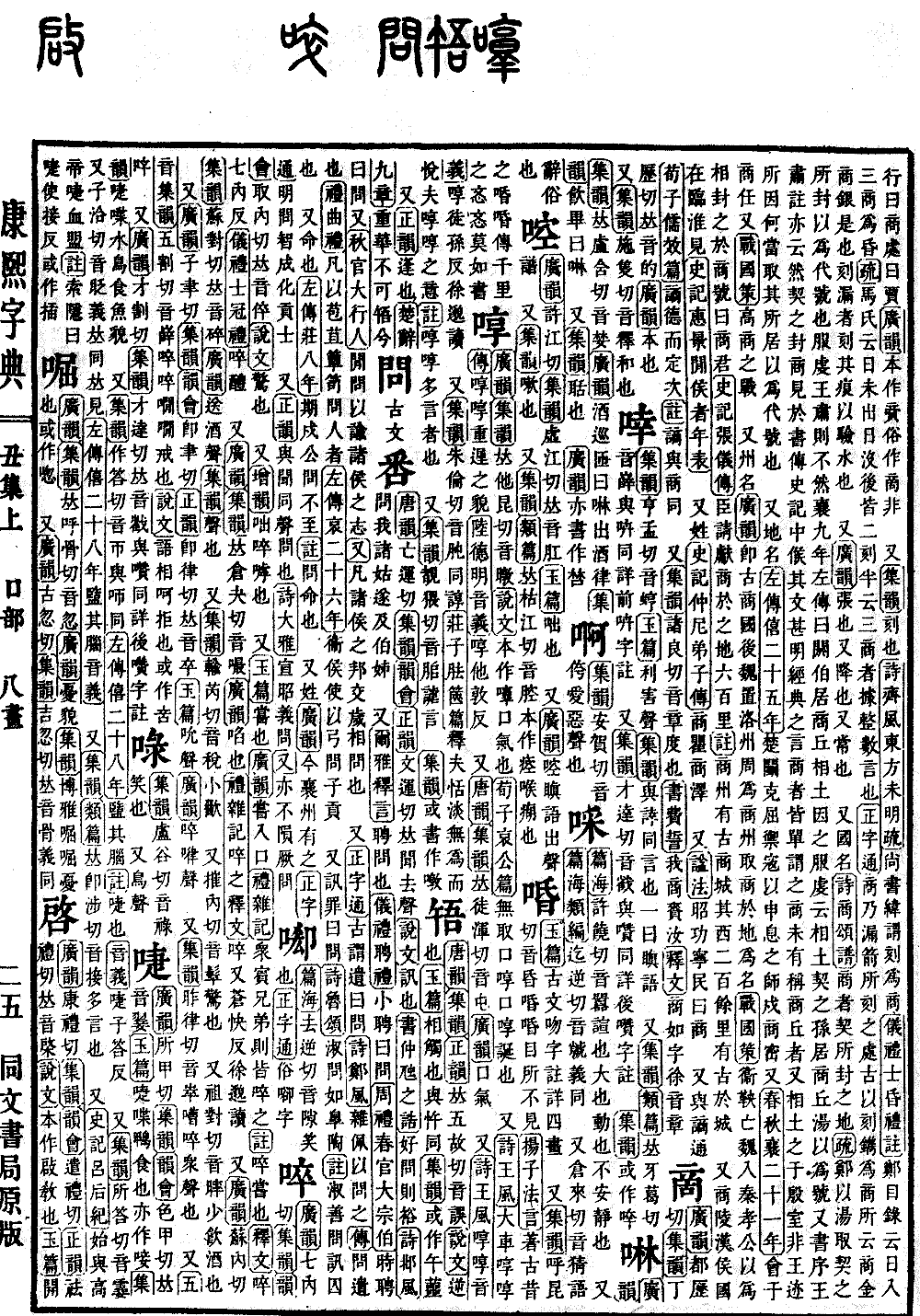
Chou Collection, Upper Volume
Radical: Mouth (kǒu)
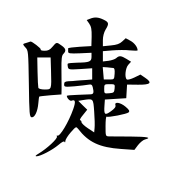
Character: 啑
Kangxi Stroke Count: 11
Page 195, Entry 15
Broad Rhymes (Guangyun): Pronounced shuo.
Collected Rhymes (Jiyun), Rhyme Compendium (Yunhui): Pronounced shuo.
Jade Chapter (Yupian): The term shuo-die refers to the way ducks eat. Also written in a variant form (sha).
Collected Rhymes (Jiyun): The term shuo-die describes the appearance of water birds eating fish.
Also, according to Collected Rhymes (Jiyun): Pronounced za. Same as the character (za).
Zuo Tradition (Zuozhuan), 28th Year of Duke Xi: To break open its brain.
Commentary: Means to eat/chew.
Pronunciation and Meaning: Pronounced da.
Also, according to Collected Rhymes (Jiyun): Pronounced sha. Also pronounced zha. The meaning is the same; see the commentary on the Zuo Tradition (Zuozhuan), 28th Year of Duke Xi regarding breaking open the brain.
Also, according to Collected Rhymes (Jiyun) and Classified Chapters (Leipian): Pronounced jie. Means to speak excessively.
Also, Records of the Grand Historian (Shiji), Annals of Empress Lü: Initially, she and the High Emperor pledged with blood (shuo).
Commentary: The Search for Mysteries (Suoyin) states: Pronounced jie. Sometimes written in a variant form (cha).