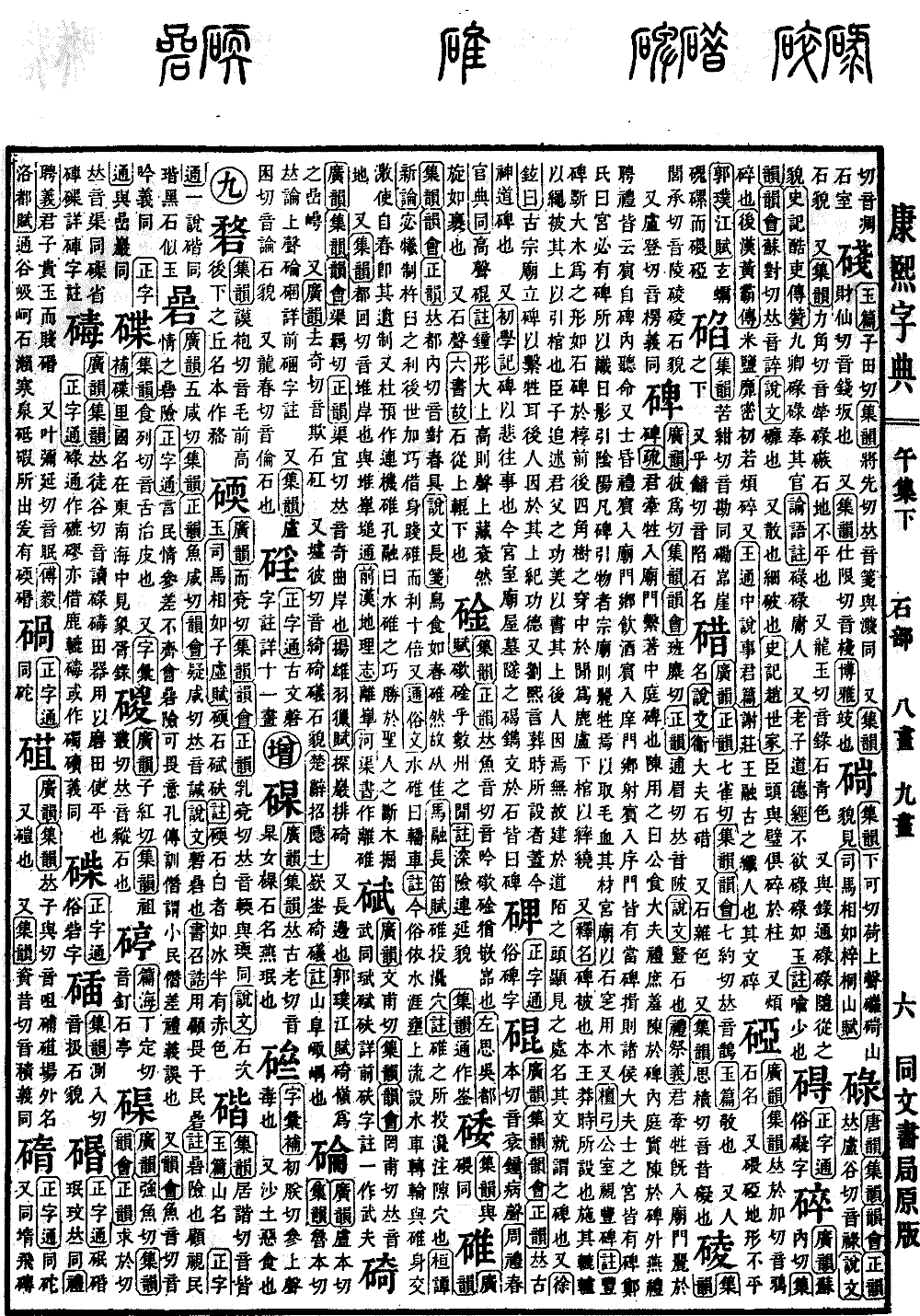
Wu Collection, Lower Volume
Radical: Stone (shí)
Kangxi strokes: 13
Page 832, Entry 15
Pronounced dui. A mortar for husking grain.
Extended Notes on the Shuowen Jiezi (Shuowen Changjian) states: Birds eating appears like husking with a mortar, therefore the character includes the component for bird (zhuī).
Ma Rong’s Rhapsody on the Long Flute (Changdi Fu): The pestle strikes the narrow opening. Annotation: The point where the mortar strikes is where the water pours into the narrow crevice.
Huan Tan’s New Treatise (Xinlun): Fuxi created the benefits of the pestle and mortar; later generations added ingenuity, using the weight of the body to tread the mortar, increasing efficiency tenfold.
Also, in the Common Glossary (Tongsu Wen), a water-powered mortar is called a wheel-cart (fānchē). Annotation: Modern practice involves obstructing the upper flow along a riverbank, installing a waterwheel, and using the rotational force to strike the mortar arm, enabling automatic husking; this is a legacy of that design.
Du Yu constructed a linked-mechanism mortar. Kong Rong said: The ingenuity of the water-powered mortar surpasses the sage’s invention of cutting wood and digging into the ground.
Also, in the Collected Rhymes (Jiyun), pronounced dui. A riverbank. Used interchangeably with the characters for pile or mound.
In the Book of Han (Qianhan Shu), Geography Treatise: Li. The Treatise on Rivers and Canals (Hequ Shu) writes it as Li-dui.