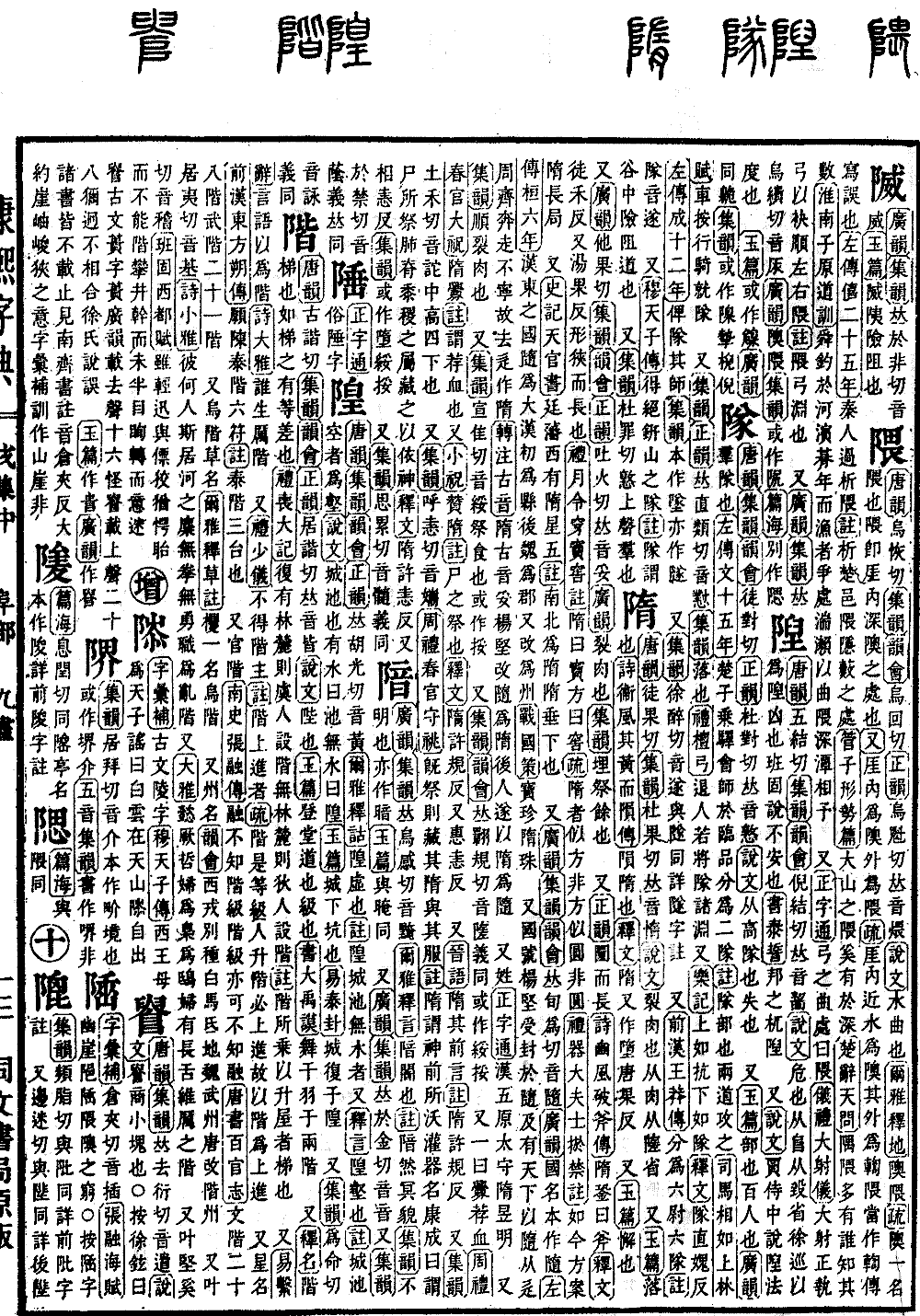
Xu Collection, Middle Volume
Radical: Mound (fù)
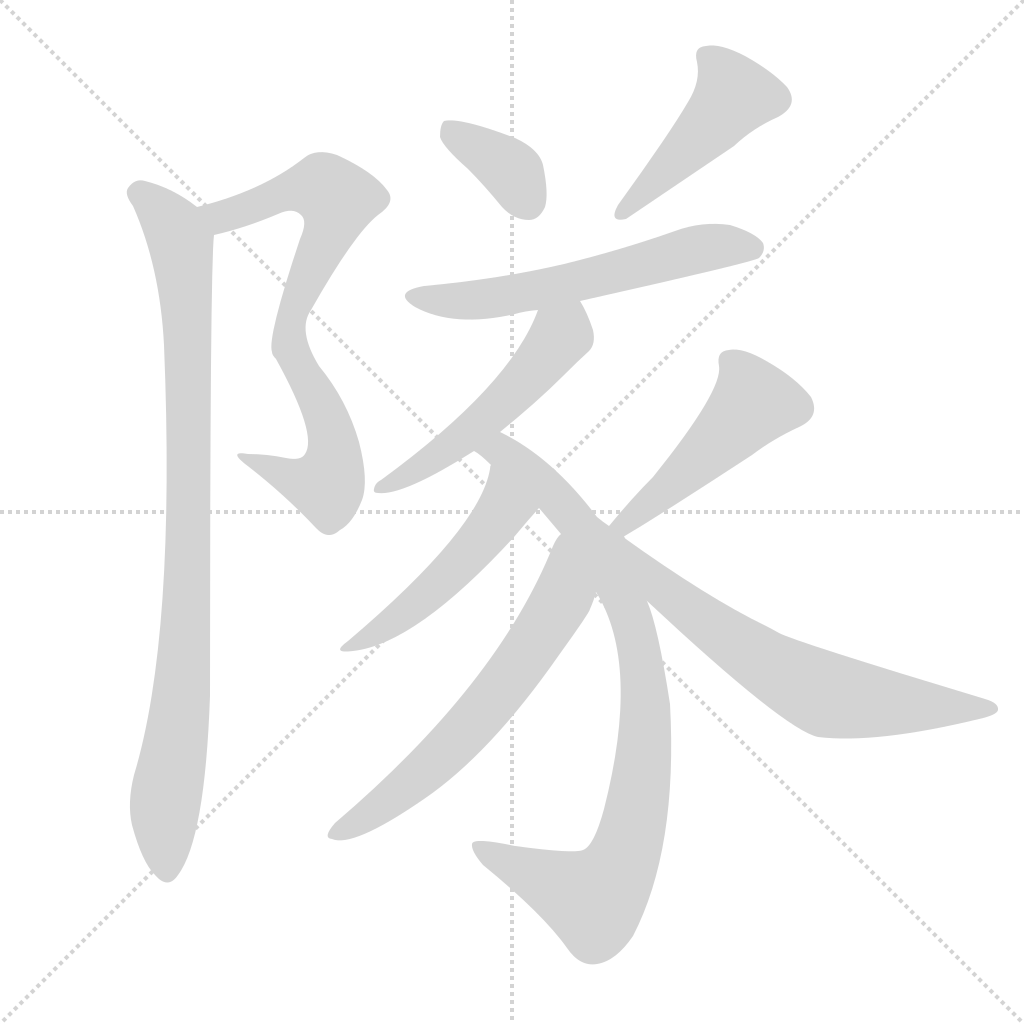
隊; Kangxi stroke count: 17; Page number: 1357, entry 04
In Tang Rhymes (Tangyun), Jiyun (Jiyun), Yunhui (Yunhui), and Zhengyun (Zhengyun), pronounced duì. In Shuowen Jiezi (Shuowen Jiezi), it means to fall from a high place and lose. Also, in Yupian (Yupian), it refers to a team or detachment. One hundred people form a team. In Guangyun (Guangyun), it refers to a group or contingent. "King Chu rode in an express carriage, assembling his troops at Linpin, and divided them into two contingents." — Zuo Commentary (Zuozhuan) on Duke Wen, 16th year. The commentary states that duì here refers to a detachment, dividing into two routes to attack. "Carriages advanced in formation, cavalry joined their ranks." — Sima Xiangru's "Rhapsody on the Imperial Park" (Shanglinfu).
Also, in Jiyun (Jiyun) and Zhengyun (Zhengyun), pronounced duì. In Jiyun, it means to fall. "To reject others is like pushing them into an abyss." — Book of Rites (Liji), "Tan Gong" chapter. "Sounds ascend as if lifted, and descend as if falling." — "Record of Music" (Yueji) chapter of Book of Rites. The Explication (Shuwen) states that duì is read as zhí kuì fǎn (referencing pronunciation). "Causing his army to fail." — Zuo Commentary on Duke Cheng, 12th year. In Jiyun, the original character is 墜 (zhuì). It is also written as 隧 (suì).
Also, in Jiyun, pronounced suì. It is the same as 隧 (suì). Refer to the annotation for the character 隧 (suì). "Divided into six wèi (officials) and six duì (units)." — Book of Han (Hanshu), "Biography of Wang Mang". The commentary states duì is read as suì. "Able to pass through the dangerous path of Xing Mountain (Xing shan)." — Mu Son of Heaven's Biography (Mu Tianzi Zhuan). The commentary states duì refers to a dangerous path in a mountain valley.
Also, in Jiyun, pronounced duì (rising tone). It means to form a group.
Textual verification: The original text "Zuo Commentary on Duke Wen, 15th year, King Chu rode in an express horse, assembling his troops at Linpin, and divided them into two contingents" has been carefully revised to "Zuo Commentary on Duke Wen, 16th year, King Chu rode in an express carriage, assembling his troops at Linpin, and divided them into two contingents."