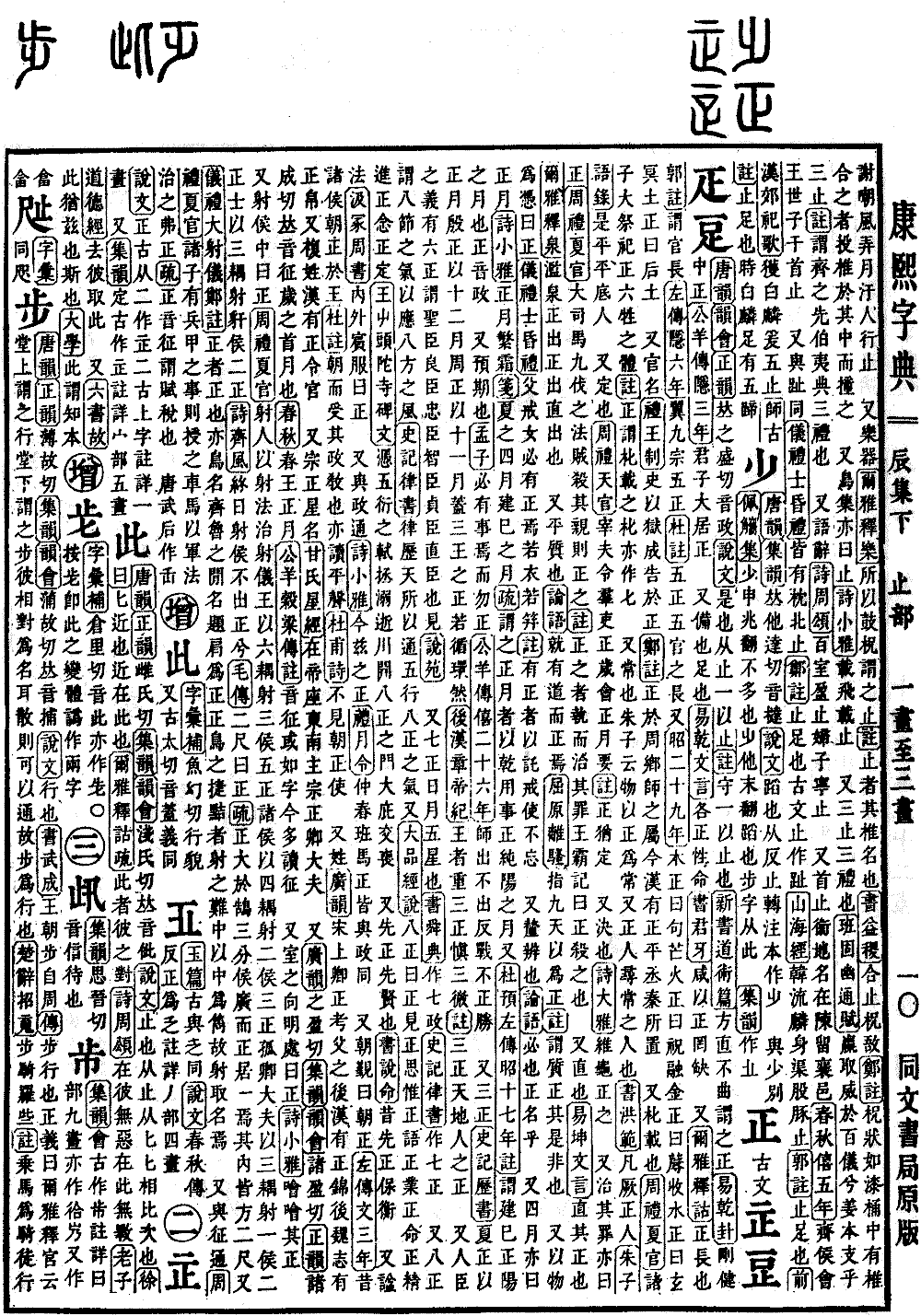
Chen Collection, Lower Volume
Radical: Stop (zhǐ)
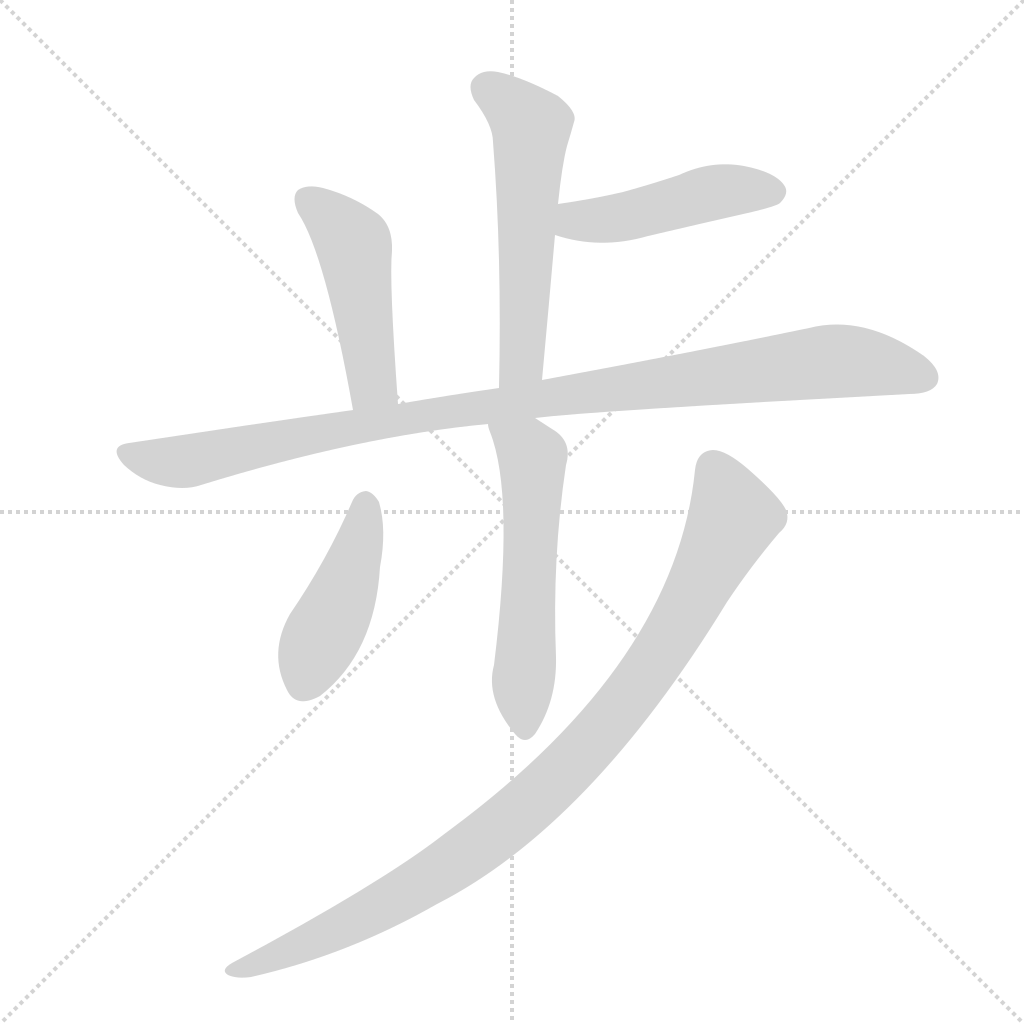
Bu
Kangxi Stroke Count: 7
Page 574, Entry 15
Tang Yun (Tang rhyme), Zheng Yun (Zheng rhyme): Pronounced bu. Ji Yun (Ji rhyme), Yun Hui (Yun meeting): Pronounced bu.
Shuowen (Explaining Graphs): To walk.
Book of Documents (Shujing), Wucheng: The king’s army walked from Zhou.
Commentary: Bu means to walk. Zheng Yi (Correct Meaning) says: The Erya, Interpreting Palaces states: Movement on the hall is called xing, movement below the hall is called bu. This is a distinction based on context; taken separately, they are interchangeable, thus bu means the same as xing.
Songs of Chu (Chuci), Invocation of the Soul: The infantry and cavalry are assembled.
Note: Those on horseback are cavalry (qi), those traveling on foot are infantry (bu).
Also, Xiao Erya: Kui is the lifting of one foot. Doubling the kui is called a step (bu).
Baihu Tong (Comprehensive Discussions in the White Tiger Hall): A person’s foot is three chi long, modeled after heaven, earth, and man. Each stride with both feet is called a step (bu), fulfilling the principles of yin and yang.
Rites of Zhou (Zhouli), Summer Official: The Master of Archery uses the li-step to set the three targets.
Note: Zheng Sinong says: A li-step is the distance of one foot-lift, equivalent to half a modern step.
Also, Sima Fa (The Art of War of Sima): Six chi make one step (bu); one hundred steps make one mu.
Book of Rites (Liji), Royal Regulations: In ancient times, eight Zhou-chi made one step; now, six chi and four cun of the Zhou-chi make one step.
Zheng Yi says: In ancient times, eight cun made one chi, and eight Zhou-chi made one step, so one step was six chi and four cun.
Records of the Grand Historian (Shiji), Annals of Qin Shihuang: The number six was taken as the standard; six chi made one step.
Note: Suoyin says: The Guanzi and Sima Fa both state that six chi make one step; this was not a regulation unique to the Qin Dynasty. Furthermore, the Royal Regulations state eight chi make a step, while now six chi and four cun are used; the length of a step has never been uniform.
Also, a carriage pulled by people is called bu.
Yun Hui: People in the world call hand-pulled carriages bu-nian, referring to them being carried or pulled by people without the use of horses.
Also, walking slowly is called bu.
Qu Yuan, Li Sao: I walk my horse slowly along the orchid-lined bank.
Shuoyuan, Jianben Chapter: Those who run are fast, those who walk are slow.
Also, taking small, quick steps is called qu; taking large steps is called bu.
Zhuangzi, Tian Zifang: If you walk slowly, I walk slowly; if you walk fast, I walk fast.
Also, Ren Fang, Shuyi Ji (Record of Strange Things): Areas by the water are called bu. In Shangyu County, there is Shituo Bu; in Wu, there is Guabu; in Wujiang, there are Yubu and Gubu; in Xiang, there is Lingfei Bu. It is noted that in the Wu and Chu regions, calling the waterside a bu is a corruption of language.
Shuijing Zhu (Commentary on the Water Classic): The Gan River flows north of Yuzhang Prefecture to become a ferry (jinbu); bu refers to small patches of land within the water.
Qingxiang Zaji: In Lingnan, village markets are called xu, and waterside docks are called bu.
Also, Liu Zongyuan, Iron Furnace Bu Record: By the river, any place where boats can be moored and people can embark or disembark is called a bu.
Han Yu, Kong Kuan Epitaph: When foreign merchant ships arrive at the mooring dock, there is a tax for dropping anchor. Commonly written as bu. Modern people call ship brokers bu-tou. Bu is pronounced like bu.
Also, Erya, Interpreting Music: Beating a drum alone is called bu.
Shu: Anything where eight types of musical instruments are complete is called music. A single instrument playing alone cannot be called music.
Also, unique talent is called du-bu.
Book of Jin (Jinshu), Biography of Wang Tanzhi: Wang Wendu is peerless in Jiangdong.
Also, ma-bu, referring to spirits that bring disaster to horses. Another view says it refers to the deity of travel.
Rites of Zhou, Summer Official, Master of Horses: Sacrifice to the ma-bu in winter.
Also, spirits of human disaster are all called bu.
Rites of Zhou, Summer Official, Master of Horses Commentary: The so-called ming-zhi-bu and ren-gui-zhi-bu belong to this category of spirits.
Also, Earth Official, Clan Master, Sacrifice to Pu Note: Pu is a spirit that brings disaster to humans and animals. Older books write it as bu; likely bu and pu are different characters but share the same sound and meaning.
Also, walking a horse is called bu-ma.
Zuo Zhuan, 26th Year of Duke Xiang: The Left Master saw the lady’s horse-walker.
Also, to lead by hand.
Book of Rites, Qu Li: When leading a horse driven by the monarch, one must walk in the middle of the road.
Also, marching an army is called bu-shi.
Zuo Zhuan, 33rd Year of Duke Xi: Our ruler heard that you were going to march your army through our state.
Also, pouring wine in sequence is called bu-jue.
Book of Rites, Shao Yi: Do not proceed to drink in sequence before tasting the side dishes.
Also, calculating the calendar is called bu-li.
Zuo Zhuan, 1st Year of Duke Wen Commentary: The sun and moon move in the sky like a person walking on the ground, so calculating the calendar is called bu-li.
Book of the Later Han (Hou Hanshu), Biography of Yang Hou: Followed Zheng Boshan of the same commandery to study the River Chart, the Luo Scroll, and methods of astronomical calculation.
Lu Ji, Yan Lianzhu: Observe the celestial phenomena and measure the shadows, then lengths can be measured.
Also, Luli, book title; the five planets are called the five-bu. See Hanzhi Kao (Study of Han Institutions).
Also, destiny; the fate of a nation is called guo-bu, the fate of heaven is called tian-bu.
Book of Odes (Shijing), Xiaoya: The fate of the nation is difficult and resources are exhausted.
Also: The fate of heaven is difficult.
Also, ascending to a high position is called gai-bu.
Guoyu (Discourses of the States): Changing the ceremonial jade, changing the rhythm of one’s step (referring to ascending the throne).
Also, step-by-step process (buzhou).
Book of the Later Han, Biography of Cao Bao: The Three Sovereigns, Five Emperors, and Three Kings had different methods and varying degrees of superiority.
Note: Xiao Jing Gouming Jue says: The Three Sovereigns practiced bu, the Five Emperors practiced zou, and the Three Kings practiced chi. Song Jun’s note says: Bu refers to moral administration operating as calmly as the sun and moon; as the affairs of the era became more fluid, the sun and moon’s movement accelerated to zou; when diligent in thought without slack, the movement was like chi; these are the differences in merit.
Also, a surname.
Guang Yun (Broad Rhymes): In the state of Jin, there was Bu Yang, whose fief was in the Bu region; later, the family took Bu as their surname. Confucius’s disciple included Bu Shu Cheng; in the Three Kingdoms period, the Wu state had Prime Minister Bu Zhi.
Also, three-character surnames.
Book of the Northern Wei (Hou Weishu): There was the Buliugu clan, later changed to the Lu clan.
Also, the Bu-Lu-Gen clan of the West, later changed to the Bu clan.
Also, Book of Northern Qi (Beiqi Shu): There was the Budahan clan.
Also, Baibu, name of a stream.
Guang Yu Ji: Located in Linhai County, Taizhou; also called E Xi (Evil Creek).
Also, Qianbu, name of a spice.
Ren Fang, Shuyi Ji: Mountains in the South Sea produce qianbu incense; wearing it makes the scent perceptible for a thousand steps (qianbu). Now there is qianbu grass by the sea, which is of this type. Zagu Ji (Miscellaneous Tribute Records) says: Nan Jun presented qianbu incense as tribute.
Also, Buguang, name of a sword. See Yuejue Shu (Lost Records of Yue).
Also, Buyao, name of a woman’s hair accessory. See Cailan Zazhi (Miscellaneous Records of Gathering Orchids).
Sushu Zheng’e: Derived from the character that is a reversed stop (zhi). Derived from shao is incorrect. This specific character is only used in the word bu. The Japanese simplified bu to a new form, facilitating the use of the character.