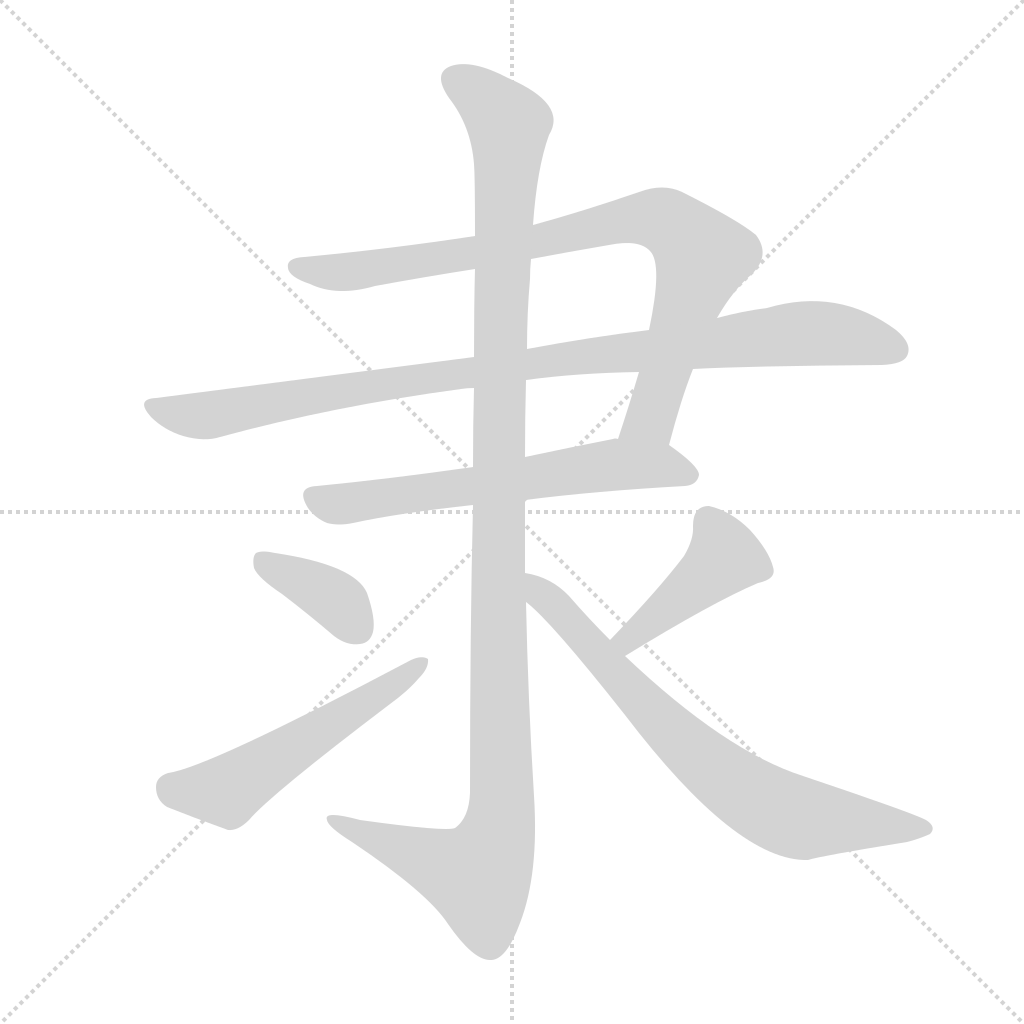
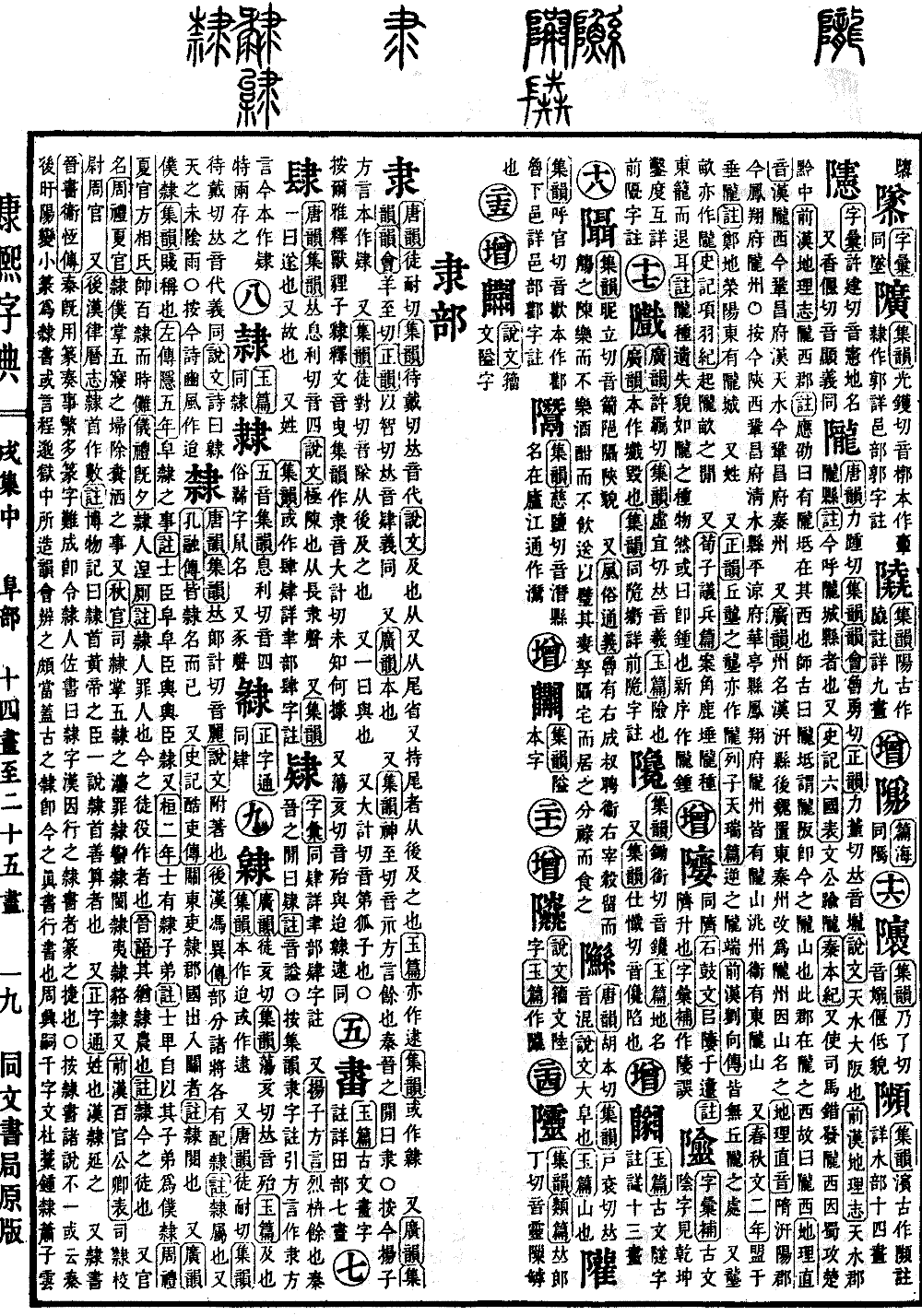
Xu Collection, Middle Volume. Radical: Slave (lì). Kangxi stroke count: 17. Page 1363, Entry 22.
Tang Rhyme (Tangyun): Pronounced dai. Collected Rhymes (Jiyun): Pronounced dai. Explanatory Note (Shuowen): To reach or attain. Composed of hand and a shorthand form of tail. It signifies holding the tail to catch up from behind. Jade Chapter (Yupian): Also written as dai. Collected Rhymes (Jiyun): Sometimes written as variant form. Also, Broad Rhymes (Guangyun), Collected Rhymes (Jiyun), and Collection of Rhymes (Yunhui): Pronounced yi. Same meaning. Also, Broad Rhymes (Guangyun): Original or foundation. Also, Collected Rhymes (Jiyun): Pronounced shi. Dialect Dictionary (Fangyan): Remainder or excess. In the region of Qin and Jin, it is called li. Note: The current version of Yang Xiong's Dialect Dictionary (Fangyan) uses the variant form. Also, Collected Rhymes (Jiyun): Pronounced dui. To catch up from behind. Another meaning is to give or provide. Also: Pronounced di. A fox cub. Note: According to Literary Expositor (Erya), entry on animals, it is a fox cub. Commentary states pronunciation is ye; Collected Rhymes (Jiyun) records it as li, pronounced di, though the basis for this is unknown. Also: Pronounced dai. Same as the characters for reach or attain.
Tang Rhyme (Tangyun), Collected Rhymes (Jiyun): Pronounced li. Explanatory Note (Shuowen): To attach or adhere. History of the Later Han (Hou Hanshu), Biography of Feng Yi: Distributing officials and generals, each with assigned subordinates. Commentary: Li means to belong or be subject to. Also, Biography of Kong Rong: All are merely assigned by name. Also, Records of the Grand Historian (Shiji), Biography of Harsh Officials: Officials from east of the pass assigned to oversee entry and exit at commanderies. Commentary: Li means to inspect. Also, Broad Rhymes (Guangyun): Servants. Collected Rhymes (Jiyun): A term for the low-ranking. Zuo Commentary (Zuozhuan), Duke Yin, 5th Year: The duties of the zao and li. Commentary: An official (shi) serves the zao, the zao serves the yu, and the yu serves the li. Also, Duke Huan, 2nd Year: Officials have li as children. Commentary: Officials use their own children as servants. Rites of Zhou (Zhouli), Summer Official, Fangxiangshi: Leads a hundred li in the seasonal exorcism rite. Book of Rites (Yili), Jixi: Li people clean the latrines. Commentary: Li people are criminals; those who perform manual labor today. Discourses of the States (Guoyu): Like farming laborers. Commentary: Li refers to laborers today. Also, an official title. Rites of Zhou (Zhouli), Summer Official: Li servants manage the cleaning and sweeping of the five sleeping chambers. Also, Autumn Official: The Director of Li manages the laws of the five types of li: criminal li, barbarian li, Min li, Yi li, and Mo li. Also, History of the Former Han (Qian Hanshu), Table of Officials and Ministers: The Colonel Director of Retainers in the Zhou system. Also, History of the Later Han (Hou Hanshu), Treatise on Rites and Music: Lishou created mathematics. Commentary: The Biographic Records state: Lishou was a minister of the Yellow Emperor. Another theory is that Lishou was someone skilled in calculation. Also, Correcting Terms (Zhengzitong): A surname. Han Liyan belongs to this. Also, Clerical Script (Lishu). Book of Jin (Jinshu), Biography of Wei Heng: After the Qin dynasty adopted the seal script, administrative matters became繁多 and complex, making seal script difficult to execute; thus, liren (clerical staff) were ordered to assist in writing, hence the term clerical script. The Han dynasty continued its use. Clerical script is a simplified, faster form of seal script. Note: Regarding clerical script, theories vary. Some say that after the Qin dynasty, a person from Xuanyang changed the small seal script into clerical script. Others say it was created by Cheng Miao while in prison. The Collection of Rhymes (Yunhui) analyzes this appropriately; essentially, the ancient li is what we call today the standard or regular script. In Zhou Xingsi's Thousand Character Classic, it mentions the draft style of Du and the clerical style of Zhong. Xiao Ziyun states: In discussing draft and clerical styles, Yishao (Wang Xizhi) did not surpass Yuanchang (Zhong Yao), and Zijing (Wang Xianzhi) did not surpass Yishao. Ren Jie's Preface to the Five Styles says: As for clerical script, it includes the styles of Xi, Xian, Zhong, Yu, Ou, Yu, Yan, and Liu. Sun Guoting's Calligraphy Manual (Shupu) says: Yuanchang excelled in clerical script, Boying was skilled in cursive, and Yishao mastered both. These all refer to the standard and running scripts as clerical script. Ouyang Xiu's Collected Records of Antiquity began the error of identifying the eight-part (bafen) script as clerical. The Calligraphy Garden (Shuyuan) states: Cai Yan said, take eight parts of Cheng's clerical script and two parts of Li's seal script to create the eight-part script. Ren Jie also says: The eight-part script sits between seal and clerical, thus proving clerical is not the eight-part script. The Tang Six Statutes (Tang Liudian) says: The proofreaders and editors manage five types of script: first, ancient characters; second, large seal; both are unused. Third, small seal, used for seals and banners. Fourth, eight-part script, used for stone classics. Fifth, clerical script, used for classics, memorials, and public/private documents. According to this, it is increasingly certain that clerical script refers to the modern regular script. Correcting Terms (Zhengzitong) states: The inscription at Dajue Temple from the Eastern Wei dynasty is in clerical script, which is the modern regular character; this is one such proof. Also, Collected Rhymes (Jiyun): Pronounced li. To attach. Also, Classified Collection (Leipian): Pronounced lie. A servant. Explanatory Note (Shuowen): Originally written with a different character. Broad Rhymes (Guangyun): Vulgar form. Collection of Rhymes (Yunhui) and Corrected Rhymes (Zhengyun): Written with a variant, which is incorrect.