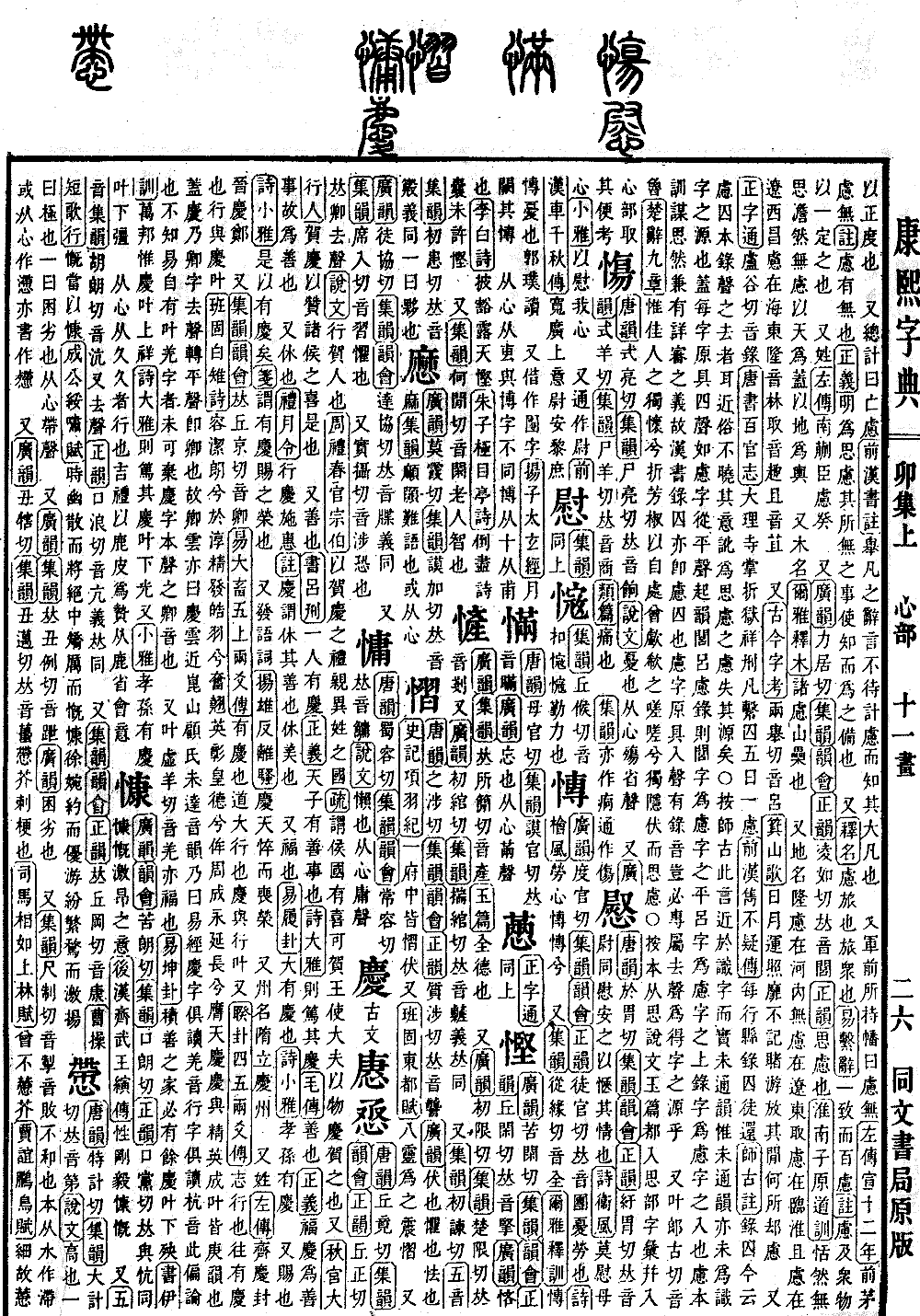
Mao Collection, Upper Volume
Radical: Heart (xīn)
Kangxi stroke count: 15
Page 400, Entry 16
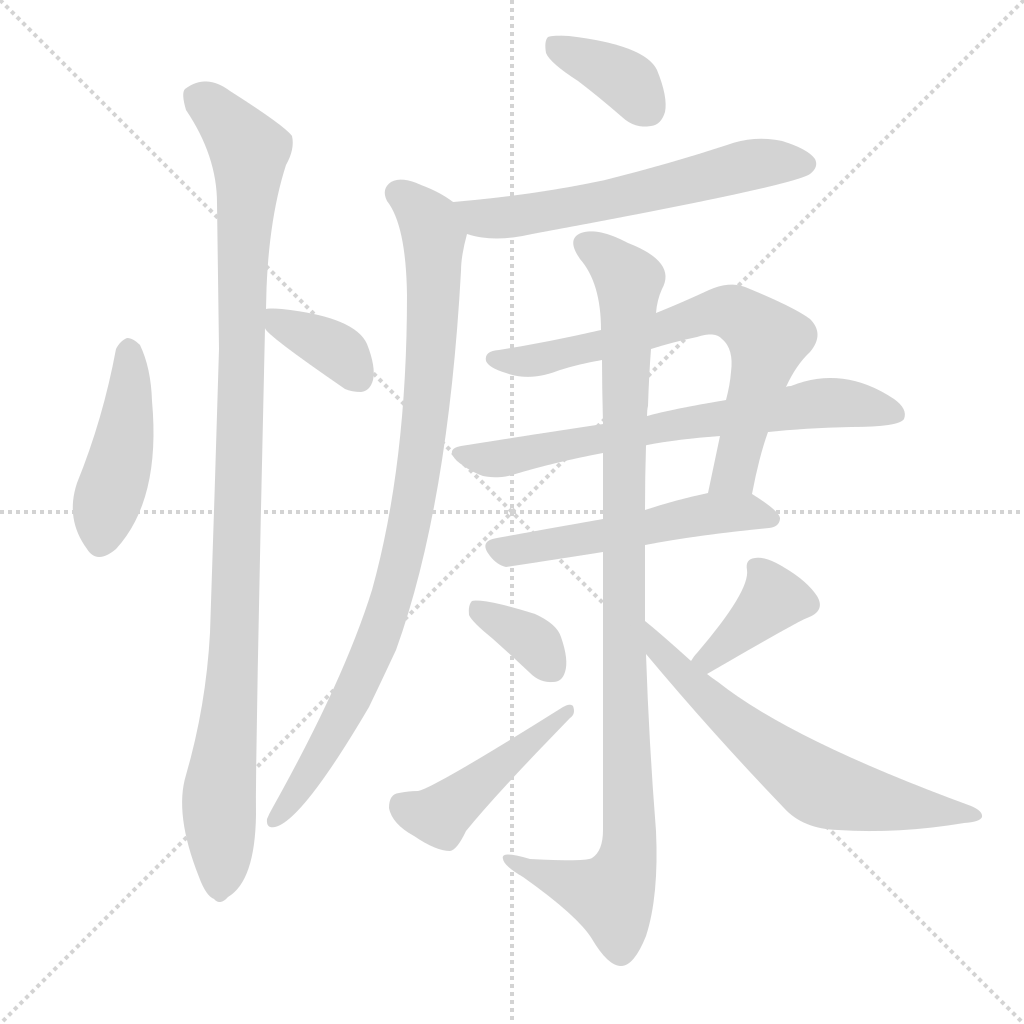
According to the Extensive Rhyme Dictionary (Guangyun) and the Rhyme Compilation (Yunhui), pronounced kang (third tone). According to the Collection of Rhymes (Jiyun), pronounced kang (third tone). According to the Correct Rhyme Dictionary (Zhengyun), pronounced kang (third tone). This is identical to the character kang. The term kang-kai describes a state of intense emotion or high spirits.
In the History of the Later Han (Hou Hanshu), in the Biography of Qi Wu Wang Yan, it describes a character that is firm, resolute, and emotionally spirited.
Additionally, according to the Five Sounds Collection of Rhymes (Wuyin Jiyun), pronounced hang (third tone), with a sound identical to hang. It is also read in the departing tone. According to the Correct Rhyme Dictionary (Zhengyun), pronounced kang (fourth tone), with a sound identical to kang. The meaning is the same.
Furthermore, according to the Collection of Rhymes (Jiyun), the Rhyme Compilation (Yunhui), and the Correct Rhyme Dictionary (Zhengyun), pronounced kang (first tone), with a sound identical to kang. In the Short Song Style (Duan Ge Xing) by Cao Cao, it is written that one should be heroic and spirited. In the Rhapsody on Whistling (Xiao Fu) by Cheng Gongshui, it describes a sound that is sometimes faint and on the verge of breaking, then high-pitched and spirited; sometimes slow and melodic, then complex and resonant.