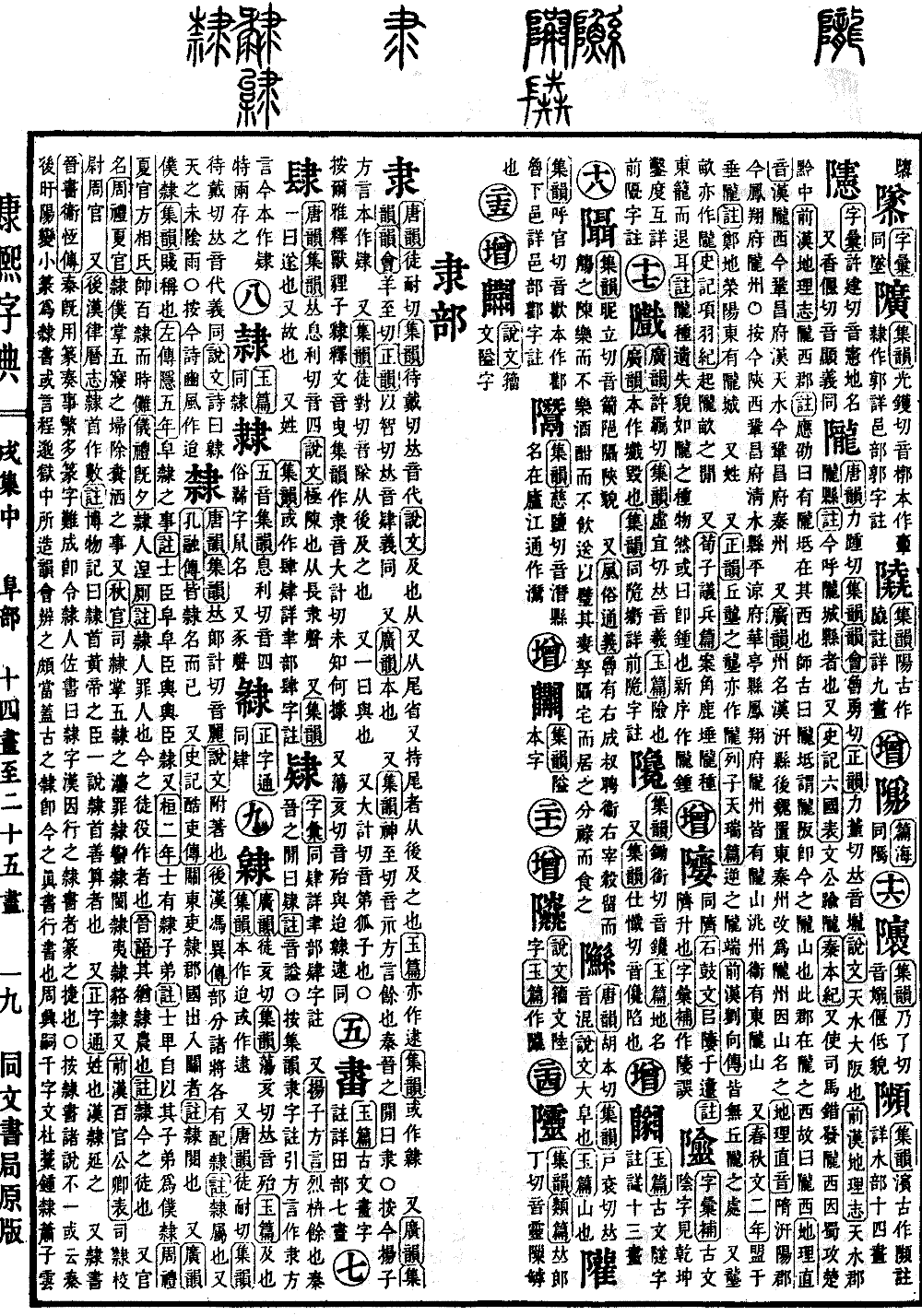
Xu Collection, Middle Volume
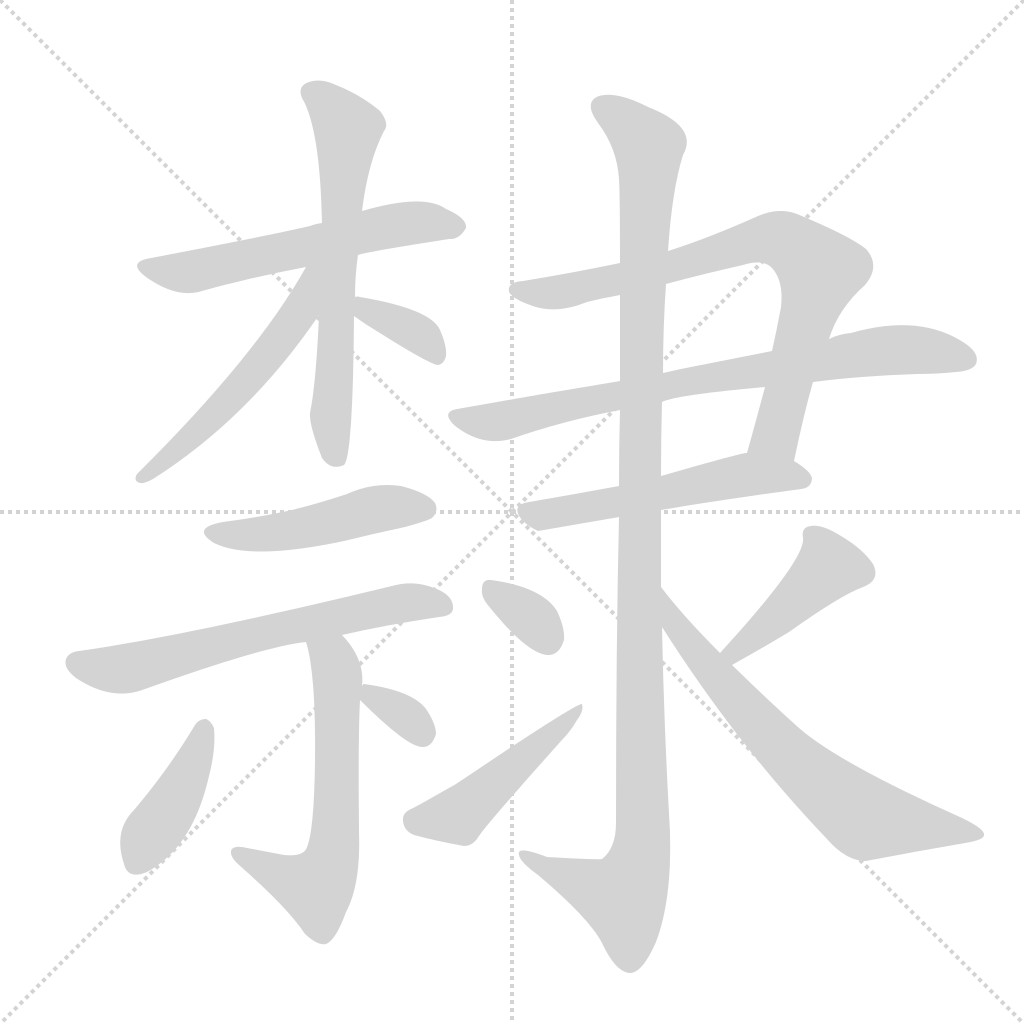
Radical: Slave (lì)
Kangxi Strokes: 17
Page 1363, Entry 30
Tang Rhyme (Tangyun) and Collected Rhymes (Jiyun): Pronounced li (falling tone).
Shuowen Jiezi (Shuowen): To attach or adhere.
History of the Later Han (Hou Hanshu), Biography of Feng Yi: To divide and assign various generals, each having those attached or belonging to them. Commentary: Li means to belong or to be subordinate.
History of the Later Han (Hou Hanshu), Biography of Kong Rong: They were all merely nominal subordinates.
Records of the Grand Historian (Shiji), Biography of Harsh Officials: Officials in the regions east of the pass would inspect those entering and exiting the checkpoints of commanderies and states. Commentary: Li means to inspect.
Expanded Rhymes (Guangyun): Servants or menials.
Collected Rhymes (Jiyun): A term for the low-ranking or base.
Zuo Commentary (Zuo Zhuan), Fifth Year of Yin: Matters concerning forced labor. Commentary: The officer manages the zaos (low-ranking attendants), the zaos manage the charioteers, and the charioteers manage the servants.
Zuo Commentary (Zuo Zhuan), Second Year of Huan: Officers could use their children and younger brothers as servants. Commentary: Officers could use their children and younger brothers as menial slaves.
Rites of Zhou (Zhouli), Summer Official, Fangxiangshi: Leads the many servants to perform the ritual of expelling ghosts at the designated time.
Book of Etiquette and Ceremonial (Yili), Jixi: Sinners fill the latrines. Commentary: The liren (servant people) are the sinners. They are equivalent to those who perform forced labor today.
Discourses of the States (Jin Yu): That is just like a servant in farming. Commentary: Li is the equivalent of those who perform forced labor today.
Official title. Rites of Zhou (Zhouli), Summer Official: The servant-servants (lipu) manage the cleaning and sprinkling of water in the five sleeping palaces.
Autumn Official: The Minister of Servants (Sili) manages the laws for five categories of servant people: criminal servants, barbarian servants, Min servants, Yi servants, and Mo servants.
Book of the Former Han (Qian Hanshu), Table of Officials and Ministers: The Colonel of the Director of Retainers (Sili Xiaowei) was an official post during the Zhou Dynasty.
History of the Later Han (Hou Hanshu), Treatise on Harmonics and Calendars: Lishou invented the numbers. Commentary: The Bowuji states that Lishou was a minister of the Yellow Emperor. Another source says Lishou was a person skilled in calculation.
Zhengzitong: A surname. In the Han Dynasty, there was Li Yan.
Clerical script (lishu). Book of Jin (Jinshu), Biography of Wei Heng: In the Qin Dynasty, seal script was already in use, but as official business was heavy and seal script was difficult to write quickly, the authorities ordered the servant people to assist in writing, hence it was called clerical script (lizì). The Han Dynasty continued this practice. Clerical script is a simplified form of seal script. Note: There are varying opinions regarding clerical script. Some say that after the Qin Dynasty, the people of Guiyang changed small seal script into clerical script. Others say Cheng Miao created it while in prison. The Rhyme Compendium (Yunhui) analyzes this quite accurately; generally, the clerical script of antiquity is equivalent to the modern standard script (kaishu) and semi-cursive script (xingshu). Zhou Xingsi’s Thousand Character Classic (Qianziwen) mentions Du's manuscript and Zhong's clerical script. Xiao Ziyun stated: In discussing the rules of cursive script and clerical script, Wang Xizhi was not as good as Zhong Yao, and Wang Xianzhi was not as good as Wang Xizhi. Ren Jie's Preface to the Five Scripts (Wuti Xu) says: Regarding clerical script, there were Wang Xizhi, Wang Xianzhi, Zhong Yao, Yu Yi, Ouyang Xun, Yu Shinan, Yan Zhenqing, and Liu Gongquan. Sun Guoting's Manual of Calligraphy (Shupu) says: Zhong Yao excelled in clerical script, Zhang Boying excelled in cursive script, and Wang Xizhi excelled in both; they all treated standard script and semi-cursive script as clerical script. Ouyang Xiu's Collected Records (Jigulu) mistakenly began by treating the eight-tenths script (bafen) as clerical script. The Shuyuan states: Cai Yan said that by taking eight-tenths of Cheng Miao's clerical script and two-tenths of Li Si's seal script, the eight-tenths script was formed. Ren Jie also says: Since the eight-tenths script is a balance between seal script and clerical script, one knows that clerical script is not the same as eight-tenths script. The Tang Six Statutes (Tang Liudian) states: The fonts managed by the proofreaders and correctors of characters were five: first, ancient script; second, large seal script, both no longer in use; third, small seal script, used for seals and flags; fourth, eight-tenths script, used for engraving stone classics; and fifth, clerical script, used for classics, memorials, and public or private documents. Based on this, one can be even more certain that clerical script is the modern standard script. Zhengzitong states: The inscription on the stele at Dajue Temple in the Eastern Wei Dynasty says: Clerical script is the modern standard character. This is another piece of evidence.
Collected Rhymes (Jiyun): Pronounced li (falling tone). Meaning to adhere or be dependent on.
Lei Pian: Pronounced lie (falling tone). Meaning servants. The Shuowen originally wrote the character differently. Guangyun mentions a vulgar form. The Yunhui and Zheng Yun consider the current form to be incorrect.