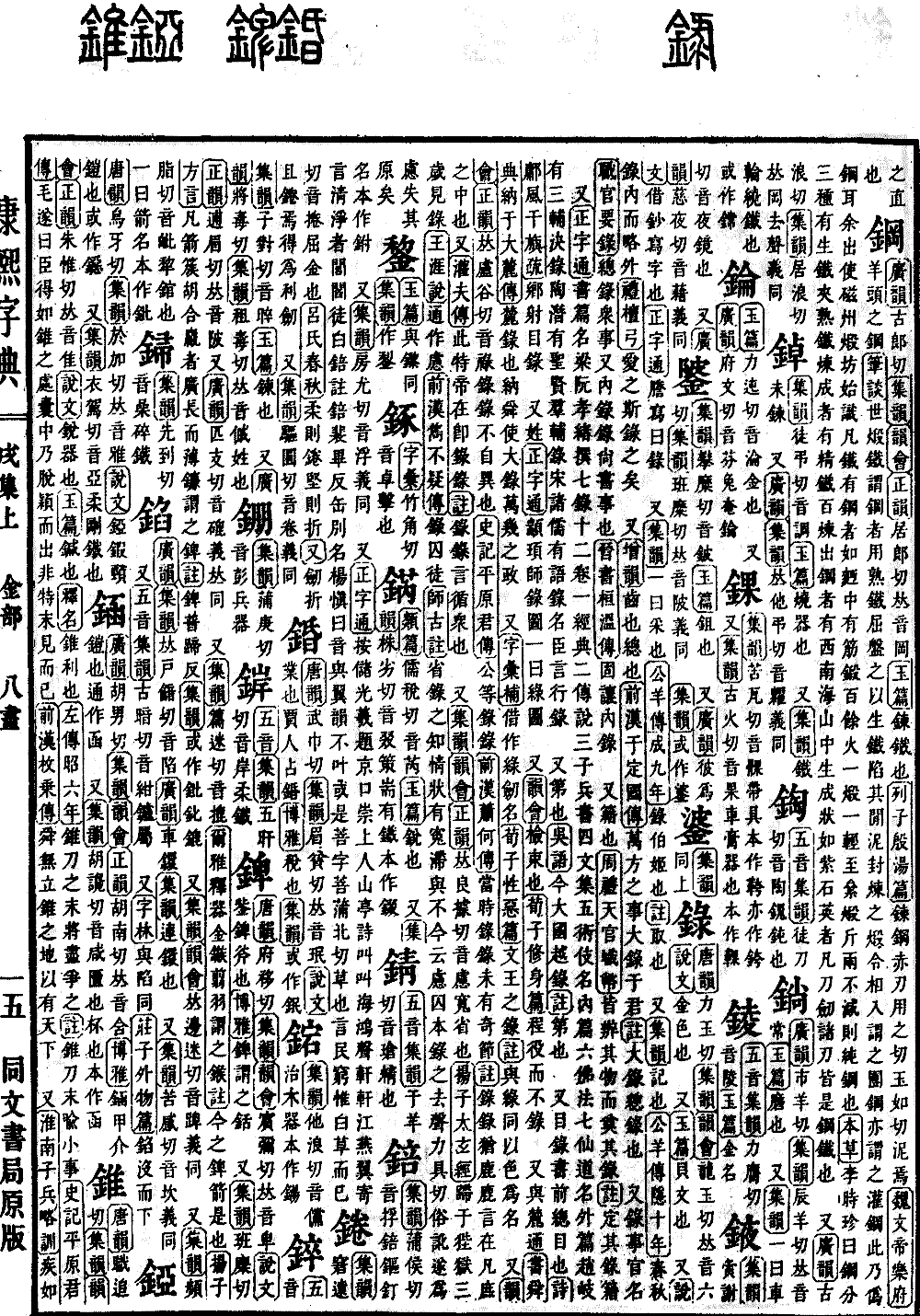
Xu Collection, Upper Volume
Radical: Metal (jīn)
Page 1309, Entry 16
Pronounced lù. According to the Shuowen Jiezi (Explanation of Characters and Phrases), it refers to the color of gold. According to the Yupian (Jade Chapter), it refers to patterns on cowries. According to the Shuowen Jiezi, it is used as a loan word for copying text. According to the Zhengzitong (Proper Character Guide), transcribing is called lu.
Also, according to the Jiyun (Compilation of Rhymes), one meaning is to gather. From the Gongyang Zhuan (Gongyang Commentary on the Spring and Autumn Annals): "To gather Lady Boji." The annotation notes: "To take."
Also, according to the Jiyun, it means to record. From the Gongyang Zhuan: "The Spring and Autumn Annals record internal matters and abbreviate external ones." From the Book of Rites (Liji): "To love is to record."
Also, according to the Zengyun (Expanded Rhymes), it means to enumerate or to summarize. From the History of the Former Han (Qian Hanshu): "The affairs of ten thousand regions are summarized by the ruler." The annotation notes: "To summarize means to gather and record."
Also, a title of a government official. From the Zhiguan Yaolu (Essential Record of Official Posts): "One who manages and summarizes all affairs."
Also, a reference to Nei Lu, which is a position overseeing the affairs of the Secretariat. From the Book of Jin (Jin Shu): "He firmly declined the position of Nei Lu."
Also, a register. From the Rites of Zhou (Zhouli): "Distinguish their items and establish their register." The annotation notes: "To fix their register."
Also, according to the Zhengzitong, it refers to book titles. Ruan Xiaoxu of the Liang Dynasty wrote the Seven Records (Qi Lu) in twelve volumes. It includes one volume for classics, two for commentaries, three for philosophical and military texts, four for collected literature, five for technical and internal arts, six for Buddhist texts, and seven for Daoist texts. Zhao Qi wrote the Records of the Three Prefectures (Sanfu Juelu). Tao Qian wrote the Records of Sages and Worthies (Shengxian Qunfu Lu). Song Dynasty scholars produced Analects (Yulu) and Records of the Sayings and Deeds of Famous Officials (Mingchen Yanxing Lu).
Also, a rank. From the Discourses of Wu (Wuyu): "Now the great state of Yue ranks them." The annotation notes: "To rank."
Also, a table of contents, the general index at the front of a book. From the Mao Commentary on the Book of Odes (Shijing): "The index for local archery rites."
Also, a surname. According to the Zhengzitong, the teacher of Zhuanxu was named Lu Tu. One account says it is Green (Lü) Tu.
Also, according to the Yunhui (Collection of Rhymes), it means to restrain. From the Xunzi: "Regulated in service, yet not restrained."
Also, interchangeable with the character meaning foot of a mountain (lù). From the Book of Documents (Shangshu): "Appointed to the great mountain foot." The commentary says: "Foot of a mountain means to record (lu). Appointed Shun to manage the affairs of ten thousand concerns."
Also, according to the Zihuibu (Supplement to the Character Collection), used as a loan for green (lǜ). A sword name. From the Xunzi: "The Lu sword of King Wen." The annotation notes: "Same as green (lǜ). Named for its color."
Also, according to the Yunhui, Zheng Yun (Correct Rhymes), pronounced lù. A repeated form (lu lu), meaning to not set oneself apart from others. From the Records of the Grand Historian (Shiji): "You gentlemen are common and unremarkable." From the History of the Former Han (Qian Hanshu): "At the time, he was unremarkable and lacked extraordinary merit." The annotation notes: "Lu lu is like being in the midst of the common crowd." From the Biography of Guan Fu: "He is merely following the crowd." The annotation notes: "Lu lu means to follow the masses."
Also, according to the Jiyun, Yunhui, and Zheng Yun, pronounced lǜ. To examine or investigate with care. From the Taixuanjing: "Imprisoned in the dungeon, judged for three years." Wang Ya says: "Commonly written as (lǜ - to deliberate)." From the History of the Former Han (Qian Hanshu): "To examine prisoners." Master Yan Shigu's annotation notes: "To review them to see if there were any grievances or delays. Today it is called (lǜ - to deliberate) prisoners. Originally written as lu in the departing tone (falling tone). Though the vulgar form has erroneously become (lǜ), it has lost its original meaning."