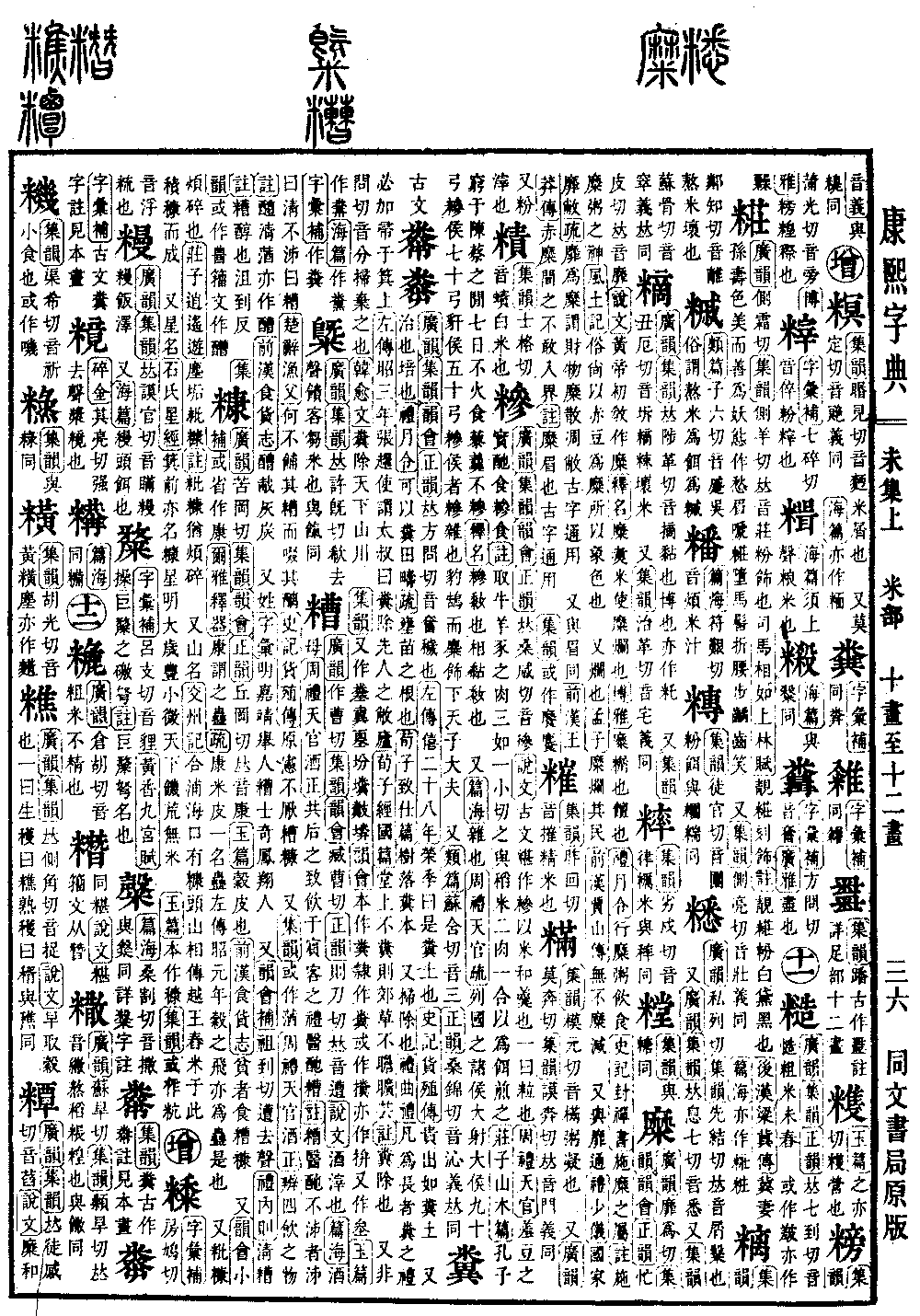
Wei Collection, Upper Volume
Radical: Rice (mǐ)
Kangxi Strokes: 17
Page 912, Entry 31
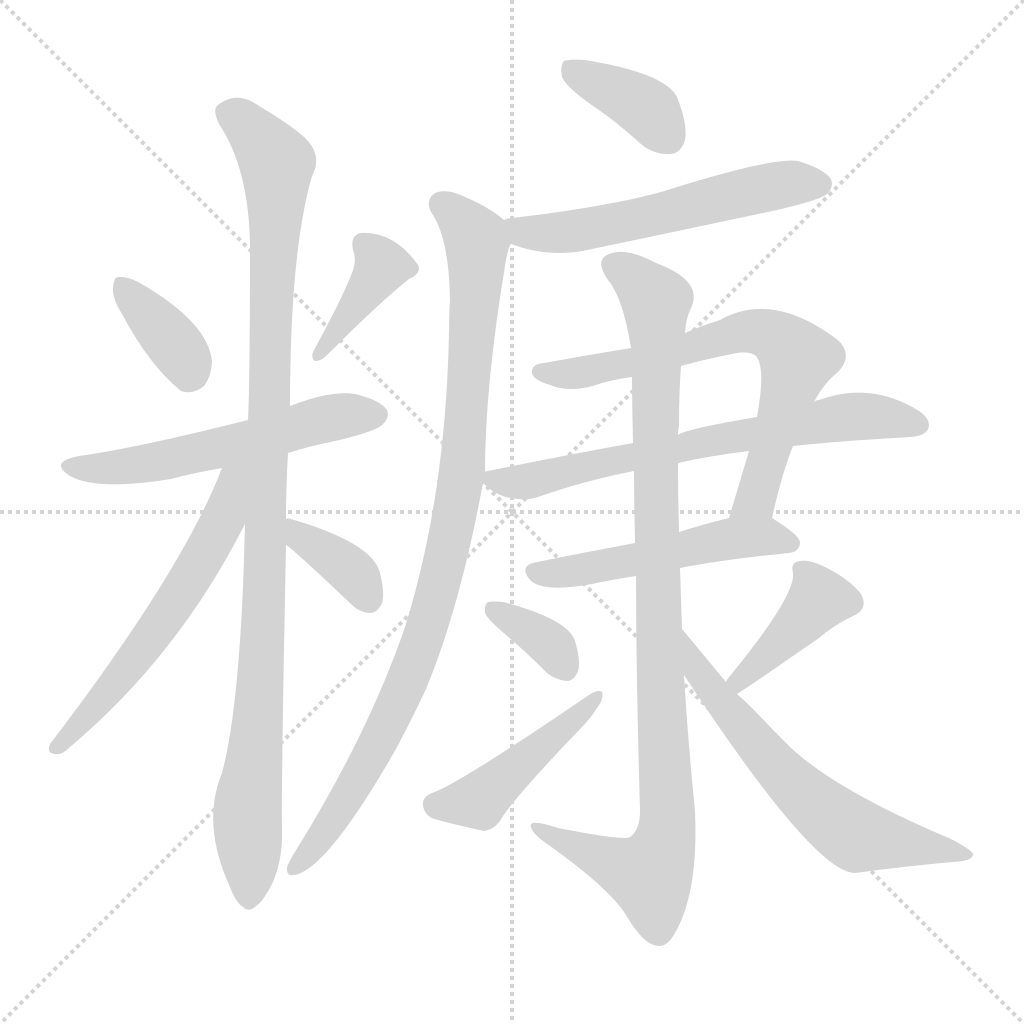
Pronounced kang.
Jade Chapter (Yupian): The husks of grain.
History of the Former Han (Qianhan Shu), Treatise on Food and Money: The poor eat dregs and husks.
Sometimes written in a simplified form (kang).
Classic of Etymology (Erya), Explanation of Vessels: Husks are called gu.
Commentary: Husks are rice peels, also known as gu. The Zuo Tradition (Zuo Zhuan), first year of Duke Zhao, mentions that when grain flies, it becomes gu.
Also refers to husks and chaff, meaning something trivial or broken.
Zhuangzi, Free and Easy Wandering: Dust, dirt, husks, and chaff.
Annotation: Husks and chaff denote things that are trivial or broken.
A mountain name.
Records of Jiaozhou (Jiaozhuji): At the sea mouth of Hepu, there is Husk-Head Mountain. Legend says the King of Yue pounded rice here, and the accumulation of husks formed it.
A star name.
Shi’s Star Classic (Shi Shi Xingjing): The area in front of the Winnowing Basket constellation is also called the Husk star. When this star is bright, the year is prosperous; when it is dim, the world suffers from famine and lack of rice.
Originally written as kang.
Also written as kang.