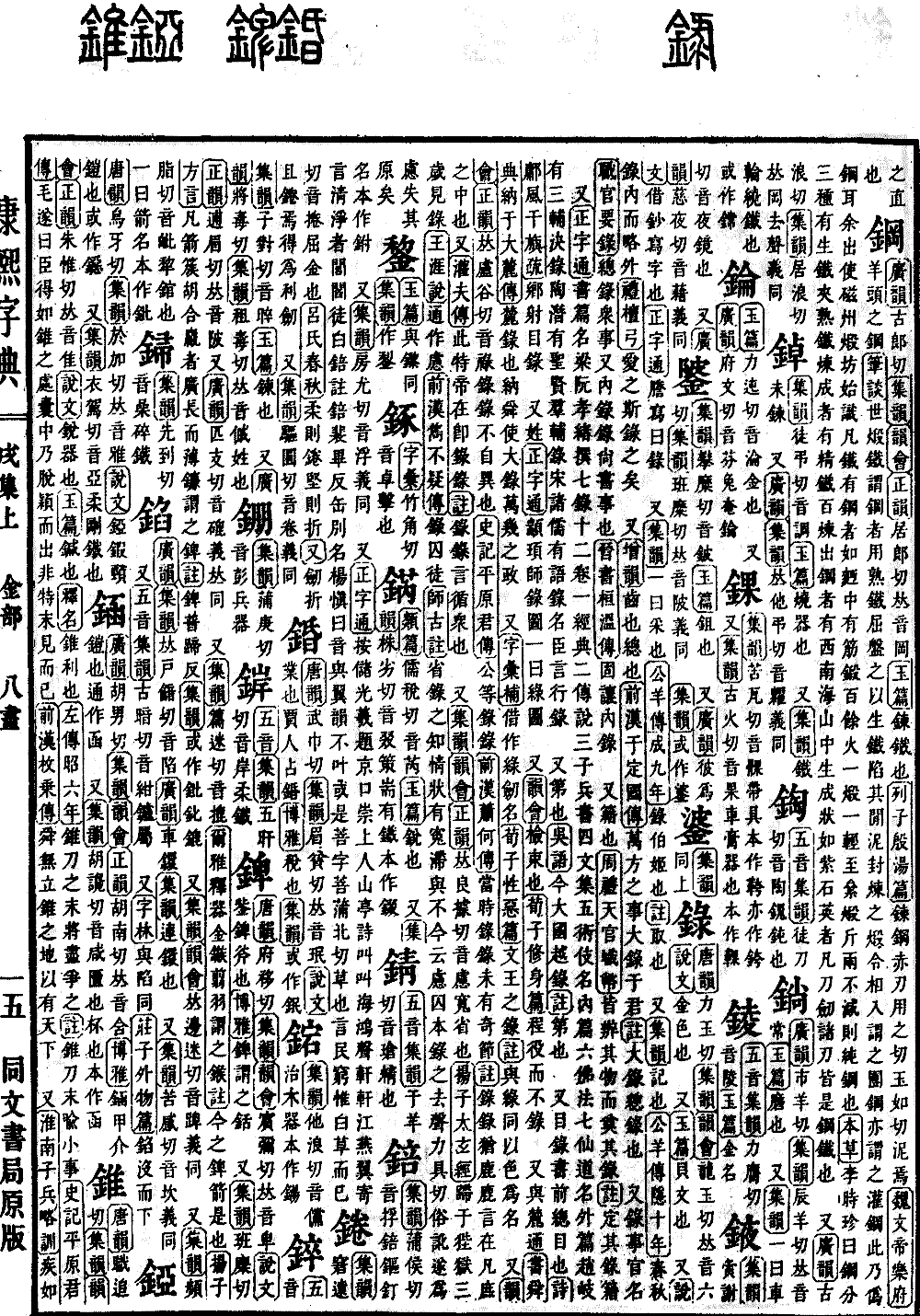
Xu Collection, Upper Volume
Radical: Metal (jīn)
Page 1309, Entry 11
Pronounced liu.
According to the Shuo Wen Jie Zi (Explaining Graphs and Analyzing Characters), it refers to the color of metal.
According to the Yu Pian (Jade Chapters), it refers to cowrie shell patterns.
According to the Shuo Wen Jie Zi, it is used for the act of copying texts.
According to the Zheng Zi Tong (Correct Character Mastery), copying text is called lu.
According to the Ji Yun (Collection of Rhymes), one meaning is to select or collect.
Commentary in the Gongyang Zhuan (Gongyang Commentary on the Spring and Autumn Annals), Ninth Year of Duke Cheng: To select Bo Ji. The commentary states this means to take.
According to the Ji Yun, it means to record.
Gongyang Zhuan, Tenth Year of Duke Yin: The Spring and Autumn Annals records internal affairs and summarizes external ones.
Book of Rites (Liji), Tan Gong: To love someone is to record their actions.
According to the Zeng Yun (Expanded Rhymes), it means to balance or to summarize.
Biography of Yu Dingguo in the Book of Han (Hanshu): The affairs of the ten thousand regions are summarized by the ruler. The commentary states that major summary refers to a general accounting.
Lu Shi is the name of an official post. In the Zhi Guan Yao Lu (Essential Record of Official Posts), it is described as the general overseeing of various affairs.
Nei Lu refers to the manager of the affairs of the Secretariat. Biography of Huan Wen in the Book of Jin (Jinshu): He firmly declined the position of manager of the Secretariat.
It also refers to a register. Zhou Li (Rites of Zhou), Office of Heaven, Official of Currency: Distinguish the items and establish their registers. The commentary states this means to fix their recorded lists.
According to the Zheng Zi Tong, it is a title for books. Ruan Xiaoxu of the Liang dynasty compiled the Seven Records in twelve volumes: first, classics; second, commentaries; third, masters and military strategy; fourth, literary collections; fifth, arts and techniques, called the inner chapters; sixth, Buddhist teachings; seventh, Taoist arts, called the outer chapters. Zhao Qi authored the Record of Decisions of the Three Prefectures. Tao Qian authored the Record of Sages and Assistants. Various Confucian scholars of the Song dynasty produced Records of Sayings and Records of the Words and Deeds of Famous Ministers.
It also means rank. In the Conversations of Wu (Guoyu): Now the great state of Yue takes its rank. The commentary notes this means order.
Mulu is the table of contents at the beginning of a book. Exegesis on the Odes of Yong (Yongfeng) in the Book of Odes (Shijing): Table of contents for the village archery ritual.
A surname. According to the Zheng Zi Tong, the teacher of Zhuanxu was Lu Tu, also written as Lu Tu (variant form).
According to the Yun Hui (Collection of Rhymes), it means to restrain or inspect. Xunzi, Cultivating the Self: Engaging in labor without restraint.
Interchangeable with the character lu (foot of a mountain). Book of Documents (Shangshu), Canon of Shun: Admitted to the great lu. The commentary states that lu means to record. It implies that Shun was entrusted to record the affairs of the ten thousand government tasks.
According to the Zi Hui Bu (Supplement to the Character Collection), borrowed to be used as green. A sword name. Xunzi, The Nature of Evil: The lu of King Wen. The commentary states it is the same as green. Named for its color.
According to the Yun Hui and the Zheng Yun (Standard Rhymes), pronounced lu. Lu-lu means not standing out from others.
Records of the Grand Historian (Shiji), Biography of Lord Pingyuan: You gentlemen are ordinary.
Biography of Xiao He in the Book of Han: At that time they were mediocre, lacking unusual integrity. The commentary notes that lu-lu is like lu-lu (deer-like), meaning to be among the common masses.
Biography of Guan Fu: This is merely to follow the crowd while the Emperor is present. The commentary states that lu-lu means following the majority.
According to the Ji Yun, Yun Hui, and Zheng Yun, pronounced lu. It means to examine or investigate leniently. Yang Xiong, Taixuan (Great Mystery): Detained in prison for three years before being investigated. Wang Ya explains that it is commonly written as lu (to consider).
Biography of Jun Buyi in the Book of Han: Investigating the prisoners. The commentary by Yan Shigu states that it means to examine and determine if there are any grievances or injustices in their cases. Today this is called lu (to consider) prisoners. Originally it was pronounced in the departing tone (falling tone). The current, common usage is a mistake and has lost its original meaning.