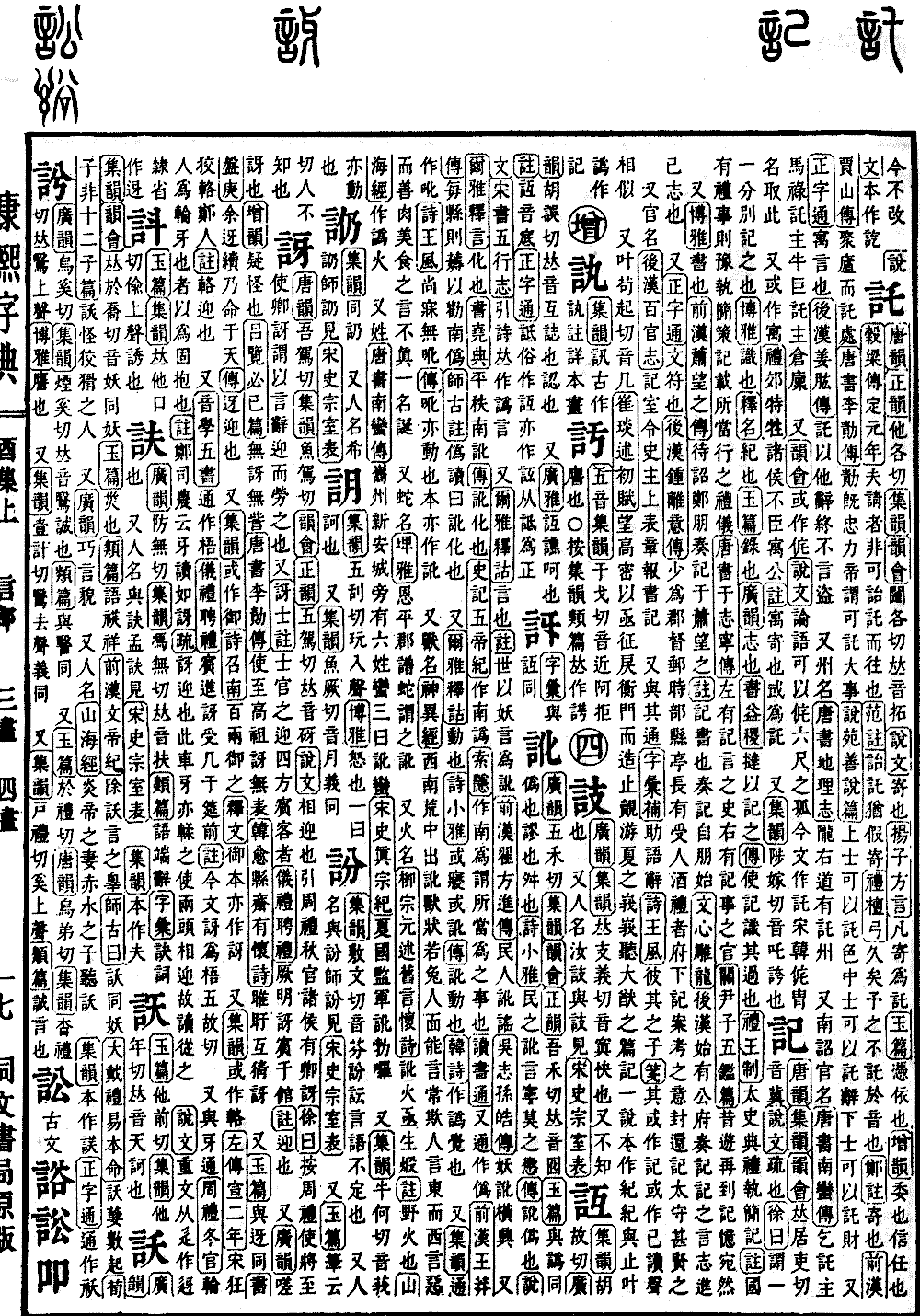
You Collection, Upper Volume
Radical: Speech (yán)
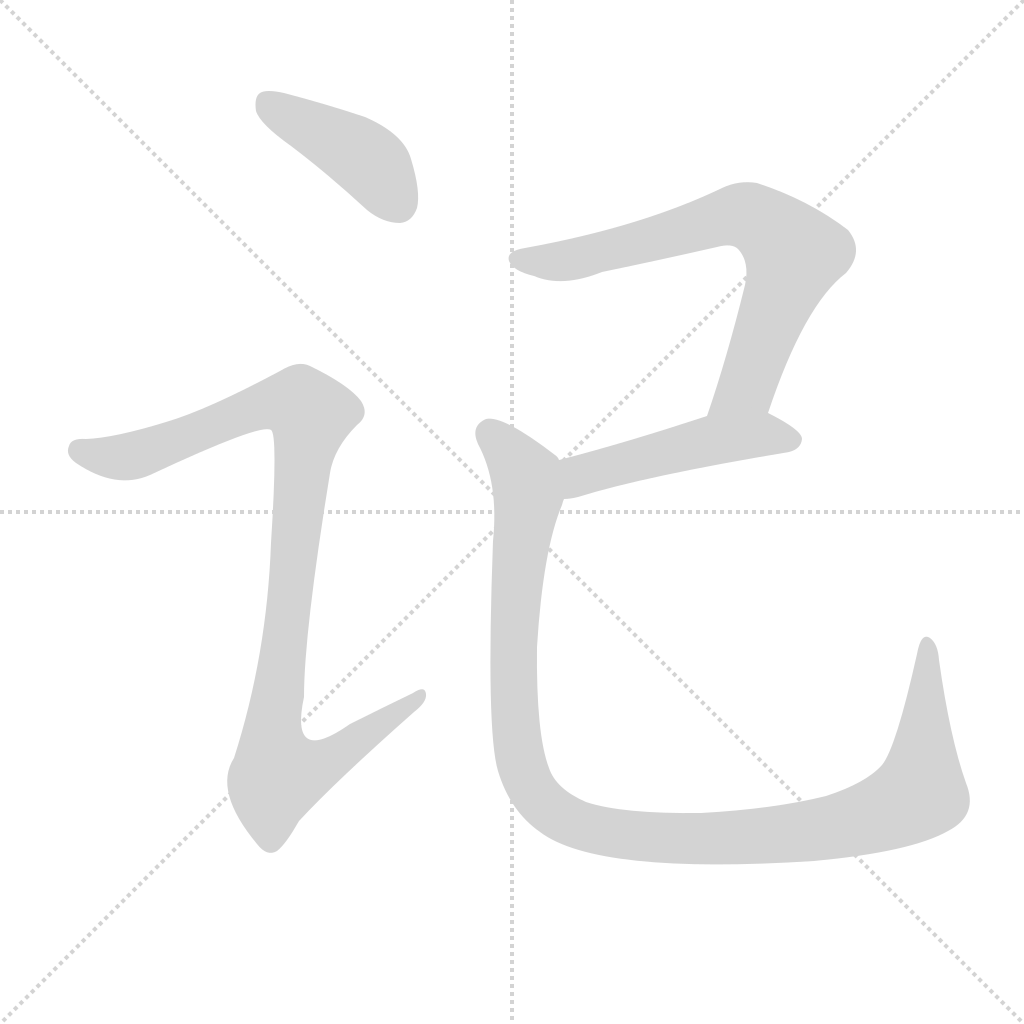
記
Kangxi stroke count: 10
Page 1149, Entry 01
Pronounced jì.
Shuowen Jiezi (Shuowen): To record item by item.
Xu Commentary: To record one by one separately.
Guangya: To memorize.
Shiming: To record.
Yupian: To record.
Guangyun: To remember.
Book of Documents (Shujing), Classic of Shun (Yiji): Use the whip to make him remember.
Commentary: To make him remember his errors.
Book of Rites (Liji), Royal Regulations (Wangzhi): The Grand Historian manages rituals and holds the records.
Annotation: When the state has ritual activities, they would hold the wooden slips in advance to record the rituals that should be performed.
Book of Tang (Tangshu), Biography of Yu Zhining: On the left were the historians who recorded speech, on the right were the officials who recorded events.
Guan Yinzi, Five Mirrors chapter: Having visited a place in the past and arriving again, the memory remains clear.
Also refers to documents.
History of the Former Han (Qianhan Shu), Biography of Xiao Wangzhi: The awaiting official Zheng Peng presented a memorandum to Xiao Wangzhi.
Annotation: A record is a document. The form of the memorandum originated with Zheng Peng.
The Literary Mind and the Carving of Dragons (Wenxin Diaolong): In the Later Han dynasty, the offices of the feudal lords began using the memorandum; a record is a means to express one’s intent and present one's opinions.
Also refers to official documents.
History of the Later Han (Houhan Shu), Biography of Zhongli Yi: When he was young, he served as a regional inspector. At that time, a local official had accepted gifts of food and wine; the commandery government issued an official document ordering an investigation. Zhongli Yi sealed the document and returned it, and the prefect considered him to be very virtuous.
Also refers to an official title.
History of the Later Han (Houhan Shu), Treatise on Officials: The Record Chamber Secretary (jishilingshi) was primarily responsible for submitting memorials and responding to documents.
Also used interchangeably with the character qí.
Zihui Bu: A particle.
Book of Odes (Shijing), Odes of Wang: That man.
Commentary: Some versions of the character qí are written as jì, while others are written as jǐ. The pronunciations are similar.
Also rhymed, pronounced jǐ.
Cui Yan, Preface to Initial Rhapsody (Shuchu Fu): Looking toward Gaomi and proceeding urgently, I arrived at the horizontal gate and stopped. Seeing the dignified appearance of Ziyou and Zixia, I listened to the records of grand strategies. One theory suggests the original character was jì (to record/discipline), and since jì rhymes with zhǐ, it was mistakenly written as jì (record).