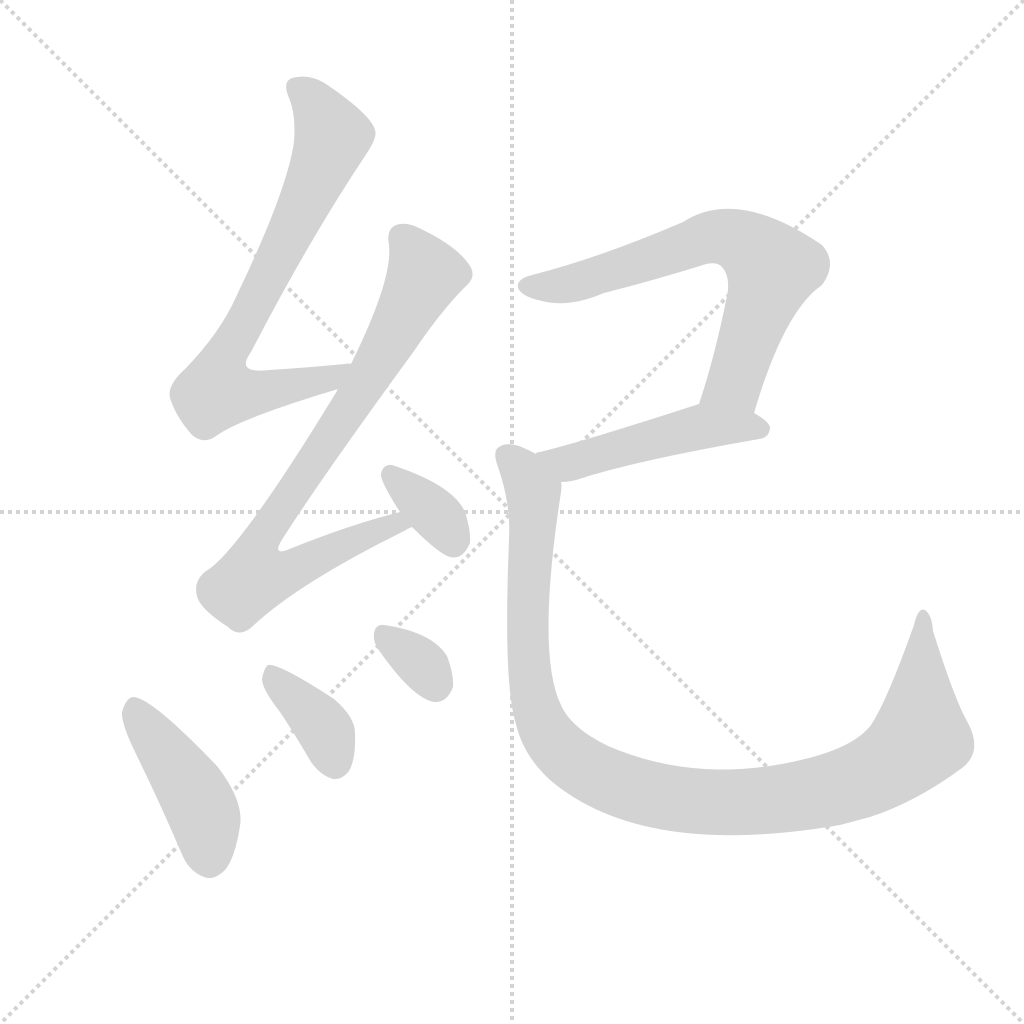
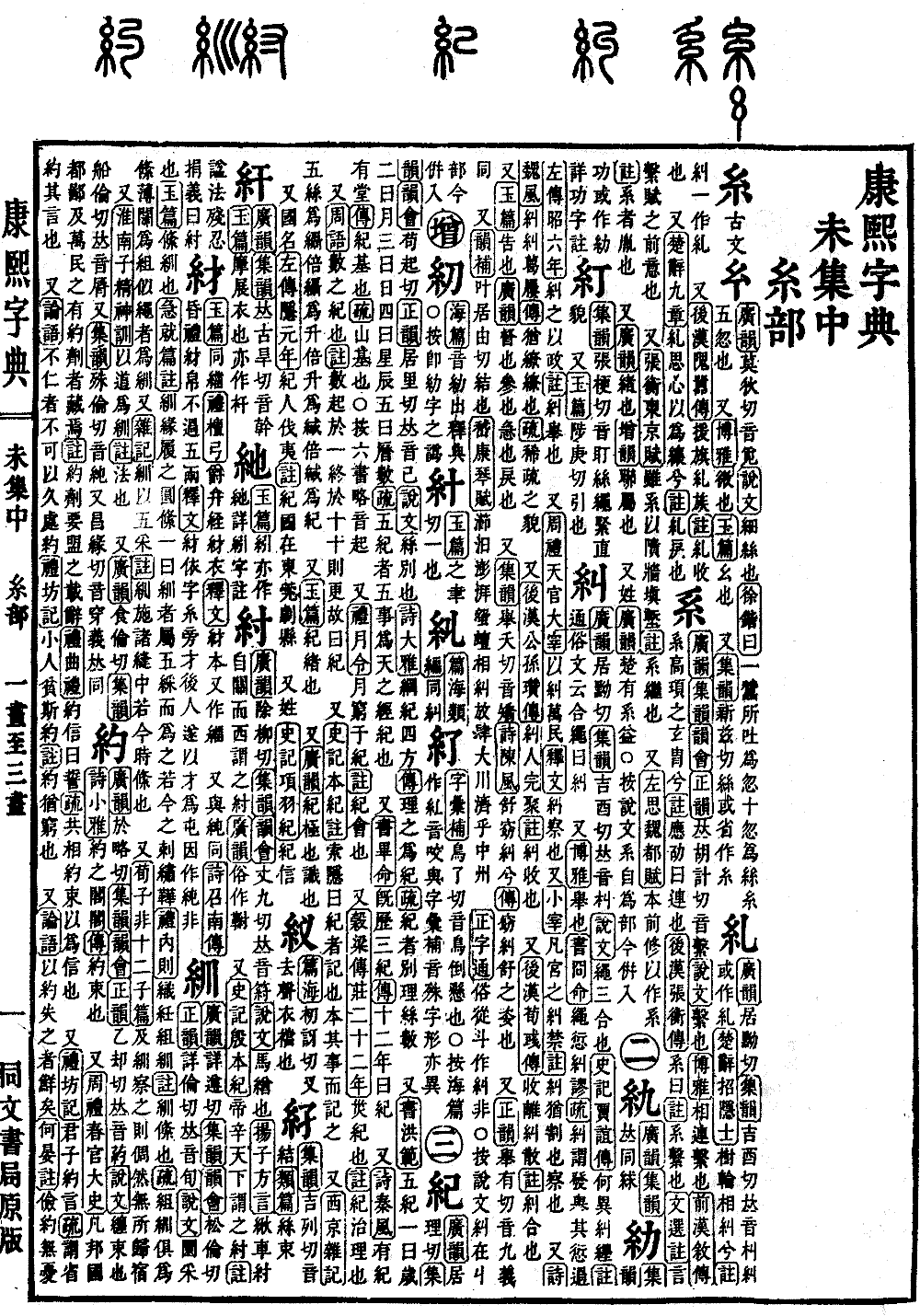
Wei Collection, Lower Volume
Radical: Silk (mì)
Page 915, Entry 13
Pronounced ji (rising tone).
According to the Explaining Graphs and Analyzing Characters (Shuowen Jiezi), it refers to separating silk threads.
In the Book of Odes (Shijing), it is written: regulating the four quarters. The commentary states that to regulate is to create a pattern (ji). The sub-commentary explains that ji refers to organizing and distinguishing the strands of silk.
In the Book of Documents (Shangshu), it is written: the five patterns (wu ji): first is the year, second is the month, third is the day, fourth is the stars and constellations, and fifth is the calendar calculations. The sub-commentary states that the five patterns are the five affairs that serve as the fundamental guiding principles of heaven.
Also, in the Book of Documents, it is written: having passed through three cycles (ji). The commentary states that twelve years is called a cycle.
In the Book of Odes, it is written: having a base and having a hall. The commentary states that ji means foundation, and the sub-commentary clarifies it as the base of a mountain. According to the Essentials of the Six Writings (Liushu Lue), the sound is also pronounced qi (rising tone).
In the Book of Rites (Liji), it is written: the month terminates at the meeting point (ji). The commentary states that ji means to meet.
In the Guliang Commentary (Guliang Zhuan), it is written: a disaster is a calamity (ji). The commentary states that ji means to govern or regulate.
In the Discourses of the States (Guoyu), it is written: the foundation (ji) of numbers. The commentary states that numbers begin at one and end at ten; at ten, they start over, therefore it is called a cycle.
In the Records of the Grand Historian (Shiji), the commentary on Basic Annals (Benji) states that ji means to record, establishing the facts of the matter and recording them.
In the Miscellaneous Records of the Western Capital (Xijing Zaji), it is written: five threads of silk make a mi, doubling that makes a sheng, doubling the sheng makes a yu, and doubling the yu makes a ji.
In the Jade Compendium (Yupian), ji means an end or a thread.
According to the Extensive Rhymes (Guangyun), ji means an extreme limit or to remember.
It also refers to a state name. In the Zuo Commentary (Zuo Zhuan), it is written: the people of Ji attacked Yi. The commentary states that the state of Ji was in the Ju county of Dongguan.
It is also a surname. In the Records of the Grand Historian, it mentions Ji Xin.