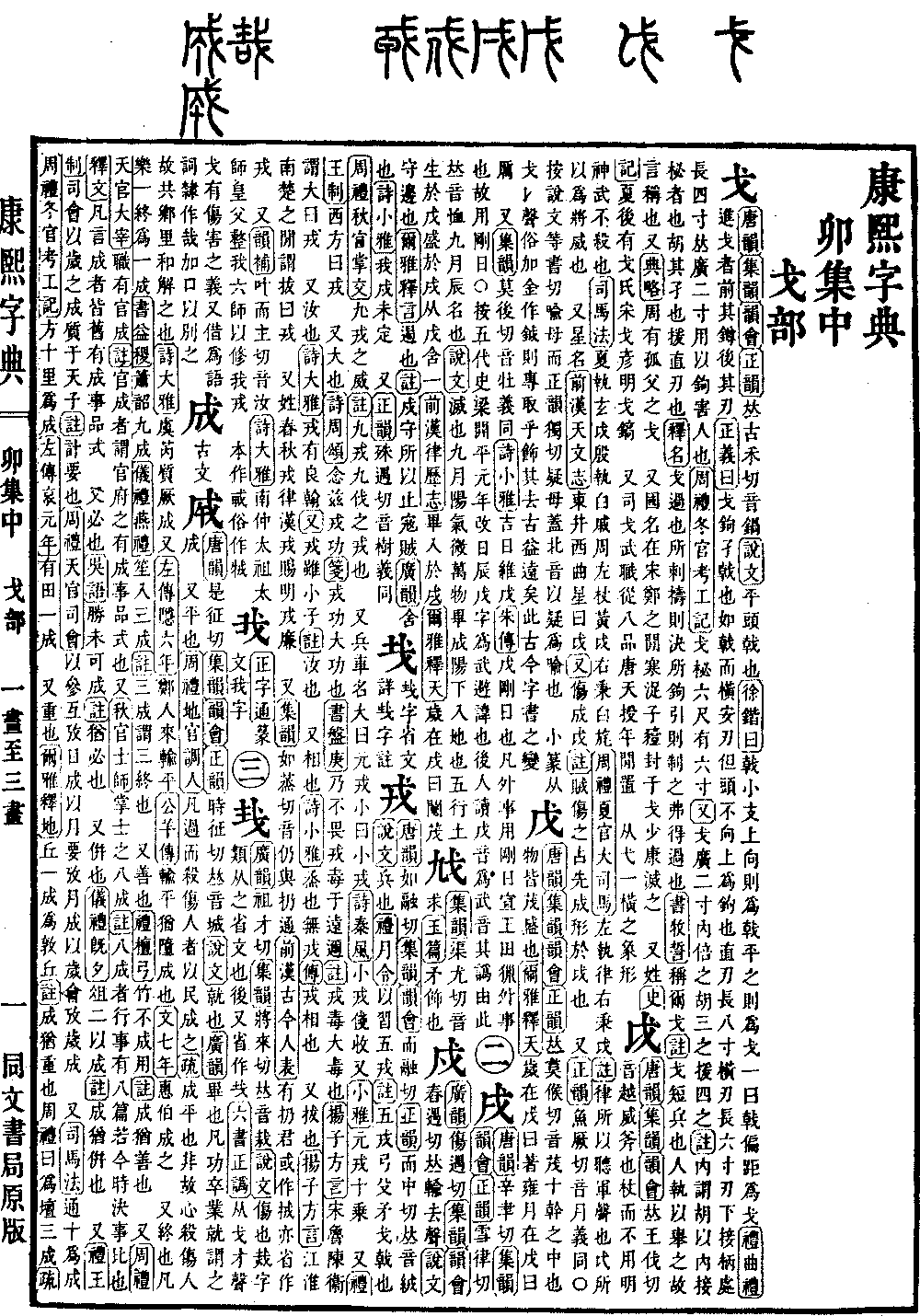
Mao Collection, Middle Volume. Radical: Halberd (gē). Kangxi stroke count: 4. Page 411, Entry 01.
Pronounced guō.
Shuowen Jiezi explains it as a halberd with a flat head. Xu Kai states that a halberd with a small branch pointing upward is considered a halberd, while one that is placed horizontally is a gē. Another interpretation suggests the side component of a halberd is called a gē.
Book of Rites (Liji), Quli: When presenting a gē, the handle should be held forward with the blade facing backward.
Zhengyi states: A gē is a type of halberd with a hook. Like a halberd, the blade is mounted horizontally, but the head does not point upward; it is used for hooking and killing. The straight blade is eight inches long, the horizontal blade is six inches long, and the section where the blade connects to the handle is four inches long and two inches wide, used to hook and wound people.
Rites of Zhou (Zhouli), Dongguan Kaogongji: The handle of a gē is six feet and six inches long.
It is further stated: The gē is two inches wide; the interior part that connects to the handle is twice the width; the hu (the downward-extending part of the head) is three times that width; and the yuan (the straight blade portion) is four times that width.
Note: The interior refers to the part within the hu that connects to the handle. The hu is the hook-shaped part extending down from the head of the gē. The yuan is the straight blade.
Shiming: The name gē means to pass. If used for stabbing, it pierces; if used for hooking and pulling, it subdues, preventing the enemy from passing.
Book of Documents (Shangshu), Mushi: Raise your gē.
Note: A gē is a short weapon. People held them aloft, which is why the term raise is used.
Dianlue records that during the Zhou dynasty, there was a gē crafted by Gufu.
It also refers to a feudal state. It was located between the states of Song and Zheng. Yi, the son of Han Zhuo, was enfeoffed in the region of Ge, but was later destroyed by Shaokang.
It is also a surname. Records of the Grand Historian (Shiji) mentions that descendants of the Xia dynasty had the surname Ge; the Song dynasty had Ge Yan, and the Ming dynasty had Ge Hao.
There was also the military position of Sige (Controller of Halberds), a rank of the eighth grade, established during the Tianshou era of the Tang dynasty.
The character form is derived from the radical yì, with an added horizontal stroke. It is a pictograph.