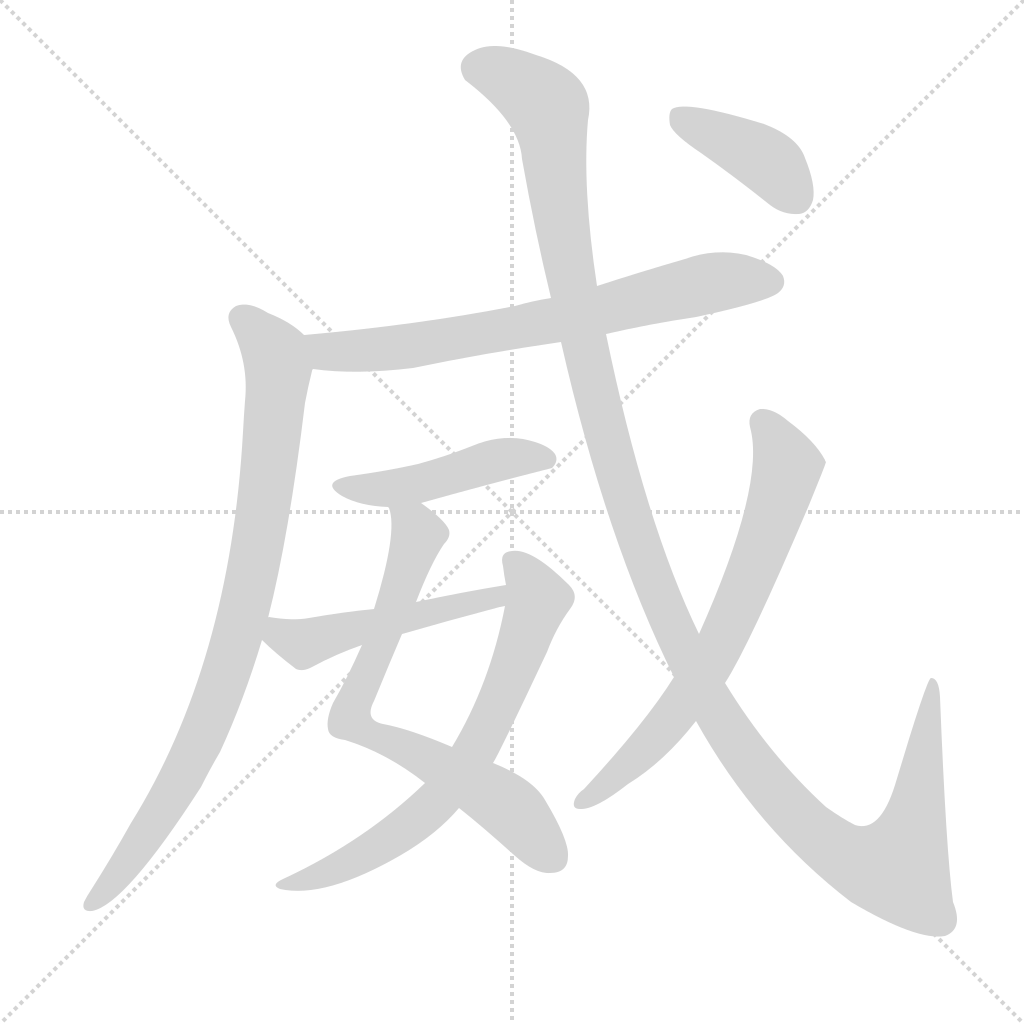
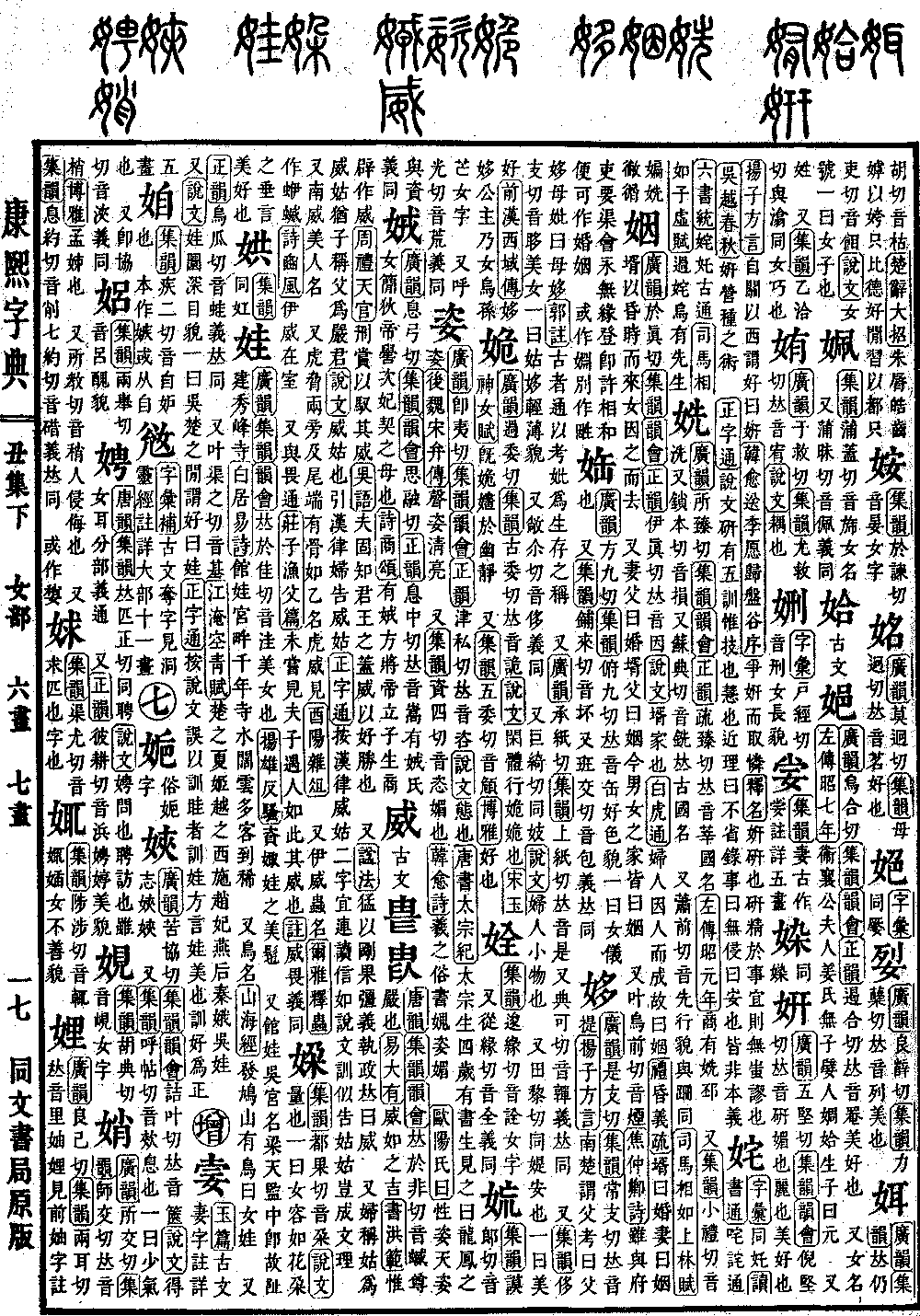
Chou Collection, Lower Volume
Radical: Woman (nǚ)
Wei
Kangxi strokes: 9
Page 261, Entry 24
Ancient form.
According to Tang Rhyme (Tangyun), Collected Rhymes (Jiyun), and Rhyme Meeting (Yunhui), the pronunciation is wei.
Dignity or majesty.
Book of Changes (Yijing): Majestic good fortune.
Book of Documents (Shangshu): Only the ruler wields power.
Rites of Zhou (Zhouli): Use rewards to control their majesty.
Discourses of Wu (Wuyu): I have always known that the king's grandeur is due to his love of victory.
谥法 (Shifa, Rules for Posthumous Titles): To be fierce, firm, and resolute, to be strong and righteous in governance, is called wei.
Also, a daughter-in-law refers to her mother-in-law as weigu. This is similar to a son referring to his father as the stern lord.
Explaining Graphs and Analyzing Characters (Shuowen Jiezi): Wei is mother-in-law. It cites the Han Code regarding a wife reporting her mother-in-law.
Correction of Characters (Zhengzitong): The Han Code should be read with the two characters weigu together. If we follow the interpretation in Explaining Graphs and Analyzing Characters, it would be reporting to the mother-in-law, which makes no sense.
Nanwei is the name of a beauty.
The tiger has bones on the sides of its flanks and at the tip of its tail shaped like the letter z, called huwei; see Miscellaneous Morsels from Youyang (Youyang Zazu).
Yiwei is the name of an insect.
Approaching Elegance (Erya): Recorded as yiyi.
Book of Odes (Shijing): The yiwei is in the room.
Also interchangeable with wei (to fear/awe).
Zhuangzi (Zhuangzi): I have never seen the master treat anyone with such awe.
Commentary: Wei and fear have the same meaning.