Hai Collection, Middle Volume
Radical: Fish (yú)
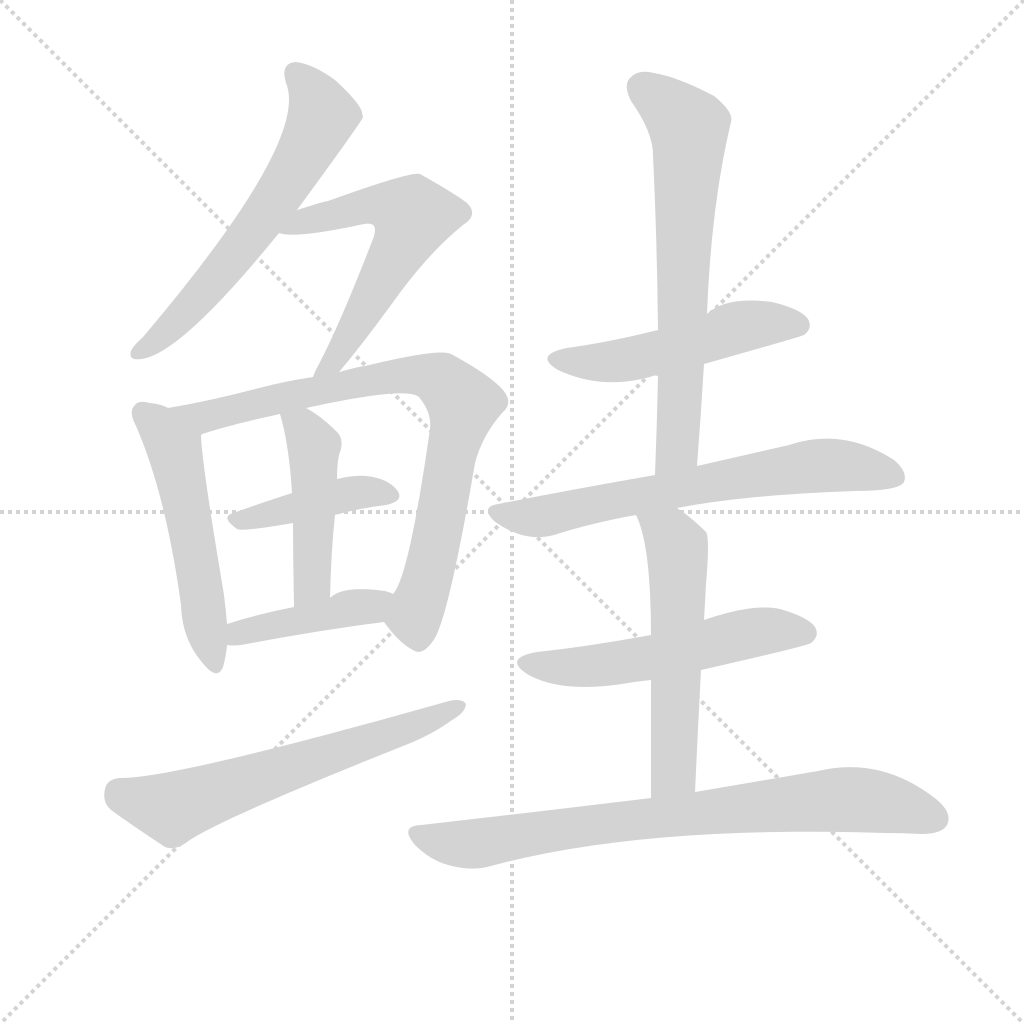
鮭
Kangxi Stroke Count: 17
Page 1470, Entry 06
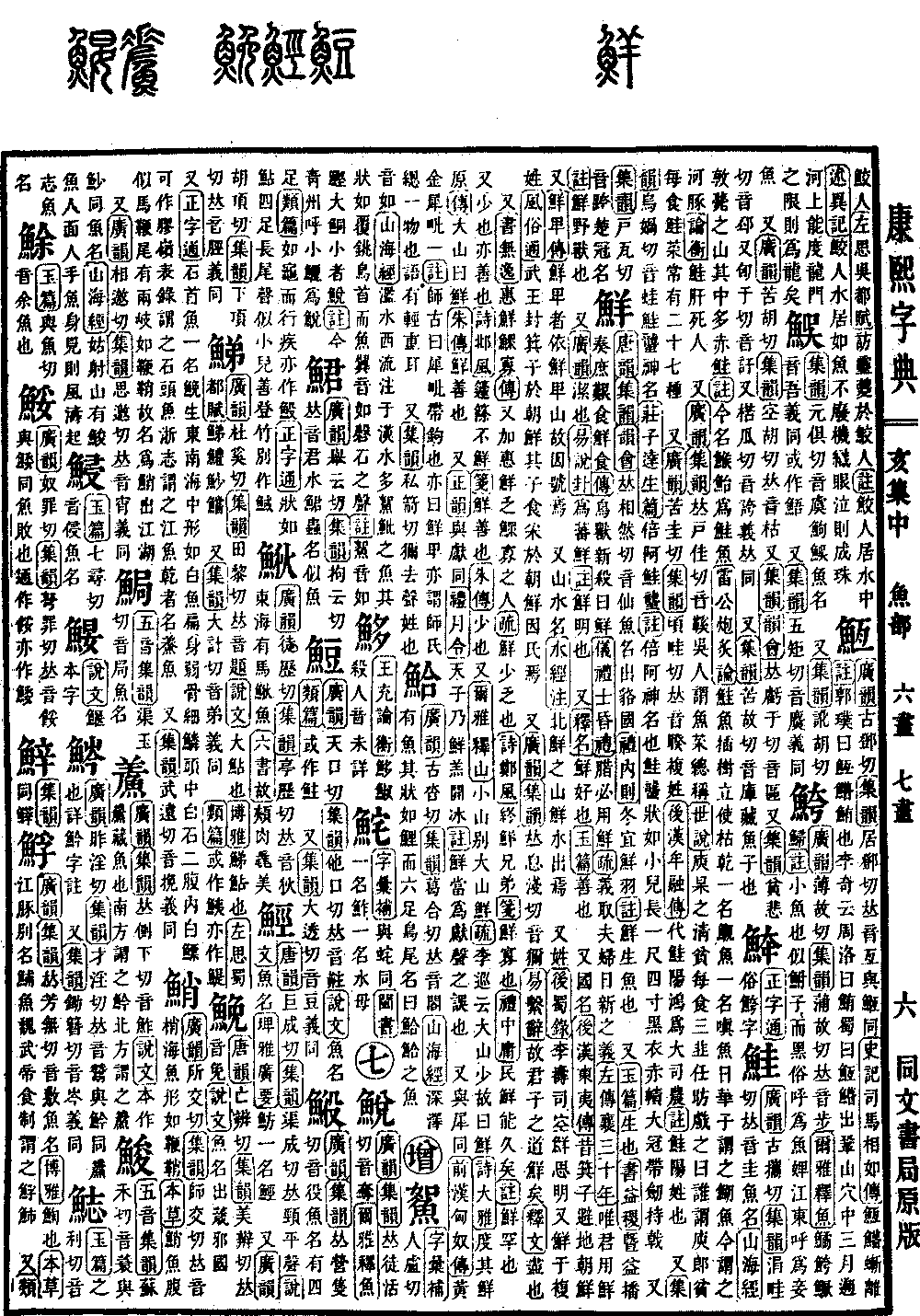
Pronounced gui. A type of fish. In the Classic of Mountains and Seas (Shanhaijing), it is written: On Mount Dunhong, there are many red gui. Annotation: Today, the pufferfish is called gui fish. According to the Leigong Paozhi Lun (Treatise on the Preparation of Materia Medica), if a gui fish is stuck into a tree, it will immediately wither and die. It is also known as the fish, and also as the chen fish. Rihuazi calls it the hu fish; today it is called the river pig (pufferfish). In the Lunheng (Balanced Discourses), it is written: The liver of the gui can kill a man.
Pronounced xie. The people of Wu use this to refer to fish and vegetables collectively. In the Shishuo (A New Account of Tales of the World), it is written: Yu Gaozhi was poor and humble, and for every meal, he ate three kinds of leeks. Ren Fang teased him, saying: Who says Master Yu is poor? For every meal, he has twenty-seven kinds of gui vegetables.
Pronounced kui. A compound surname. In the Biography of Mou Rong in the History of the Later Han (Hou Hanshu), it is written: He replaced Guiyang Hong as Minister of Agriculture. Annotation: Guiyang is a surname.
Pronounced wa. Gui long, the name of a spirit. In the chapter on Understanding Life in the Zhuangzi, it is written: Bei-a and gui long. Annotation: Bei-a is the name of a spirit. The gui long is shaped like a small child, one foot and four inches tall, wearing black clothing, a red head-cloth, and a large cap, carrying a sword and holding a halberd.
Pronounced kua. A type of cap from the state of Chu.