Shen Collection, Upper Volume
Radical: Grass (cǎo)
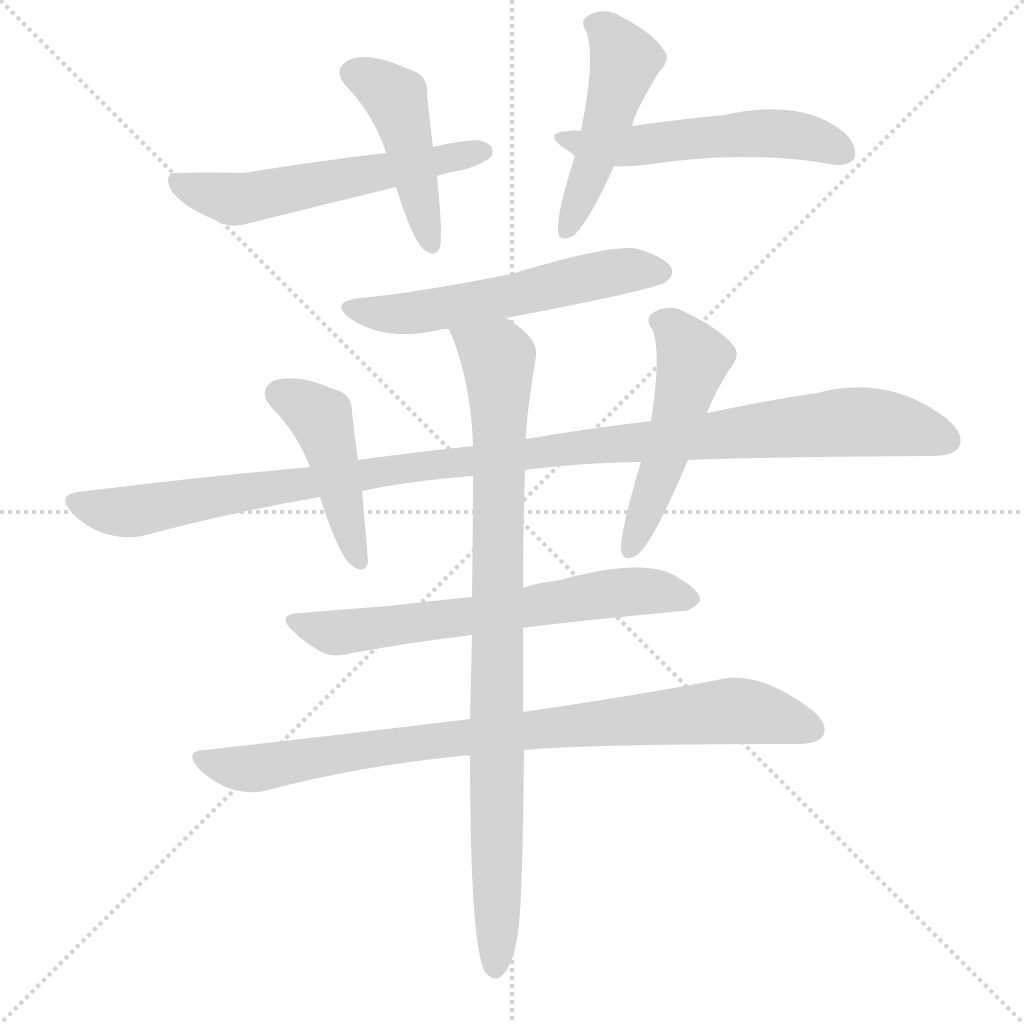
華
Kangxi strokes: 14
Page 1039, Entry 14
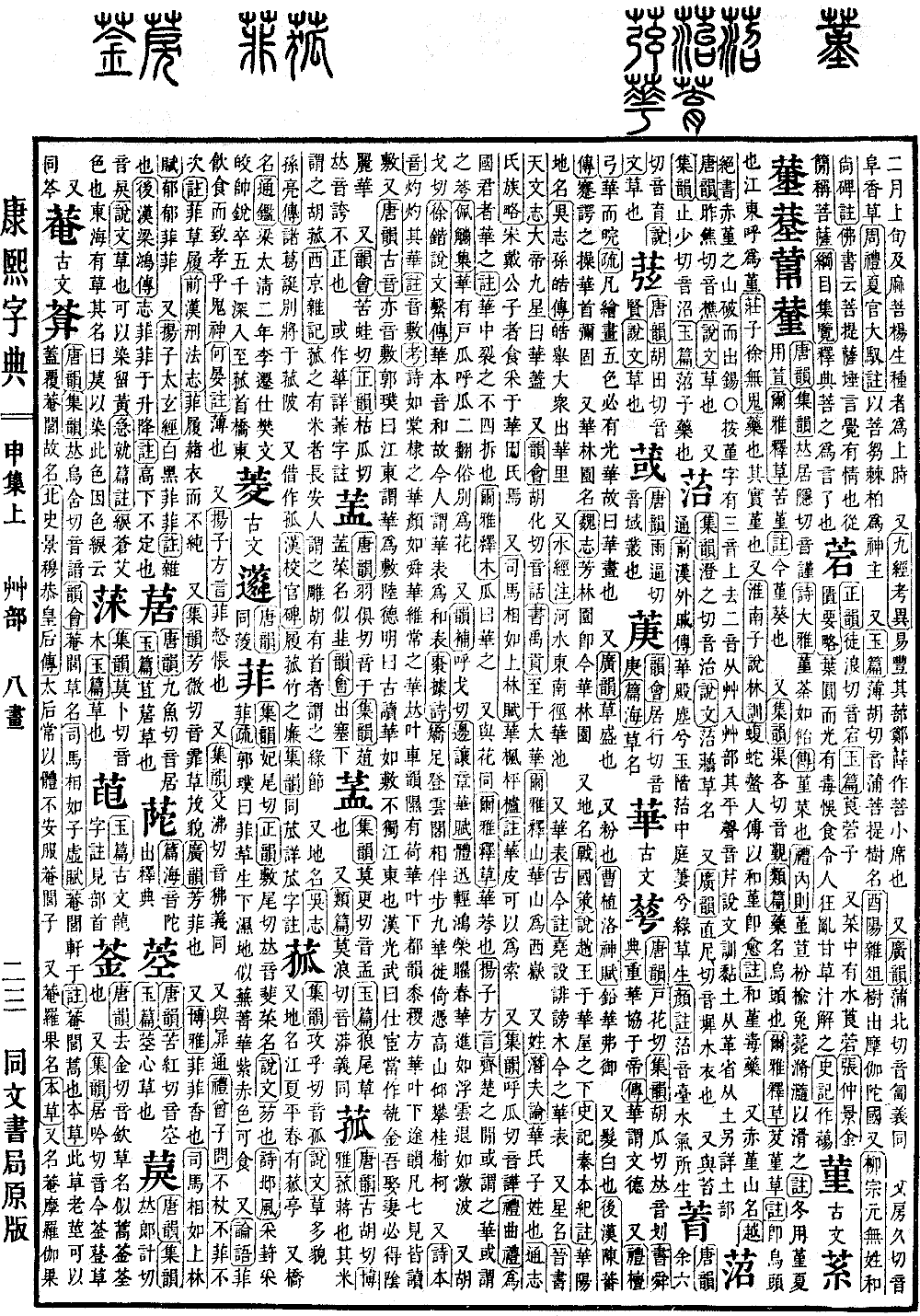
In ancient texts, it is recorded in the Tang Rhyme (Tangyun) that it is pronounced hua. In the Collected Rhymes (Jiyun), it is pronounced hua. The pronunciation is similar to hua. The Book of Documents (Shangshu), in the Canon of Shun (Shundian), mentions "Chonghua harmonized with the Emperor." The Commentary (Zhuan) explains that hua refers to literary virtue. Furthermore, the Book of Rites (Liji), in the Tan Gong chapter, mentions "hua and huan." The Sub-commentary (Shu) explains that whenever one paints, the five colors necessarily have luster, therefore hua means to paint. It is also explained in the Broad Rhymes (Guangyun) as the luxuriant growth of plants and trees. It also refers to cosmetic powder. The Cao Zhi Ode on the Goddess of the Luo River (Luoshen Fu) contains the line "without the application of leaden powder (hua)." It also refers to greying hair. The History of the Later Han (Hou Hanshu), in the Biography of Chen Fan, mentions "the integrity of Jian E, with white hair (hua) becoming more steadfast." There is also Hualin, a garden name. The Records of Wei (Weizhi) records that the Fanglin Garden is the current Hualin Garden. It is also a place name. The Strategies of the Warring States (Zhanguo Ce) mentions "persuading the King of Zhao beneath the decorated halls (hua wu)." The Records of the Grand Historian (Shiji), in the Basic Annals of Qin, mentions Huayang, which is a place name. The Records of Wu (Wuzhi), in the Biography of Sun Hao, mentions "Hao led the masses out of Huali." The Commentary on the Water Classic (Shuijing Zhu) records "the Yellow River flows southeast passing Huachi." There is also the Huabiao. The Records of Past and Present (Gujin Zhu) records that Yao set up a tablet for criticisms, which is the current Huabiao. It is also the name of a star. The Book of Jin (Jinshu), in the Treatise on Astronomy, records that the nine stars of the Great Emperor are called Huagai.
In the Rhyme Compendium (Yunhui), it is pronounced hua. The Book of Documents (Shangshu), in the Tribute of Yu (Yugong), mentions "reaching as far as Mount Taihua." The Erya, in the Explanation of Mountains (Shishan), records Huashan, which is the Western Peak. It is also a surname. The Discourses of a Recluse (Qianfu Lun) mentions the son of the Hua clan, which is a surname. The General Records (Tongzhi), in the Genealogy of Clans, records that the son of Duke Dai of Song was enfeoffed at Hua, and therefore took Hua as his clan name. Sima Xiangru's Rhapsody on the Shanglin Park (Shanglin Fu) mentions "hua, feng, ping, lu." The Annotation (Zhu) explains that the bark of the hua tree can be used to make ropes.
In the Collected Rhymes (Jiyun), it is pronounced hua. The Book of Rites (Liji), in the Qu Li chapter, mentions "those who serve the sovereign should hua it." The Annotation (Zhu) explains that hua means to split from the middle, not divided into four petals. The Erya, in the Explanation of Trees (Shimu), mentions that a melon is called a hua. It is identical to the character for flower (hua). The Erya, in the Explanation of Plants (Shicao), explains "hua is a blossom (fu)." The Fangyan by Yang Xiong records that between Qi and Chu, some call it hua, and some call it fu. The Peiqi Ji records that hua has two pronunciations, hua and hua; the common variant is written as flower (hua).
In the Supplement to Rhymes (Yunbu), it is pronounced ge. Bian Rang's Rhapsody on Zhanghua (Zhanghua Fu) writes "the body is swift as a light wild goose, glorious as the spring hua. Advancing like floating clouds, retreating like surging waves." It is also pronounced ge. Xu Kai's Explanation of Characters Series (Shuowen Xichuan) records that the original pronunciation of hua was he, therefore people today call the Huabiao the Hebiao. The Zao Ju Poetry writes "lifting feet to ascend the cloud pavilion, walking together in the Nine-Hua. Leaning high on the mountain, gazing up at the branch of a cinnamon tree."
The Book of Odes (Shijing), in its Original Pronunciation (Benyin), mentions "burning, burning is its hua." The Annotation (Zhu) says the pronunciation is fu. Textual verification: In the Book of Odes (Shijing), instances such as "the hua of the Changdi," "the face is like the hua of the sun," and "the hua of the chang" rhyme with the "che" rhyme. "In the marshes there is lotus hua" rhymes with the "du" rhyme. "The millet and panicled millet are just coming into hua" rhymes with the "tu" rhyme. It appears a total of seven times, and all are pronounced fu. The Ancient Pronunciation of the Tang Rhyme (Tangyun Guyin) also pronounces it fu. Guo Pu said: In the Jiangdong region, hua is pronounced fu. Lu Deming said: In ancient times, hua was pronounced like fu, not just in Jiangdong. Emperor Guangwu of Han said: If one serves as an official, one should be a bearer of the gold mace (Jinwu); if one takes a wife, one must marry Yin Lihua.
In the Rhyme Compendium (Yunhui), it is pronounced kua. In the Correct Rhymes (Zhengyun), it is pronounced kua. The meaning is incorrect. It may also be written as a variant. See the note for that character for details. It is also written as a variant.
Textual verification: Book of Rites, Tan Gong: "Hua and huan." I have corrected "huan" according to the original text. Book of Odes, Original Pronunciation: "Burning, burning is its hua." Annotation: The pronunciation is fu. Textual verification: In the Book of Odes, such as "the hua of the Tangdi." I have corrected "Tang" to "Chang" according to the original text.