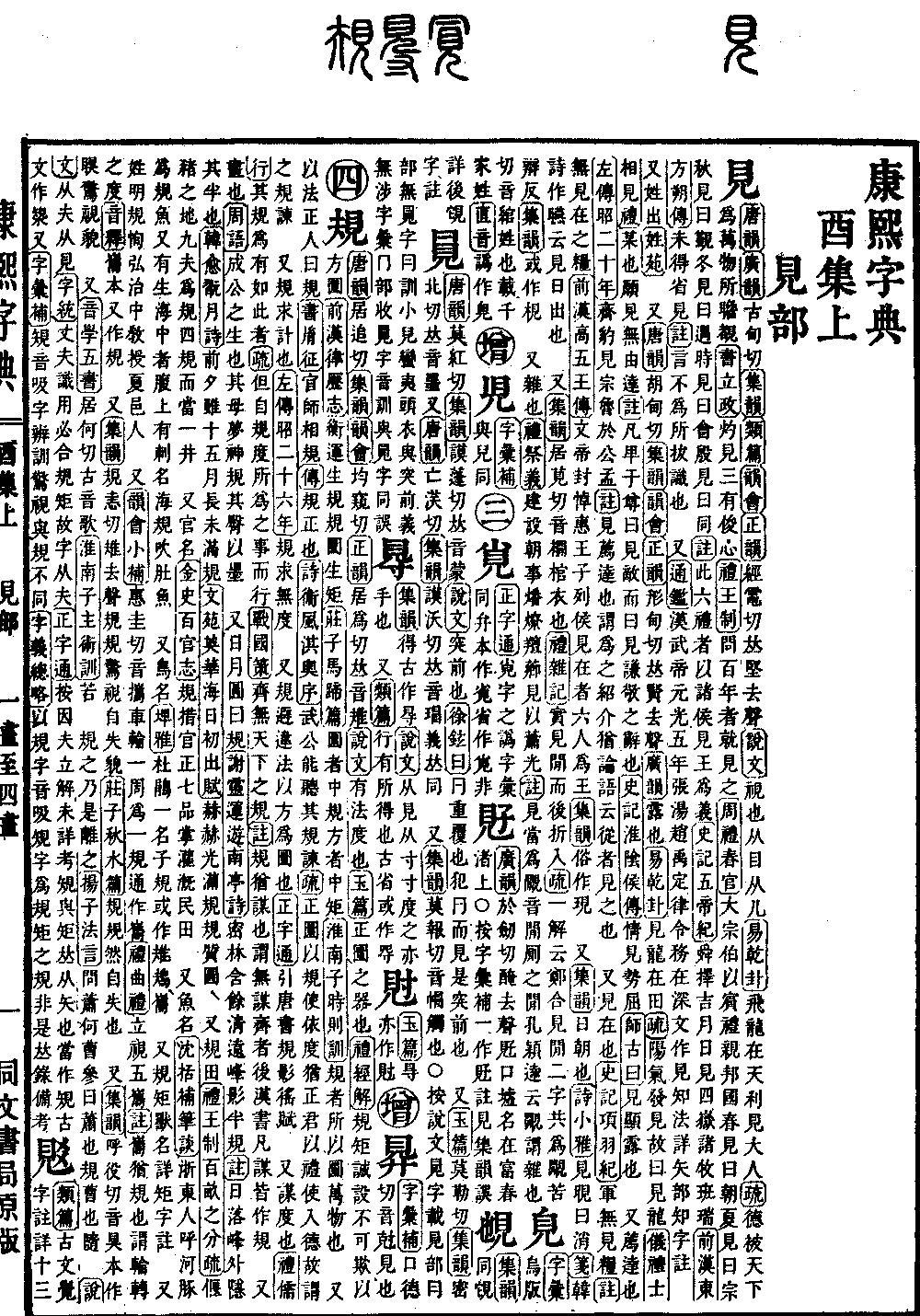
You Collection, Upper Volume
Radical: See (jiàn)
Kangxi Strokes: 11
Page 1133, Entry 01
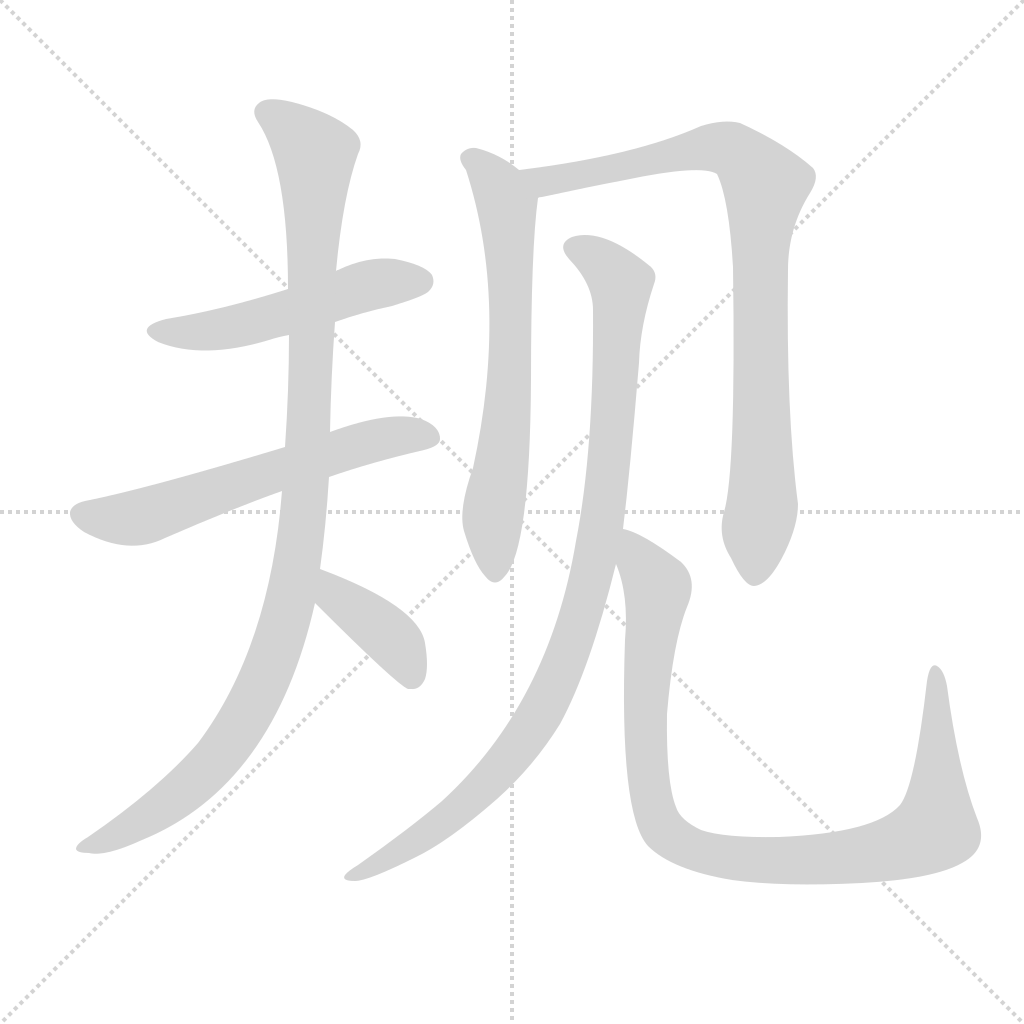
Pronounced gui.
According to the Explaining Graphs and Analyzing Characters (Shuowen Jiezi), it refers to having standards or laws.
The Jade Compendium (Yupian) defines it as an instrument for drawing a perfect circle.
Book of Rites (Liji): When the compass and square are set correctly, one cannot be deceived by square or round shapes.
History of the Former Han (Qianhan Shu): The balance rotates to create the compass, and the circle creates the square.
Zhuangzi: That which is round fits the compass, and that which is square fits the square.
Huainanzi: The compass is that by which the myriad things are made round.
Also, to correct people using the law is called gui.
Book of Documents (Shangshu): The official teachers corrected one another.
Commentary: Gui means to rectify.
Book of Odes (Shijing): Duke Wu was able to listen to such remonstrances (gui jian).
Sub-commentary: To correct a circle with a compass so it conforms to standard is like correcting a ruler with ritual to ensure virtue; thus, it is called gui jian.
Also, gui means to plan or seek.
Zuo Tradition (Zuo Zhuan): Seeking without limit.
Also, to avoid the law, making what is square into round.
Zhengzitong: Cites the Old History of Tang (Jiu Tang Shu): To evade taxes and labor levies.
Also, to plot or measure.
Book of Rites (Liji): His planning was as such.
Sub-commentary: Simply self-measuring the matters to be done and acting upon them.
Strategies of the Warring States (Zhanguo Ce): Qi had no plans for the world.
Annotation: Gui means plan, referring to those without plans for Qi. In the History of the Later Han (Houhan Shu), all plans are written with the character gui.
Also, to draw.
Discourses of the States (Guoyu): When Duke Cheng was born, his mother dreamed a deity marked his buttocks with ink using a compass.
Also, the roundness of the sun and moon is called gui.
Xie Lingyun: Dense forests contain lingering clarity; distant peaks cast half-round shadows (gui).
Annotation: As the sun sets beyond the peaks, it hides half of its roundness.
Han Yu: Although it was the fifteenth of the previous night, the moon was not yet a full circle (gui).
Wenyuan Yinghua: Radiant light fills, perfectly round in quality.
Also, a measure of field land.
Book of Rites (Liji): In marshy lands, nine men constitute a gui, and four gui equal one well-field.
Also, an official title.
History of the Jin (Jin Shi): Officials of planning (gui cuo guan), seventh rank, in charge of irrigating civilian fields.
Also, the name of a fish.
Shen Kuo: People in East Zhejiang call the pufferfish the gui fish. There is another that lives in the sea with thorns on its belly, called the sea-gui blowing-belly fish.
Also, the name of a bird.
Piya: The cuckoo, also known as zigui. Sometimes written as guijuan.
Also, "guiju" (compass and square), the name of a mythical beast. See the entry for the character "ju".
Also, a surname. Ming dynasty official Gui Xun, a professor during the Hongzhi era, from Xiayi.
Also, pronounced hui. A single rotation of a carriage wheel is called one gui. Frequently written as the variant form (gui).
Book of Rites (Liji): Stand and look for five rotations.
Annotation: Gui is the same as gui, referring to the degree of a wheel's rotation.
Phonetic Interpretations: The character gui originally was also written as gui.
Also, pronounced gui (falling tone). "Guigui" describes the appearance of looking startled and losing one's composure.
Zhuangzi: Startled and lost, as if beside oneself.
Also, pronounced jiong. Originally written as the variant form (jiong). Describes the appearance of looking startled.
Also, according to the Five Books of Phonology (Yinxue Wushu), pronounced ge.
Huainanzi: If one wants to correct (gui) it by lacking a character, then it separates from it.
Yangzi Fayan: When asked about Xiao He and Cao Can, he replied: Xiao planned (gui), Cao followed.
The Explaining Graphs and Analyzing Characters (Shuowen Jiezi) states: Formed from the components "man" and "see".
Character Unification (Zitong): Men's wisdom and application must fit the compass and square, hence the character is formed from "man".
Zhengzitong: Regarding the explanation based on "man", it is not yet clear; upon examination, like the character for square which uses the "arrow" component, this should be written differently. Ancient script form is written as gui.
Also, in the Supplement to the Character Treasury (Zihuibu), pronounced xi. The Dictionary of Characters distinguishes it as having the definition of looking startled, which is different from the standard gui. The General Survey of Characters (Zihuizonglue) notes that reading the character gui as xi for the word meaning "compass and square" is incorrect. This is recorded for reference.