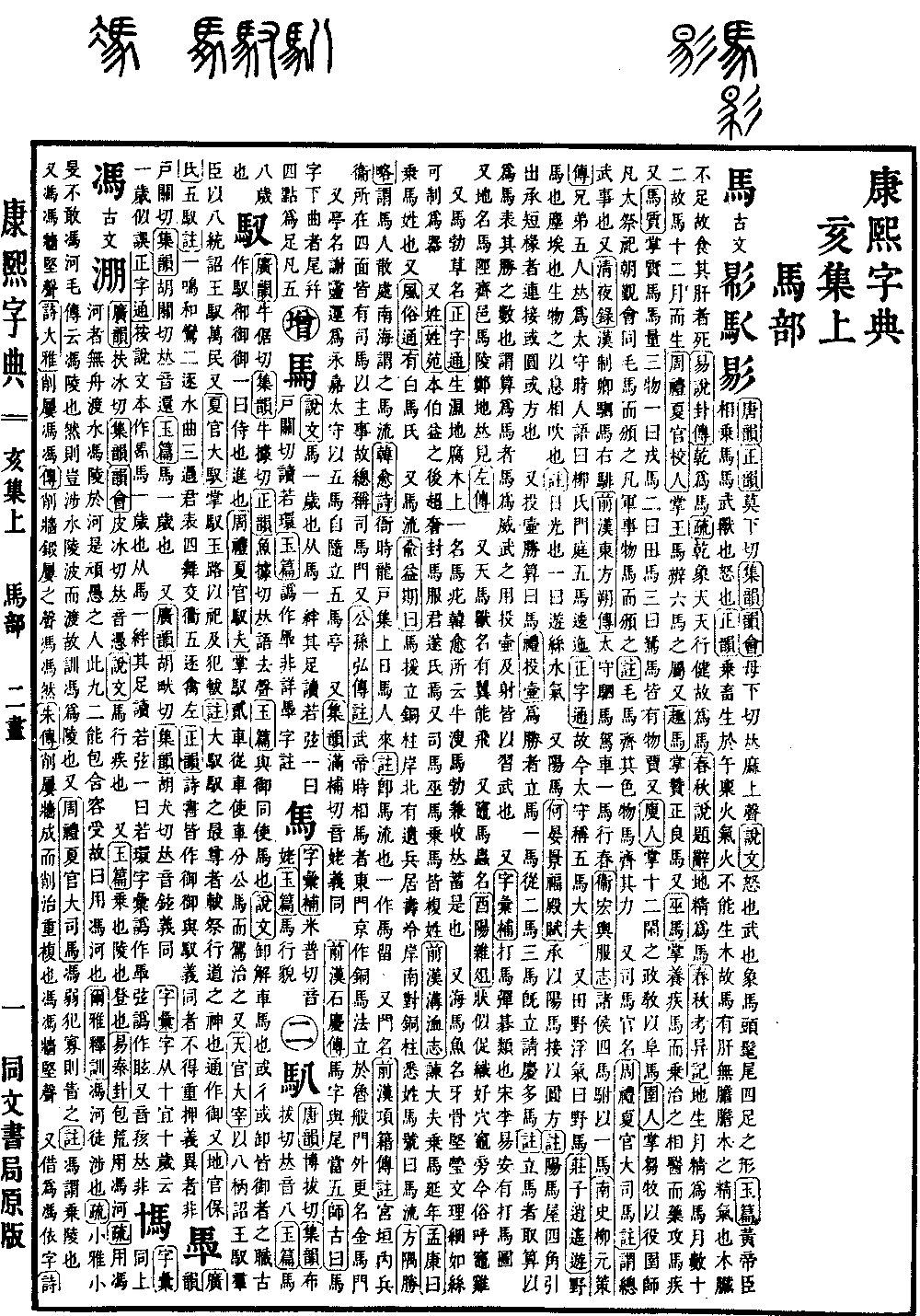
Xu Collection, Upper Volume
Radical: Horse (mǎ)
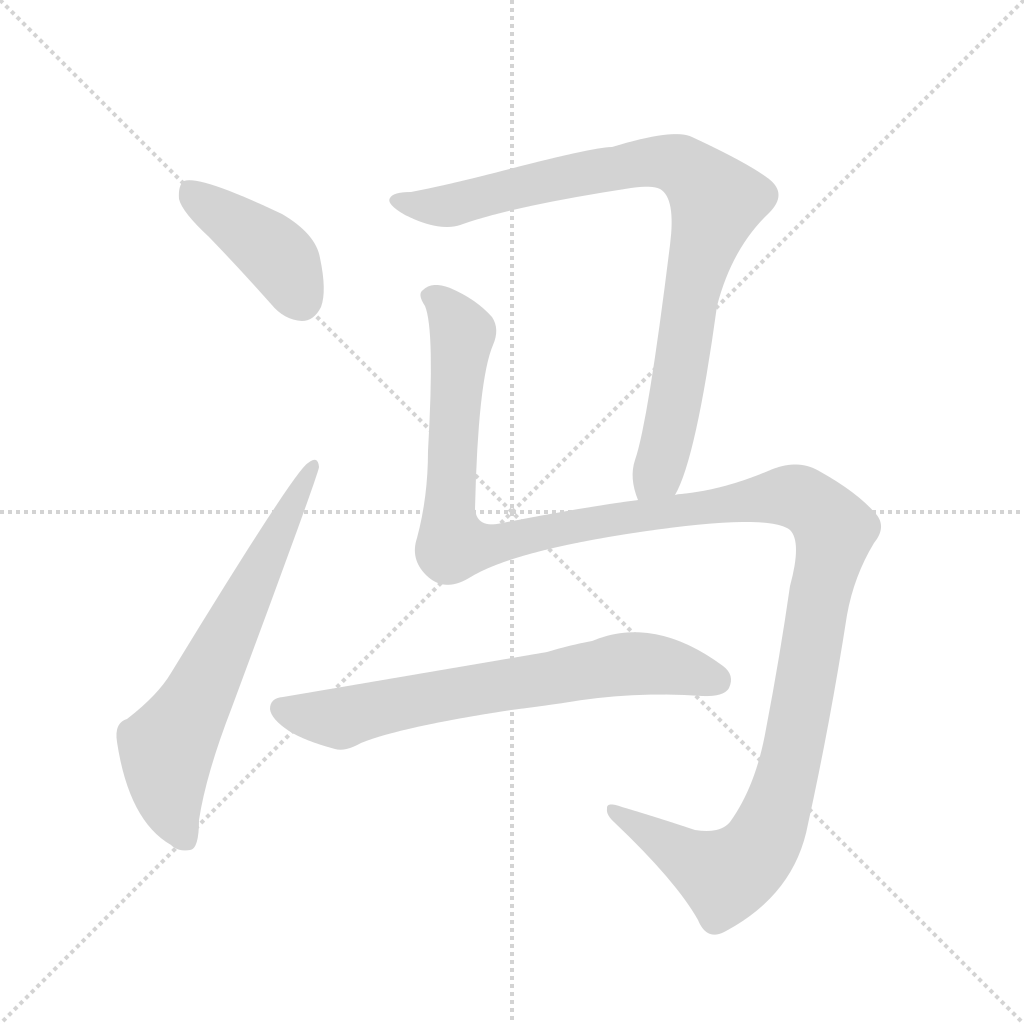
Character: 冯
Kangxi Stroke Count: 12
Page: 1433
In ancient writings, it was written as "淜".
According to "Guangyun" and "Jiyun", pronounced "píng" (rising tone), same pronunciation as "凭".
"Shuowen Jiezi" states it refers to a horse running fast.
Also, in "Yupian", it means to ride, to ascend, or to mount.
"Book of Changes (Yijing) - Tai Gua": "Using Feng to cross the river."
Commentary: "Using Feng to cross the river" means crossing the river without a boat, wading through on foot, which is foolish. The second line of this hexagram can encompass and accept, hence "using Feng to cross the river."
"Erya - Shixun": "Feng He" refers to wading across the river on foot.
Commentary: "Book of Odes (Shijing) - Xiaoya - Xiaomin" has the line "Dare not Feng He." Mao's commentary explains: Feng means to cross over. It means to cross the river empty-handed, stepping on the waves, hence "Feng" is explained as "ling" (to cross over).
Also, in "Zhou Rituals (Zhouli) - Xiaguan - Damashi": "Fenging the weak and offending the few will lead to mistakes."
Note: Feng refers to bullying.
Also, "Feng Feng" describes the sound of a sturdy wall.
"Book of Odes (Shijing) - Daya": "The walls are trimmed and Feng Feng."
Commentary: The sound of trimming and leveling the walls after construction is "Feng Feng."
Zhu's commentary: "Xue Lü" refers to repeatedly trimming and leveling the walls after they are built. "Feng Feng" is the sound of a sturdy wall.
It is also borrowed to write the character "píng" meaning to rely on.
"Book of Odes (Shijing) - Daya": "Having Feng, having Yi."
Commentary: Having people to rely on and to assist.
Also, in "Yangzi - Fangyan", Feng means anger. In the Chu region, it is called "Feng."
Note: Feng describes a state of great anger.
"Zuo Tradition (Zuozhuan) - Duke Zhao Year 5": "Now the lord is agitated, and Feng is enraged."
Also refers to relying on or being conceited.
"Records of the Grand Historian (Shiji) - Biography of Boyi": "The common people Feng Sheng."
Note: Feng means to rely on. It means the common sentiment of people is mostly to rely on and value their own lives.
Also, in "Zhuangzi - Daizhi Pian": "The rich are drowned in Feng Qi, like carrying a heavy load and walking uphill."
Note: Lü Jifu said: Feng refers to arrogance and haughtiness due to abundant wealth. The old commentary reads "Feng" as "fen" (resentment), which is incorrect.
Also means dissatisfaction.
"Zhang Heng - Xijing Fu": "Only the divine splendor of emperors, fearing that high and low are not distinguished. Although this dwelling is spacious and flat, the heart still Fengs and has not been expressed."
Note: The palace is divinely solemn and is used to distinguish between high and low status. Therefore, although this dwelling is spacious and flat, the heart is still Fengs and has not been expressed.
It is also an ancient commandery name.
"Former Han Dynasty (Qian Hanshu) - Treatise on Geography": Note under "Zuo Fengyi", originally the Neishi of the Qin Dynasty, renamed in the first year of Taichu.
There is also "Fengcheng County", belonging to Cangwu Commandery.
It is also an official title.
"Zhou Rituals (Zhouli) - Chunguan - Zongbo": "Feng Xiang Shi."
Note: Feng means to ride; Xiang means to observe.
Also, "Feng Yi", the name of a deity.
Also, according to "Jiyun", pronounced "pēng" (rising tone), same pronunciation as "怦". "Feng" refers to grandness. One interpretation is vast emptiness.
Also, according to "Tangyun", pronounced "fēng" (first tone), same pronunciation as "逢".
"Yupian" states it is a surname.
"Yunhui" gives an example: Feng Zi of the State of Zheng.
Also, according to "Jiyun", pronounced "pìng" (falling tone), same pronunciation as "病". Meaning to rely on.
Also pronounced "fù" (falling tone). Same as "fèn" (resentment). Meaning to be annoyed.
Verification: "Erya - Shixun": "Feng He, to wade across."
Commentary: "Book of Odes (Shijing) - Xiaoya - Xiaomin", "Dare not Feng He." Mao's commentary says: Feng, ling (to cross over). Thus, to wade across the water and cross over the waves, hence Feng is explained as ling. Note: Changed "to wade through water" to "to wade across the water."
"Zhang Heng - Xijing Fu": "The heart still Fengs and has not been considered." Note: Changed "not considered" to "not expressed."
Also a commandery name. "Former Han Dynasty (Qian Hanshu) - Treatise on Geography": "Zuo Fengyi." Note: Added the character "note" under "Zuo Fengyi."