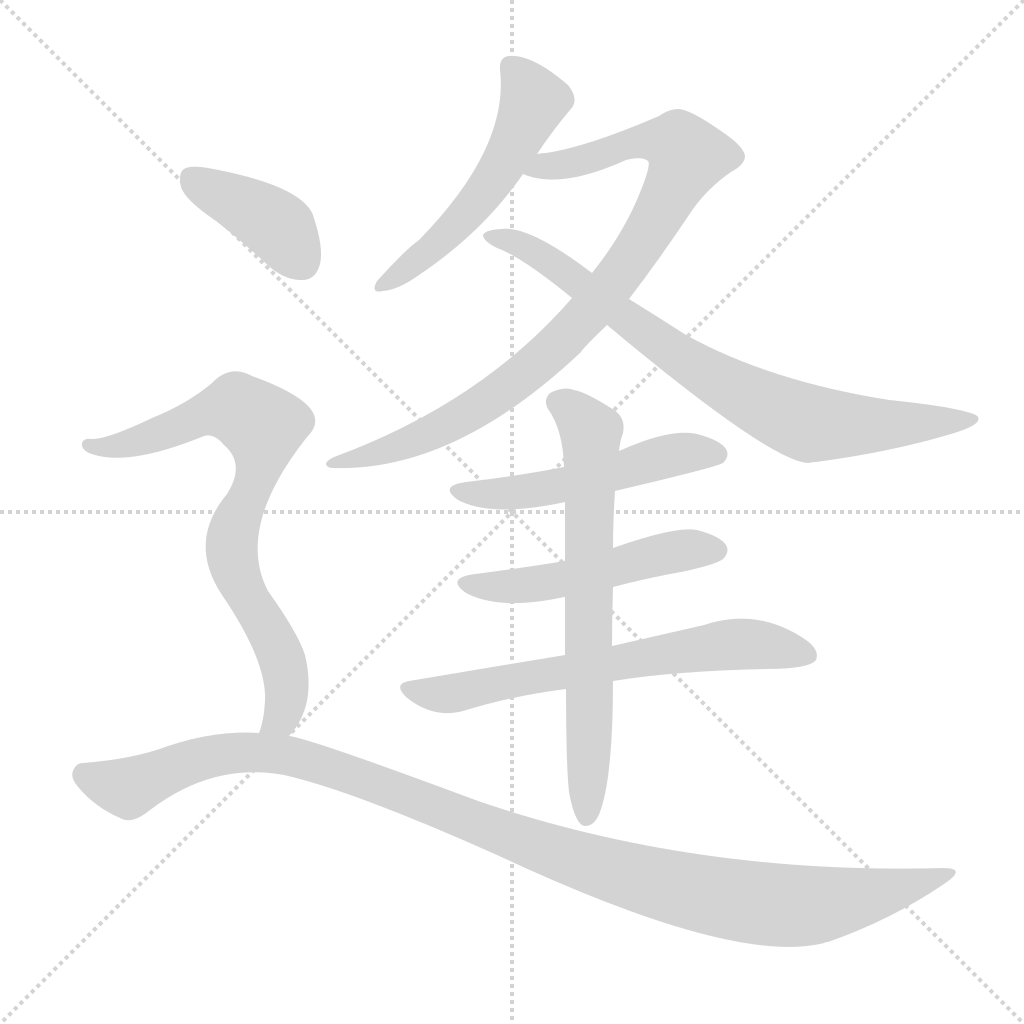
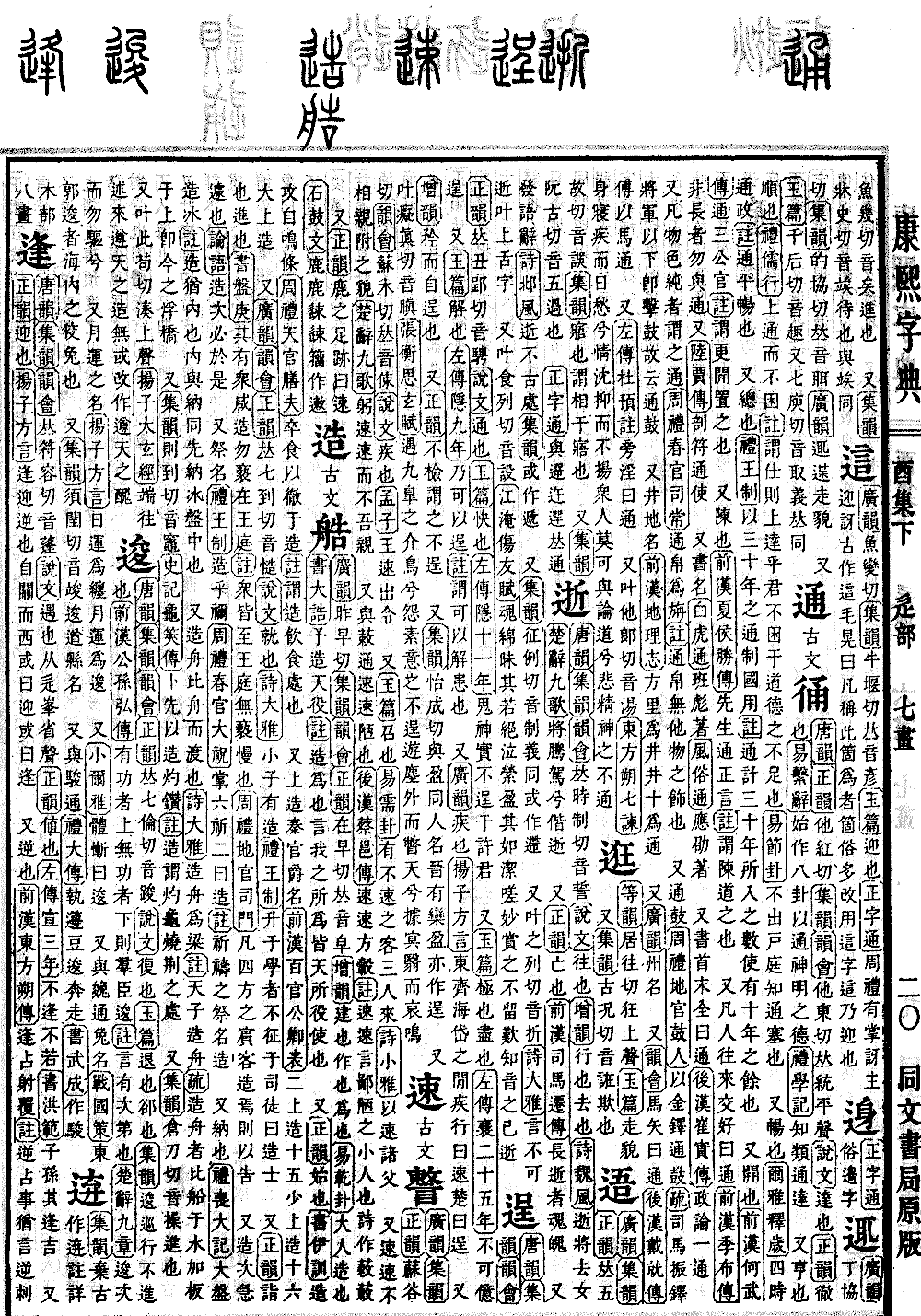
You Collection, Lower Volume
Radical: Walk (chuò)
Kangxi Strokes: 14
Page 1258, Entry 16
Pronounced féng.
In the Explanation of Characters (Shuowen Jiezi), it means to encounter. Formed from the radical for walk, with the phonetic element derived from the abbreviated form of peak.
In the Zheng Yun, it means to value or to meet.
In the Commentary on the Zuo Tradition (Zuozhuan), Year 3 of Duke Xuan: If one does not meet with the favorable.
In the Book of Documents (Shangshu), Great Plan: Your descendants will meet with good fortune.
Also, it means to welcome. In the Dialect (Fangyan) by Yang Xiong: Fengying means to go out to meet. From the pass to the west, some say ying and some say feng. It also means to go against or oppose.
In the History of the Former Han (Qian Hanshu), Biography of Dongfang Shuo: Fengzhan shefu. Commentary: To anticipate and divine matters, similar to saying to predict or guess.
Also, it means large or wide. In the Book of Rites (Liji), Confucian Conduct: Wearing garments with wide sleeves. Commentary: The part under the armpit of the garment is wide and large.
Also, E-Feng is a name of a year. In the Erya, Explaining Heaven: When the Grand Duke (Jupiter) is in the Jia year, it is called E-Feng. Commentary: It means that the sharp points of all things are ready to emerge, but are blocked and not yet through.
Also, used interchangeably with the character for seam. In the Book of Rites (Liji), Jade Pattern: The seams of the deep robe are twice the width of the waist. Commentary: Feng is sometimes written as feng.
Also, You-Feng is the name of a state. In the Commentary on the Zuo Tradition (Zuozhuan), Year 20 of Duke Zhao: You-Feng Bo Ling relied on it. Commentary: You-Feng Bo Ling was a feudal lord of the Yin dynasty.
Also, a surname. Qi Feng Choufu.
Also, pronounced péng. The sound of a drum. In the Book of Odes (Shijing), Great Odes: The crocodile-skin drums beat with a booming sound.
Also, in the History of the Former Han (Qian Hanshu), Biography of Sima Xiangru, Treatise on the Feng and Shan Sacrifices: The virtue of the Great Han, bubbling like a spring. Commentary: Feng is read like the smoke from a signal fire, signifying the rising of a beacon and the flowing of a spring.
Also, rhymes with fáng. In a poem by Han Yu: Desolate for ten thousand miles, how can we meet? (The rhyme follows jiāng and xiāng).
Note: Characters formed with the radical for descend are pronounced páng. Characters formed with the phonetic element fēng are pronounced féng or péng. In the Family Instructions of Mr. Yan (Yanshi Jiaxun), it notes that the distinction between the surnames Pang and Feng should not be ignored.
Textual Correction: The text previously indicated it was read as péng. However, since feng belongs to the dong rhyme category and peng belongs to the dong rhyme category, feng is not pronounced as peng. Following the Guang Yun, the pronunciation has been corrected to feng.
In the Erya, Explaining the Years: When the Grand Duke is in the Jia year, it is called E-Feng. Corrected to Explaining Heaven per the original text.