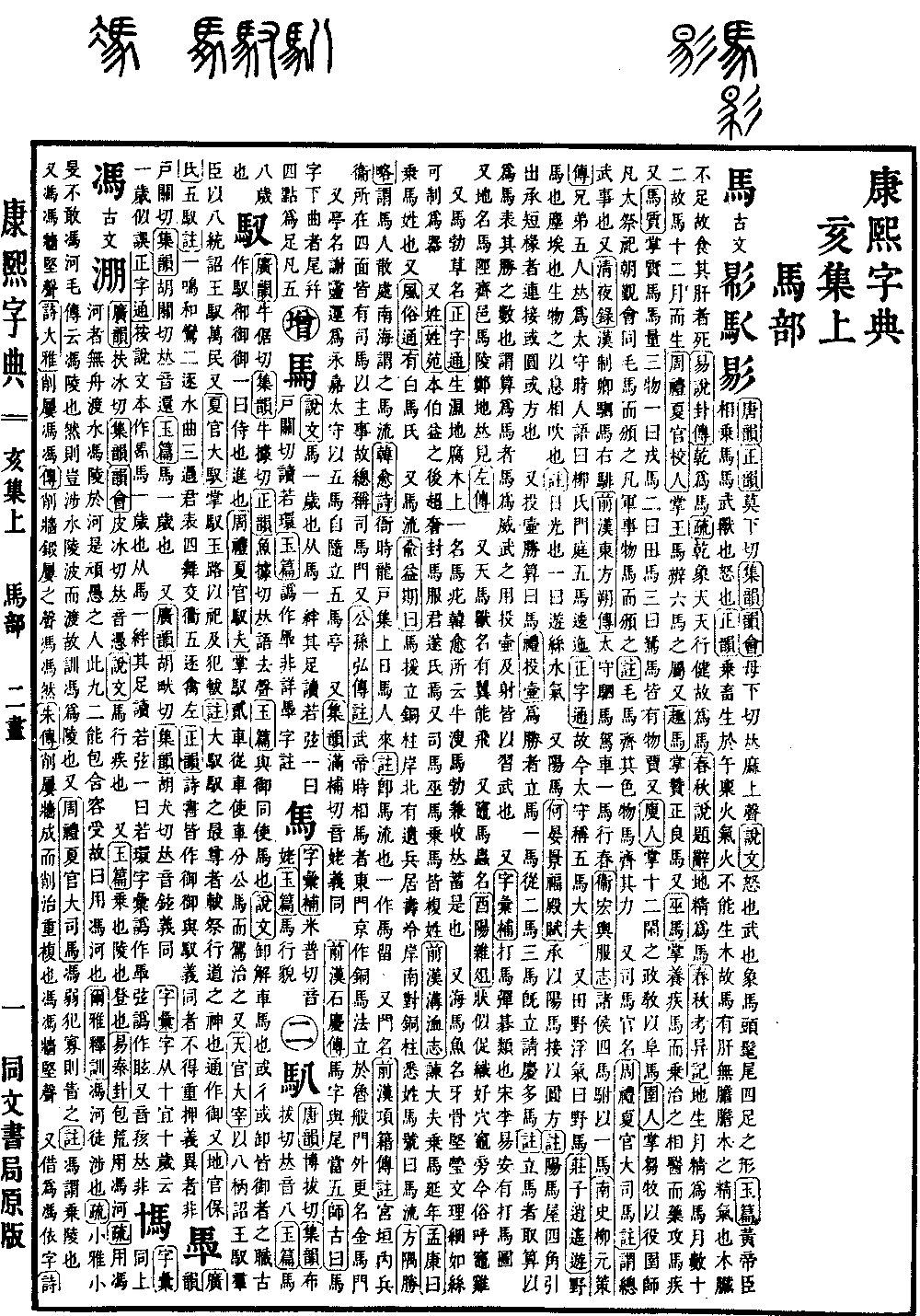
Hai Collection, Upper Volume
Radical: Horse (mǎ)
Kangxi Strokes: 12
Page 1433, Entry 11
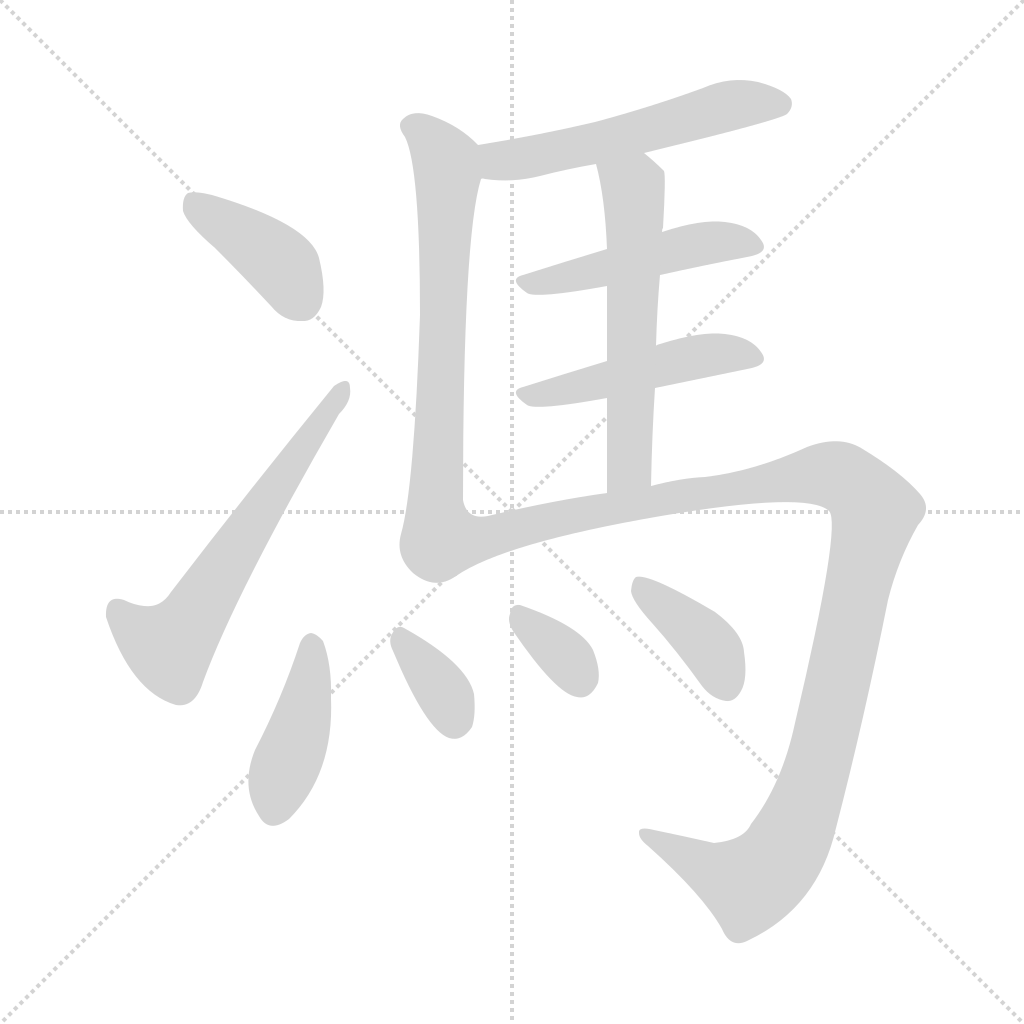
In ancient writing, it is written as a variant form (péng).
According to the Extensive Rhymes (Guangyun), it is pronounced ping; according to the Collected Rhymes (Jiyun) and the Rhyme Collection (Yunhui), it is also pronounced ping, with the same sound as ping.
According to the Explaining Graphs (Shuowen), it refers to a horse running swiftly.
Also, according to the Jade Chapters (Yupian), it carries the meanings of to ride, to transgress, and to ascend.
In the Book of Changes (Yijing), Hexagram Tai: "Wrapping the savage, one dares to ford the river (ping he)." The commentary explains: "Forcing the river" means to ford a river on foot without a boat, which is the act of a foolish person. In the second line of this hexagram, one is able to be inclusive and accepting, hence the phrase "forcing the river."
In the Erya (Erya), Explanation of Teachings: "Forcing the river" means to wade across on foot. The commentary notes: In the Book of Odes (Shijing), Lesser Odes of the Kingdom (Xiaoya), "Small Misfortunes (Xiaomin)" contains the line "Do not dare to ford the river." The Mao commentary explains: Ping means to traverse or overcome. Thus, it refers to wading across empty-handed, stepping upon the waves, and so ping is explained as lingering or traversing.
Also, in the Rites of Zhou (Zhouli), Summer Offices, Grand Minister of War: "If one bullies the weak and offends the few, then inflict punishment." The commentary notes: Ping refers to bullying or oppressing.
Also "ping ping," describes the sound of a sturdy wall. In the Book of Odes (Shijing), Greater Odes of the Kingdom (Daya): "Scraping repeatedly, ping ping." The commentary notes: The sound of ping ping occurs when scraping and smoothing a wall during construction. Zhu Xi's commentary notes: "Scraping repeatedly" refers to the process of scraping the wall after it is built to make it level. "Ping ping" is the sound of a firm, sturdy wall.
Also, it is used as a loan character for the ping in "pingyi" (to rely or depend on). In the Book of Odes (Shijing), Greater Odes of the Kingdom (Daya): "There are those to rely on, there are those to assist." The commentary notes: There is someone to depend upon, and someone to provide assistance.
Also, according to the Dialects of Yangzi (Fangyan), ping means anger. In the state of Chu, it is called ping. The commentary notes: Ping refers to the appearance of intense, surging anger. In the Zuo Tradition (Zuozhuan), Year 5 of Duke Zhao: "Now the ruler is aroused, shaking with surging anger (ping nu)."
Also, it refers to relying upon or being conceited. In the Records of the Grand Historian (Shiji), Biography of Bo Yi: "The masses rely upon (ping) life." The commentary notes: Ping means to rely upon. It refers to the common human tendency to rely upon and value one's own life.
Also, in the Zhuangzi, Chapter on Robber Zhi: "Wealthy people are drowned and sunken in surging pride (ping qi), as if carrying a heavy load while walking uphill." The commentary notes: Lu Jifu says: Ping is relying upon one's abundant wealth while one's arrogance overflows. The old commentary that reads ping as fen (anger) is incorrect.
Also refers to being unsatisfied or pent-up. In Zhang Heng's Western Capital Rhapsody (Xijing Fu): "Only the divine majesty of emperors, fearing that their status would not be distinct. Although this palace is already broad and level, the heart is still pent-up (ping) and has not yet been released." The commentary notes: Palaces are divine and solemn, used to distinguish between the honored and the humble; thus, although the halls are wide and flat, the heart remains heavy and unsatisfied.
Also, the name of an ancient commandery. In the History of the Former Han (Qianhan Shu), Treatise on Geography, the entry for "Zuo Pingyi" notes that it was originally the Interior Clerk (Neishi) of the Qin Dynasty, renamed in the first year of the Taichu era. There is also a Pingcheng County, belonging to Cangwu Commandery.
Also an official title. In the Rites of Zhou (Zhouli), Spring Offices, Minister of Rites: "Pingxiang Shi." The commentary notes: Ping means to ride or survey; Xiang means to look. An official position for observing celestial phenomena.
There is also Ping Yi, the name of a deity.
Also, according to the Collected Rhymes (Jiyun), it is pronounced peng; meaning vast or grand. One source says it refers to the void and the vastness.
Also, according to the Tang Rhymes (Tangyun), it is pronounced feng; according to the Collected Rhymes (Jiyun), the Rhyme Collection (Yunhui), and the Correct Rhymes (Zhengyun), it is also pronounced feng. It serves as a surname. According to the Rhyme Collection (Yunhui), an example is Feng Zi of the state of Zheng.
Also, according to the Collected Rhymes (Jiyun), it is pronounced bing; meaning to rely upon.
Also pronounced fen; same as fen. Meaning vexation or annoyance.