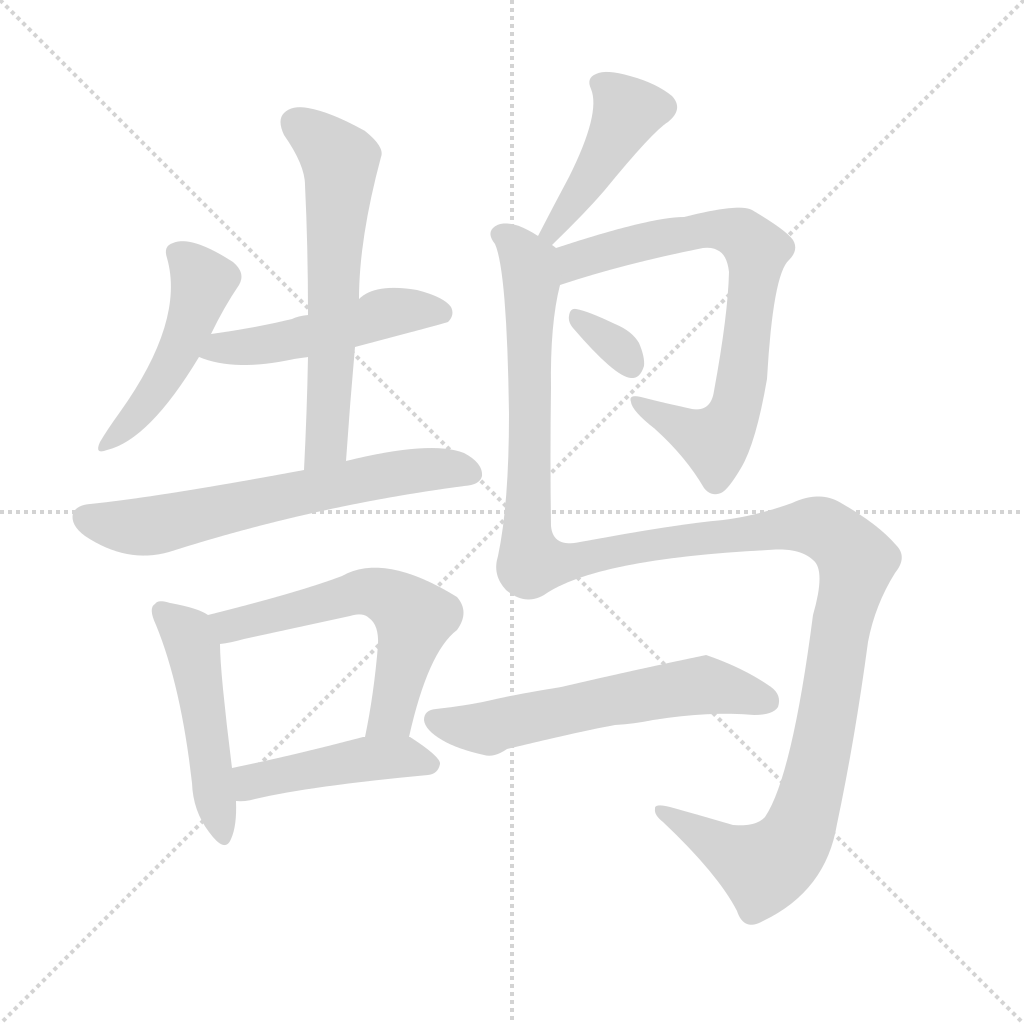
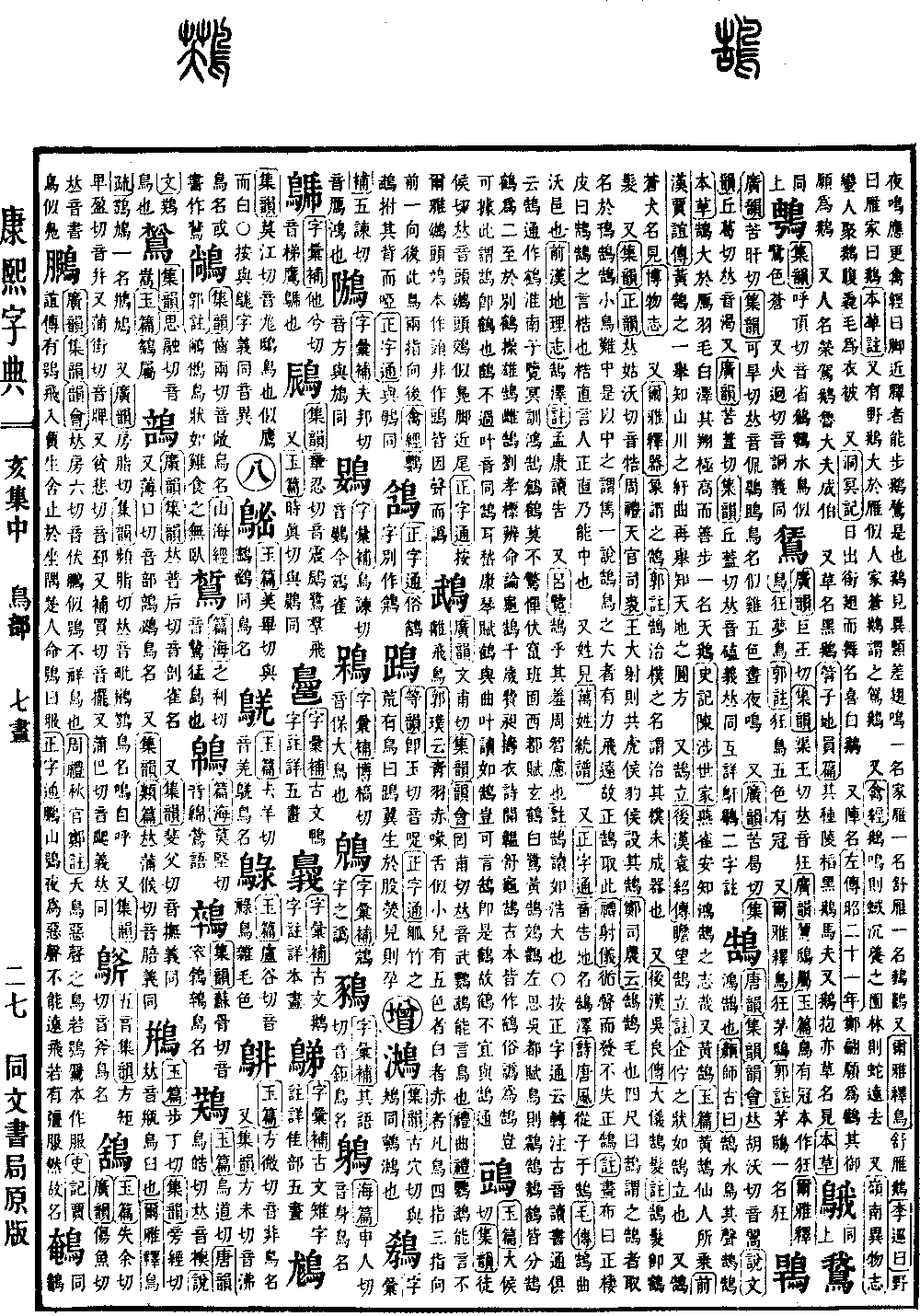
Hai Collection, Middle Volume
Radical: Bird (niǎo)
Kangxi Strokes: 18
Page 1491, Entry 01
Pronounced huo.
Shuowen Jiezi (Explanation of Simple and Compound Characters): The swan.
Yan Shigu says: The swan is a water bird; its call sounds like gu.
Bencao (Materia Medica): The swan is larger than a wild goose, its feathers are pure white and lustrous, it flies very high, and is adept at walking. It is also called the heavenly goose.
Records of the Grand Historian (Shiji), Biographies of Chen She: How can a sparrow know the aspirations of a swan.
Refers to the yellow swan.
Yupian (Jade Chapters): The yellow swan is what immortals ride.
Book of Han (Hanshu), Biography of Jia Yi: Once the yellow swan takes flight, it knows the twists and turns of mountains and rivers; when it flies again, it knows the shape of heaven and earth is round or square.
Refers to standing like a swan.
Book of the Later Han (Houhanshu), Biography of Yuan Shao: Stretching the neck and waiting in expectation, standing like a swan.
Commentary: Describes the appearance of standing on tiptoe in anticipation, like a swan stretching its neck to stand.
Refers to Hucang, the name of a dog. See Bowuzhi (Treatise on Miscellaneous Subjects).
Erya, Explanations of Tools: An ivory blank is called a gu.
Guo commentary: Gu is the name for a processed blank, meaning the raw material that has not yet been fashioned into an object.
Book of the Later Han (Houhanshu), Biography of Wu Liang: With a dignified demeanor and hair white as the feathers of a swan.
Commentary: White hair is called swan hair.
Pronounced gu.
Book of Rites (Zhouli), Offices of Heaven, Supervisor of Fur: When the king holds a grand archery ceremony, he provides targets of tiger and leopard hide.
Zheng Sinong says: Gu refers to a target decorated with the feathers of the ban-gu bird. A target four feet square is called a gu; it is named after the bird. Because this small bird is difficult to hit, hitting it is called jun (outstanding). Another theory is that the swan is a large bird with the strength to fly far, hence the target is named zheng-gu (central target) for this reason.
Book of Rites (Liji), Rites of Archery: Releasing arrows in accordance with the musical rhythm, without deviating from the center of the target.
Commentary: The target drawn on cloth is called zheng, and the target made of animal hide is called gu. The meaning of gu is gu (upright/straight). Straight means that only a person of upright character can hit the target.
A surname. See Wanxing Tongpu (Comprehensive Genealogy of Ten Thousand Surnames).
Pronounced gao. A place name. Guze.
Book of Odes (Shijing), Odes of Tang: Follow you to the city of Gu.
Mao Commentary: Gu is a city in Quwo.
Book of Han (Hanshu), Treatise on Geography: Guze.
Commentary: Meng Kang reads it as gao.
Pronounced hao.
Lüshi Chunqiu (Master Lü's Spring and Autumn Annals): How vast is the heart and mind, ashamed to use subtle stratagems.
Commentary: Gu is read as hao, meaning vast.
Note: The Zhengzitong (Correction of Character Meaning) states that the Zhuanzhu Guyin (Ancient Pronunciation by Radical Derivative) and the Dushutong (Comprehensive Study of Books) both suggest that gu can be interchangeable with he (crane). In the Huainanzi, it says: Swans and cranes all flee in terror. In Ban Gu's Rhapsody on the Western Capital: White cranes and egrets, yellow swans and cranes. In Zuo Si's Rhapsody on the Capital of Wu: As for birds, there are cranes and swans. These texts distinguish the swan and the crane as two different birds. As for the "Lament of the Separate Crane," the "thousand-year turtle-crane," and the poem "Beating Clothes" by Fei Chang, ancient editions all write them as crane, and later generations mistakenly wrote them as swan. How can one base the conclusion that the swan is a crane on these errors? The crane simply happens to rhyme with the swan in certain contexts. In Xi Kang's Rhapsody on the Zither, crane rhymes with qu and is read as gu; can one truly say the swan is the crane because of this? Therefore, the crane should not be interchangeable with the swan.